
Samsung Patents a Light-Absorbing Edge System for Cleaner LED Display Panels
When you tile multiple LED panels together to build a giant display wall, light bleeding out from the edges ruins the seamless look. Samsung's new patent takes direct aim at that problem.
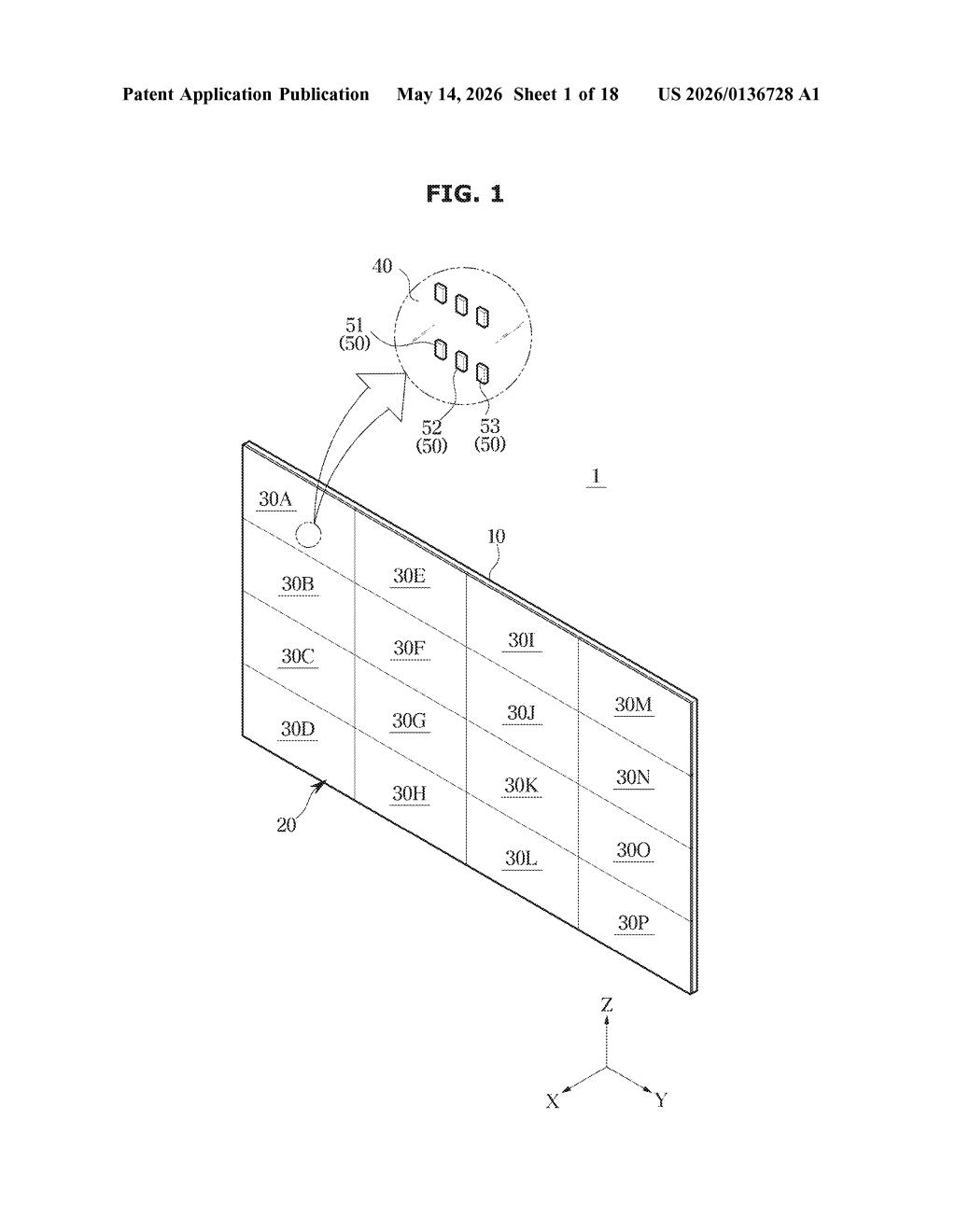
What Samsung's edge-sealing display module actually does
Imagine you're building a giant video wall by snapping together dozens of individual LED panels — like assembling puzzle pieces into one big screen. The tricky part is that light from the LEDs doesn't just shoot straight forward; some of it sneaks out through the edges of each panel, creating a faint glow along every seam and making the whole display look less like one cohesive picture.
Samsung's patent describes a display module with a special light-absorbing end member — essentially a dark border that wraps around the sides of the panel. It covers both the substrate's side surface and the edges of the protective front cover, physically blocking that wayward light from escaping.
The front cover itself is a two-layer sandwich: one layer bonds directly to the LEDs to protect them, and a second layer on top controls how the light looks — think anti-glare or color-tuning. The edge member ties the whole package together, keeping light where it belongs: pointing at you, not bleeding sideways.
How the front cover layers and absorbing end member work together
The patent describes a display module built around three main components working in concert.
First, there's the substrate — the base board on which an array of light emitting devices (LEDs or micro-LEDs) is mounted. The substrate has a flat mounting surface facing the viewer and side surfaces around its perimeter.
Second, a front cover sits on top of the mounting surface. It's a two-layer structure:
- First layer: bonded directly to the mounting surface, acting as a protective encapsulant for the LEDs — shielding them from physical damage and environmental exposure.
- Second layer: placed on top of the first, responsible for controlling optical characteristics — this could mean diffusion, color filtering, anti-reflection, or contrast enhancement.
Third — and most novel — is the light absorbing end member. This component wraps around the side surface of the substrate and over at least part of the side edge of the front cover. Because the front cover layers can be slightly translucent, light from the LEDs can travel laterally through them and exit at the sides. The end member intercepts that light, absorbing it rather than letting it escape. This is particularly valuable in tiled multi-panel display walls, where side-emitted light would illuminate the bezels and seams between modules.
What this means for Samsung's modular LED display lineup
Samsung is one of the largest manufacturers of large-format direct-view LED displays — the kind you see in arenas, corporate lobbies, and broadcast studios. These displays are built by tiling together many individual modules, and light leakage at the seams is a known quality issue that affects perceived contrast and visual uniformity.
A structural fix baked into the module itself — rather than relying on post-assembly calibration or software correction — is a cleaner, more scalable solution. If Samsung integrates this into its The Wall or similar professional display product lines, installers and display integrators could get better out-of-box visual performance without additional tuning work.
This is solid, unglamorous display engineering — the kind of incremental improvement that separates good professional displays from great ones. It won't generate headlines at CES, but for anyone specifying large-format LED walls, edge light control is a real pain point and a structural solution is genuinely preferable to software workarounds.
There are more where this came from
We read every patent application Big Tech publishes and send you the ones worth knowing. Plain English, free, every week.
Want this weekly breakdown for a company we don't cover? Patentlyze Pro →