
Sony Patent Reveals Earbuds That Automatically Track and Follow Moving Speakers
Your earbuds already filter out background noise, but what if they could also swivel their attention to follow a speaker who keeps walking around the room? That's the core idea in this Sony patent.
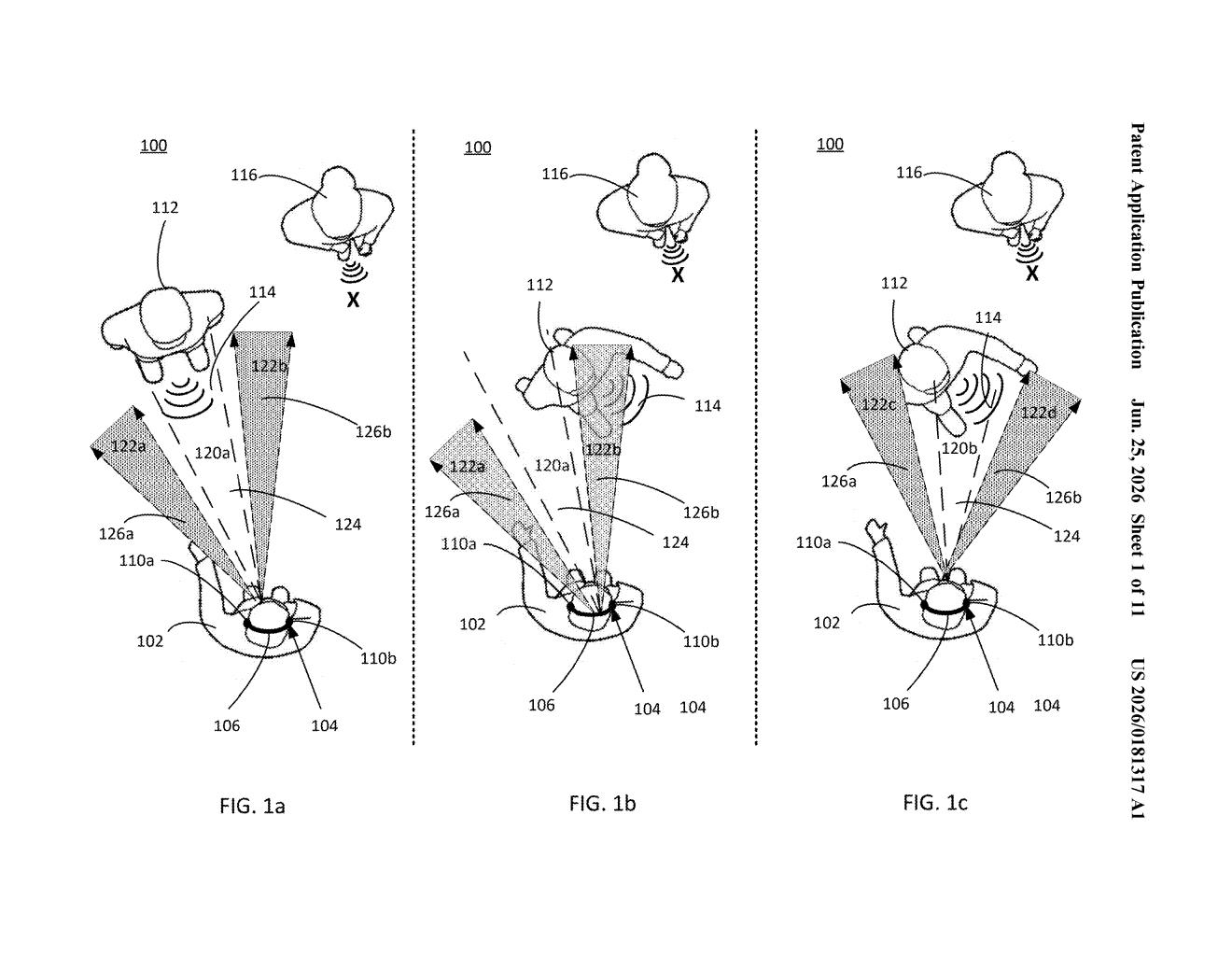
What Sony's moving-speaker tracking earbuds actually do
Imagine you're wearing wireless earbuds at a dinner party, trying to focus on one person talking to you. They stand up, walk to the kitchen, keep talking. Right now, your earbuds don't know they've moved, and the audio focus stays pointed at where they were.
Sony's patent describes a system that fixes that. Your earbuds would use two sets of microphones doing two different jobs at once: one set keeps listening in the direction you're already focused on, while a second set scans the room for any sign that the speaker has moved. When the scanning microphones detect a shift, the earbuds automatically re-aim their audio focus toward the new location.
The whole process is automatic, no head-turning or button-pressing required. The system can even predict where a moving person is headed and adjust before they fully arrive there.
How Sony splits microphone duties to track and listen at once
The patent describes what Sony calls an auditory scanning system, built around a technique called beamforming (the ability to electronically aim a microphone array at a specific direction, boosting sounds from that angle and suppressing others).
The system divides the earbuds' microphones into two functional groups:
- Primary microphones lock onto the current speaker location and maintain a tight audio beam in that direction.
- Scanning microphones simultaneously sweep other directions, looking for evidence that the sound source has moved or is about to move.
When the scanning beam picks up a signal suggesting the speaker has shifted position, the system calculates the new direction relative to the user and redirects the primary beam to follow. The patent also mentions predictive adjustment, meaning the system can anticipate a trajectory and pre-aim the audio focus before the speaker fully settles in a new spot.
Listening parameters, including the specific angles and sensitivity profiles used in beamforming, are updated automatically throughout this process. No manual input from the wearer is needed.
What this means for hearing aids and next-gen earbuds
For everyday wireless earbuds, this kind of dynamic tracking would make conversations feel more natural in noisy environments like open offices, restaurants, or crowded homes. Right now, most beamforming in consumer earbuds locks onto a fixed direction; you have to physically turn your head to keep someone in focus as they move.
The bigger opportunity may be in hearing aids and assistive devices, where automatically following a moving talker is a long-standing challenge. Sony already sells both consumer earbuds (WF and WH series) and has commercial interests in medical-grade hearing technology. A system that handles speaker tracking without requiring the wearer to constantly reorient themselves would be a meaningful improvement for anyone with hearing difficulty.
This is a genuinely useful idea, not just a paper patent. The split-microphone architecture (one set holds, one set hunts) is a clever solution to a real limitation in modern beamforming earbuds, and the predictive positioning angle pushes it beyond simple reactive tracking. Whether Sony ships this into consumer earbuds or hearing health devices first will tell you a lot about which market they're betting on.
There are more where this came from
We read every patent application Big Tech publishes and send you the ones worth knowing. Plain English, free, every week.
Want this weekly breakdown for a company we don't cover? Patentlyze Pro →