
Sony
Figure AI · Robotics · Filed Jun 26, 2026 · USPTO published Nov 19, 2026 · This week's release
Figure AI Patents a Backpack Rig That Lets Workers Teach Humanoid Robots
Figure AI's patent application describes a backpack-style frame with two sensor-filled robot arms that a worker wears, so a humanoid robot can learn by copying a real job. The glove is the only place the rig touches the wearer's arms.
- Publication number
- US 2026/0364774 A1(US20260364774A1)
- Applicant
- Figure AI Inc.
- Filed · Published
- Jun 26, 2026 · Nov 19, 2026
- Inventors
- Victor Ragusila, Nathan Jenest, Corey Lynch, Michael Rose, Lee Magnusson
- Status when we published
- Waiting for an examiner
- Document
- 24 claims
- US classification
- 700/264
- Parent application
- Continuation of PCT/US2026/013952 (filed Feb 4, 2026)(PCTUS2026013952)
What Figure's wearable robot-teaching rig does
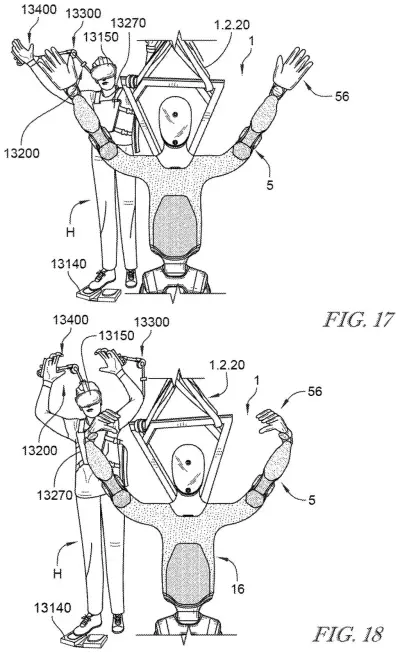
Imagine you work on a factory line moving sheet metal from one stack to another, and your boss straps a metal frame to your back. Two jointed arms reach over your shoulders and follow your own arms down to your hands. As you do your normal job, every bend of your shoulder, elbow and wrist gets recorded.
That is the idea behind this Figure AI patent application. Humanoid robots learn from huge amounts of human motion, and collecting it usually takes a dedicated motion capture studio or a heavy rig. Figure's version goes where you go, so the person training the robot can walk around a real workplace.
The same gear can also steer a robot live. Your movements travel to a humanoid robot, which copies them, and the filing aims for a delay of under 20 milliseconds so the robot follows almost as you move.
a wearable base mount configured to be worn on a torso of a human operator such that the mobile data collection apparatus is carryable by the human operator during operation …
Translation: A harness worn on the upper body lets a human carry the entire tracking rig.
How the arm rig tracks every joint you move
The apparatus has a wearable base mount that runs along the operator's back and is held on by an adjustable harness. Left and right articulated arms (jointed metal arms) extend from it. Each arm has three rigid links joined by a shoulder with two perpendicular pivots, an elbow, and a two-axis wrist assembly. The filing describes up to seven axes of rotation per arm, and some links can change length to fit different wearers.
Sensors sit throughout the rig:
- Joint encoders, devices that measure how far a joint has turned. One example is a 14-bit absolute encoder that talks over a CAN bus (a wiring standard common in vehicles and machines).
- Inertial measurement units (IMUs), small motion sensors that report tilt and orientation, placed at the wrist and on the torso.
- A glove-style distal manipulator at the end of each arm, with haptic (touch-feedback) buttons that need 2 to 5 newtons of force to press.
A piloting control system, which the filing says can sit on the base with a battery, turns the sensor readings into control information and sends it to the humanoid robot over a network. One independent claim sets the end-to-end delay below 20 ms. A clutch can pause that stream, and one version uses machine learning to predict pauses in the wearer's workflow and engage itself. The rig can also store its sensor data for training a machine learning model, and a headset can show video from the robot's cameras.
… a pair of articulated arms extending from opposite sides of the base mount. Each articulated arm comprises a first rigid frame link coupled to the base mount, a shoulder joint with first and second couplers defining orthogonal rotational axes with corresponding sensors …
Translation: Two mechanical arms mirror the human's shoulders using sensors to track upper body movement.
Why portable training gear matters to Figure
You are unlikely to ever wear this, but it targets the thing that holds humanoid robots back: training data. The filing says robots need large amounts of high-quality motion data, and gathering it usually means camera studios or heavy rigs. A rig that moves with a worker could capture that motion during real tasks, such as moving sheet metal on a factory line, with no camera lighting setup to manage and no spots hidden from view.
The design choices point at a tight loop between person and robot. The rig's sensors match the ones in the robot's own joints, and the filing says that reduces the work of converting human motion into robot commands. It can also record without a robot at all and hand the data over for training later. It is a patent application, so nothing here says a product is coming.
Source: US 2026/0364774 A1 at the USPTO (PDF). Full patent text and figures are in the official publication.
Get our take in your Top Stories
Liked this breakdown? Add Patentlyze as a preferred source on Google, and our plain-English take shows up more often in your Top Stories the next time Figure AI patent news breaks.
Add Patentlyze on Google
One click.
There are more where this came from
We read the new patents from Big Tech, carmakers and more and send you the ones worth knowing. Plain English, free, every week.
The drawings · 26 sheets
26 drawing sheets from US 2026/0364774 A1 · click any drawing to enlarge


Show the other 18 sheets


No comments yet