
Unitree
Unitree · Robotics · Filed Mar 2, 2026 · USPTO published Nov 19, 2026 · This week's release
Unitree Patents a Compact Robot Joint Built to Survive Hard Knocks
Robot joints are where falls do their damage, and Unitree's patent describes a gearbox that spreads a hit across many teeth at once. It aims to be small, simple, and hard to break.
- Publication number
- US 2026/0366599 A1(US20260366599A1)
- Applicant
- HANGZHOU YUSHU TECHNOLOGY CO., LTD.
- Filed · Published
- Mar 2, 2026 · Nov 19, 2026
- Inventors
- Xingxing WANG
- Status when we published
- Waiting for an examiner
- Document
- 15 claims
- US classification
- 475/162
- Parent application
- National Stage Entry of PCT/CN2023/127255 (filed Oct 27, 2023)(PCTCN2023127255)
What Unitree's tough robot joint actually is
Imagine a humanoid robot that trips and lands hard on one knee. Inside that knee is a small motor, and between the motor and the leg sits a set of gears whose job is to trade speed for strength. If those gears are fragile, one bad fall can strip a tooth and leave the leg dead.
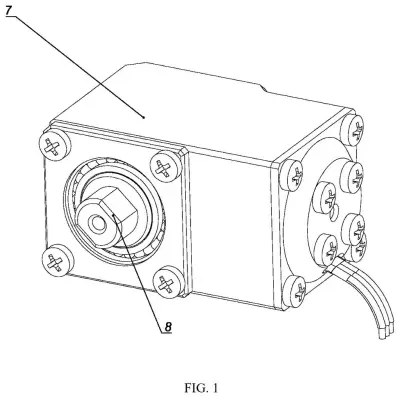
Unitree's patent describes a gear package built to take that kind of punishment while staying small. The motor spins a first set of gears, which turn a shaft with an off-center wheel on it. That wheel makes a gear ring wobble around between two other rings, shifting one tooth at a time, so the output moves in tiny steps. Tiny steps mean lots of leverage.
The selling point is that many teeth share the load at once, so a sudden shock gets spread out instead of landing on one or two teeth. The filing also says it needs fewer parts than a common planetary gearbox to get the same amount of gear-down.
… the number of teeth on the external side of the double-sided ring gear differs by one tooth from the number of teeth on an internal side of the internal ring gear, and the number of teeth on the internal side of the double-sided ring gear differs by one tooth from the number of teeth on an external side of the external ring gear …
Translation: The gears have a tiny one-tooth difference to handle the reduction process.
How the wobbling gear ring cuts speed
The mechanism is a motor plus two stages of gear reduction (gears that slow rotation down and multiply turning force). The first stage is conventional: cylindrical gears (flat gears on parallel shafts) and/or bevel gears (angled gears that turn power 90 degrees). The filing gives two layouts, one with a bevel pair for a right-angle bend and one using only cylindrical gears so input and output stay parallel.
The second stage is the new part. The first stage turns a transmission shaft carrying an eccentric wheel (a wheel whose center sits off the axis it spins around). That wheel pushes a double-sided ring gear, a ring with teeth on both its inside and outside, into a wobbling motion. The outer teeth mesh with an internal ring gear, the inner teeth mesh with an external ring gear, and each pair differs by exactly one tooth. That one-tooth gap means every wobble nudges the output forward by a single tooth.
One of the two outer rings is fixed to the housing, and the other becomes the output. The filing also describes:
- A base housing that holds the motor and both gear stages, with bearings supporting the rings and shaft
- A coreless or brushless motor with a rotary encoder (a sensor that reports shaft position) and a drive circuit board
- Folded layouts, shaped like an n or a U, that shrink the space the joint needs
One claim covers a general-purpose humanoid or four-legged robot built with this joint.
… the reduction structure exhibits strong overload resistance and is less prone to damage or failure under impact loads …
Translation: This design handles heavy sudden impacts without breaking.
Why a tougher joint matters for Unitree's robots
For a walking robot, the joints take the abuse. Every step, stumble, and landing sends a jolt back through the gears. A joint that stays small and also shrugs off impacts is useful for a humanoid or four-legged robot that has to move around in the real world instead of a lab.
The filing points to two known pain points, bulky gearboxes and weak impact resistance, as what it is trying to fix. It gives no test data, so the toughness is a design claim, not a measured result. If it holds up, the payoff could be fewer broken joints and slimmer limbs, which is what you would want from any robot that falls over now and then.
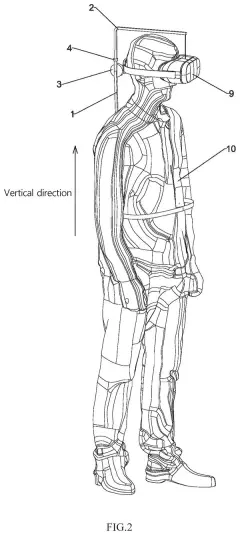
Unitree's second filing in our Unitree coverage since November follows a VR headset weight frame, the two patents we have tracked for the company so far.
Source: US 2026/0366599 A1 at the USPTO (PDF). Full patent text and figures are in the official publication.
Get our take in your Top Stories
Liked this breakdown? Add Patentlyze as a preferred source on Google, and our plain-English take shows up more often in your Top Stories the next time Unitree patent news breaks.
Add Patentlyze on Google
One click.
There are more where this came from
We read the new patents from Big Tech, carmakers and more and send you the ones worth knowing. Plain English, free, every week.
The drawings · 6 sheets
6 drawing sheets from US 2026/0366599 A1 · click any drawing to enlarge


More from Unitree
All 2 Unitree patents →More in Hardware
All 2,375 Hardware patents →
Samsung
Samsung Patents a Robot That Figures Out Whose Turn It Is to Be Looked At
Sony
Sony Files Patent for Robot Arms That Dodge Obstacles Before They Get Close
Samsung
Samsung Files Patent to Turn Messy Robot Vacuum Maps Into Tidy 3D Floor Plans
Tesla
No comments yet