
Sony
Sony · Robotics · Filed Jun 6, 2025 · USPTO published Nov 19, 2026 · This week's release
Sony Files Patent for Robot Arms That Dodge Obstacles Before They Get Close
Most robots react to a nearby object only when it's already close. Sony's new patent describes a way for a robot arm to guess where a collision would happen a moment from now and bend away early.
- Publication number
- US 2026/0364796 A1(US20260364796A1)
- Applicant
- Sony Group Corporation
- Filed · Published
- Jun 6, 2025 · Nov 19, 2026
- Inventors
- Yannik NAGEL, Sina MIRRAZAVI
- Status when we published
- Examiner raised objections; the company can respond
- Document
- 20 claims
- US classification
- 700/255
- Examiner
- TANG, BRYANT (Art Unit 3658)
- Parent application
- National Stage Entry of PCT/EP2023/086173 (filed Dec 15, 2023)(PCTEP2023086173)
What Sony's early-dodge robot arm patent does
Ever watched someone steer around a stranger on a crowded sidewalk? They don't wait until they're nose to nose. They shift a few steps early, and it looks effortless.
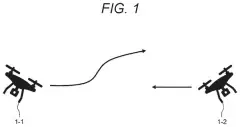
Many robot arms work the other way around. They tend to react only once something is already close, which can mean a jerky last-second swerve. Sony's patent describes a method that guesses where the robot and a nearby object will be a moment from now, based on how fast they're closing in on each other.
If the two would overlap in that near-future snapshot, the software adjusts the robot's pose now so the overlap never happens. The same idea also covers a robot arm bumping into itself, and animated game characters whose limbs shouldn't pass through things.
… determining a target pose for a collision-free target state of the kinematic structure with respect to the at least one obstacle based on their current states …
Translation: The system figures out a safe position for the robotic arm to move into without hitting anything.
How Sony's system projects and sidesteps a crash
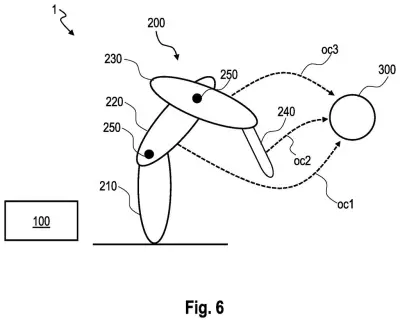
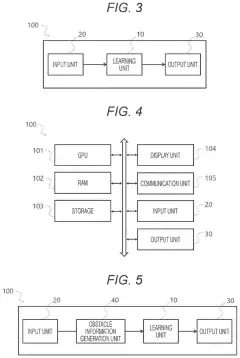
Sony's filing covers a way to decide where a robot arm (or any jointed structure, including an animated game character's skeleton) should position itself to stay clear of obstacles. The software takes in the current state of the arm and the obstacle: shape, size, position and speed.
From the relative speed between the two, it estimates a region of interest, a stand-in for where a collision could happen a moment from now. Think of it as a flat snapshot of the near future with both objects projected into it. Any overlap in that snapshot is a collision waiting to happen.
To fix the overlaps, the software first imagines the obstacle removed, which leaves the arm in a collision-free starting pose. It then slides the obstacle back in step by step, bending the arm's joints out of the way each time. The filing also describes trying several directions and combining the results.
The resulting target pose goes through inverse kinematics (the math that works out what each joint must do to reach a pose), solved as a fast optimization on every control update. It penalizes getting too close to obstacles and breaking the robot's hardware limits. Sony also describes training a machine-learning model on many such runs so it can produce poses on the fly.
… resolving, in a region of interest estimated based on a relative velocity between the kinematic structure and the at least one obstacle in accordance with their current states as a potential region of collision, any overlap or intersection between the kinematic structure and the at least one obstacle by adapting the state of the kinematic structure …
Translation: It calculates where potential impacts might happen based on speed and adjusts the arm's position ahead of time.
Why Sony's approach could mean smoother robots
If this idea ends up in real machines, the benefit would be robot arms that move out of the way early and smoothly instead of jerking aside when something gets close. That matters wherever things move unpredictably, like factories and warehouses, or in a game where a character's arm shouldn't pass through a wall. The filing says the method needs little computing power, which is what would let it run in real time.
Sony's filing doesn't name a product, and the examiner's first review rejected the claims as filed, which is routine at this stage and usually followed by amendments. Treat it as a look at an engineering problem Sony is working on, with no launch plan attached.
That makes this Sony's ninth filing we've tracked since July on teaching robots to grasp and move, after earlier applications covering a force-sensing robot arm and light-based finger touch sensors.
Source: US 2026/0364796 A1 at the USPTO (PDF). Full patent text and figures are in the official publication.
Get our take in your Top Stories
Liked this breakdown? Add Patentlyze as a preferred source on Google, and our plain-English take shows up more often in your Top Stories the next time Sony patent news breaks.
Add Patentlyze on Google
One click.
There are more where this came from
We read every patent application Big Tech publishes and send you the ones worth knowing. Plain English, free, every week.
The drawings · 8 sheets
8 drawing sheets from US 2026/0364796 A1 · click any drawing to enlarge


More from Sony
All 722 Sony patents →
More in Hardware
All 2,355 Hardware patents →
Tesla
Tesla Patents a Touch-Sensitive Skin Molded to Fit Robot Hands
Samsung
Samsung Patents a Robot That Figures Out Whose Turn It Is to Be Looked At
Samsung
Samsung Files Patent to Turn Messy Robot Vacuum Maps Into Tidy 3D Floor Plans
Samsung
No comments yet