
AI Assistant Gains Long-Term Memory Organized by Topic
What if your AI assistant actually remembered that you've been planning a kitchen renovation for three months — and didn't make you explain it all over again every time you asked a new question? That's the core idea behind this Google patent.
What Google's topic-based AI memory actually does
Imagine calling your bank's support line, and instead of starting from scratch every time, the agent already has a running summary of every issue you've ever called about, organized neatly by topic. Google's patent describes building that exact kind of memory into an AI assistant.
Right now, most AI chat tools — including Google's own Gemini — have a short memory. They can recall what you said earlier in the same conversation, but start a new chat and they're back to square one. This patent describes a system that keeps topic-based summaries of everything you've ever asked about, so when you bring up a subject again, the AI already has context.
So if you've spent weeks asking your AI assistant about buying a used car — different questions on different days — it wouldn't just remember the last chat. It would pull a tidy summary of all those conversations and use that to inform its next answer. You stop repeating yourself. The AI stops feeling forgetful.
How the system stores, classifies, and retrieves past chats
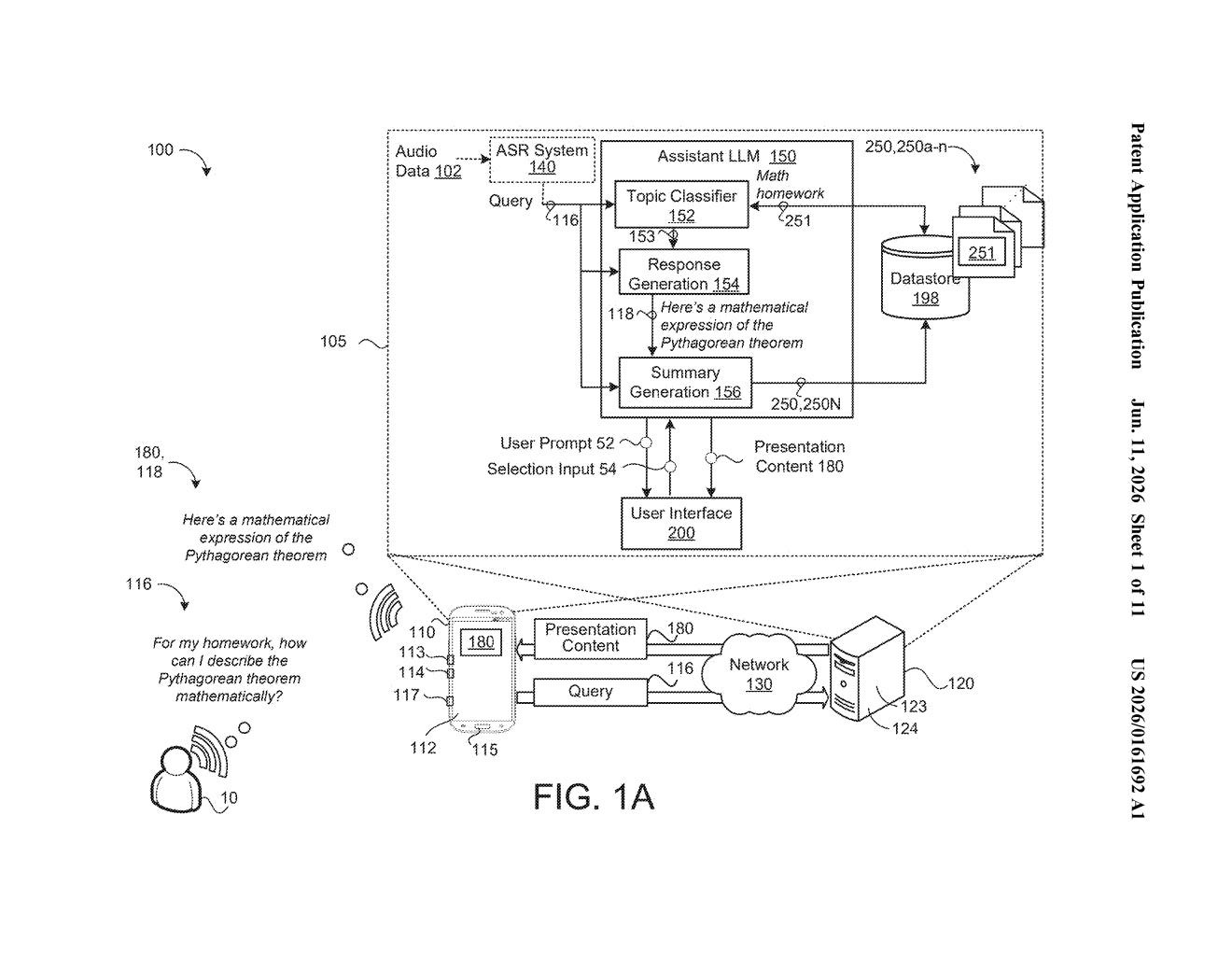
The system works in three main stages. First, it continuously logs your past question-and-answer exchanges with the AI assistant into a datastore — basically a searchable memory bank.
When you send a new question, the system classifies it (figures out which topic it belongs to — think "car shopping" or "meal planning" or "tax questions"). It then looks up a pre-built topic summary for that subject — a condensed version of everything you've previously discussed under that label.
The AI then generates its response conditioned on (meaning, informed by) that topic summary rather than starting cold. The patent describes these topic summaries as artifacts — persistent, retrievable objects that exist across sessions, not just within a single conversation window.
Key components include:
- A topic summary datastore — a structured store of per-topic memory objects
- A classification step — matching each new query to an existing topic
- A conditioning step — feeding the matched summary into the model before it answers
Notably, the patent focuses on the retrieval and classification architecture, not on how the summaries are originally generated — though the implication is that the AI builds and updates them automatically over time.
What this means for Google's Gemini and AI assistant ambitions
For everyday users, persistent topic memory would make AI assistants genuinely more useful for anything that unfolds over days or weeks — job searching, home improvement projects, medical questions, ongoing research. You wouldn't have to paste in background context every time you started a new chat. The AI would just know.
For Google, this is a meaningful move in the race to make Gemini feel less like a search box and more like a personal assistant with genuine continuity. OpenAI has already shipped memory features in ChatGPT, so Google is clearly working to close that gap. The architecture described here — topic-indexed summaries rather than raw conversation logs — suggests Google is thinking about this at scale, where dumping entire chat histories into every prompt would be too slow and expensive.
This is a genuinely useful idea, and the specific design choice — organizing memory by topic rather than just keeping a raw log — is the interesting part. It's a more elegant solution than what's currently live in most AI assistants, and it scales better. Whether it ships as described is another question, but the underlying problem it's solving is real and irritating.
There are more where this came from
We read every patent application Big Tech publishes and send you the ones worth knowing. Plain English, free, every week.
Want this weekly breakdown for a company we don't cover? Patentlyze Pro →