
Google Patents an AI That Turns a Vague Request Into a Full Social Media Campaign
Google's patent application describes an AI that rewrites your one-line request into a long, detailed brief before it writes anything, then checks your own documents for facts and style.
What Google's campaign-from-one-line AI does
You're the whole marketing team for a small coffee company, and you type one line into an AI tool: make a campaign for our new decaf. What comes back is generic, so you spend the next stretch re-asking until it sounds like your brand.
Google's patent application tries to cut that loop. Before your request reaches the main AI, helper models guess what you're really after, what strategy would work, and what the design should look like. The system turns those guesses into a much longer, more detailed instruction and sends that instead.
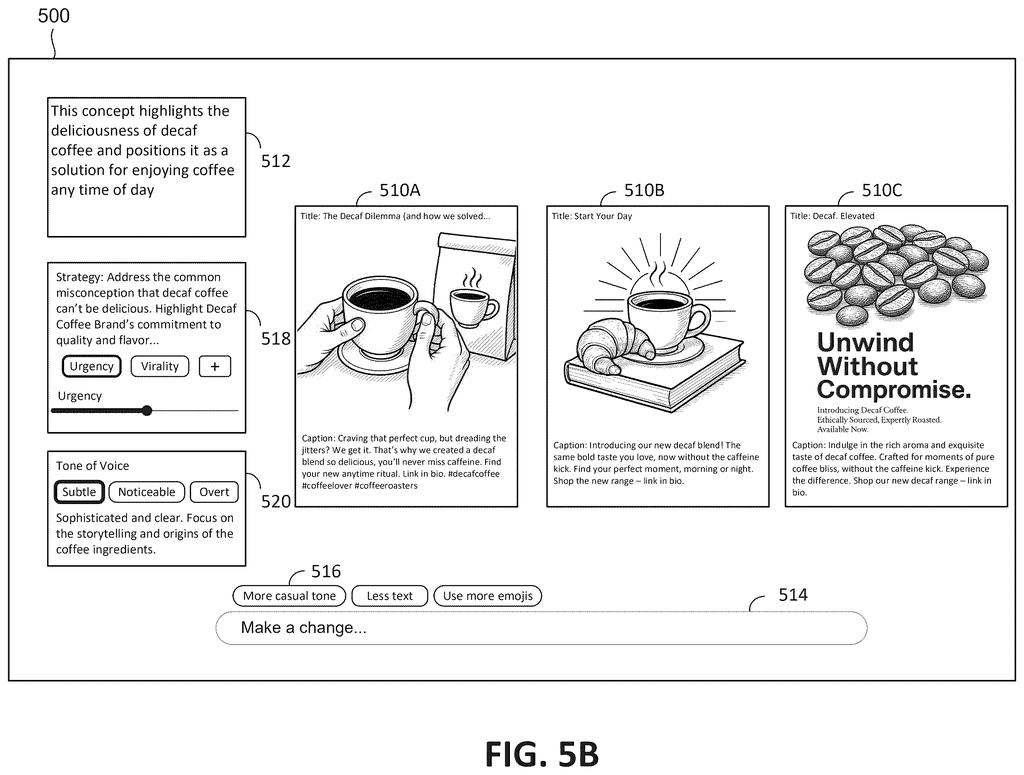
It also reads your existing documents, such as product launch schedules and branding, so the posts match your actual business. Afterward you get controls, like a slider that moves a post from soft sell to hard sell, to adjust the result without starting over.
receiving, by a set of one or more processing devices, a user query comprising a request to generate content in accordance with a content concept, the content concept reflecting at least one of a target audience of the content, a purpose of the content, a style of the content, or a tone of the content …
Translation: The system takes a simple user request that outlines goals like target audience, style, and tone.
How Google expands your request before the AI sees it
A person types a request tied to a content concept, which the filing defines as a high-level idea such as the target audience, purpose, style, or tone of what they want made. The filing's running example is a social media campaign for a decaf coffee company.
Next, the system works out what the request really means. Separate models (software trained to make one specific kind of guess) predict the person's intent, a tactic such as using 'limited time only' phrasing, and design choices like color and typography. Those guesses are folded into an expanded prompt (the written instruction handed to the main AI model).
The main model then produces content items based on that expanded prompt and on existing content in the person's documents, such as launch schedules or branding. The filing lists several formats:
- Text and images for a social post
- Audio, such as a podcast spot
- Animation and video
Follow-ups are built in. A person can type a change or move a slider, for example nudging 'urgency' from 0.5 to 0.75 for a slightly more urgent tone, and the system writes an updated prompt and regenerates. The filing also describes scanning your documents to suggest campaign ideas you can click.
An output of the AI model is obtained, the output including content item(s) generated based on the expanded version of the request in accordance with the generated prompt and further based on existing content of electronic document(s) associated with a user associated with the user query and/or the content concept.
Translation: The artificial intelligence creates the final content by combining the expanded prompt with the user's existing files.
Why your own files matter to Google's AI drafts
If this reached a real product, the biggest change would be less back-and-forth. Instead of rewriting your request until a chatbot gets the tone right, the tool would fill in the audience, strategy and look for you, then pull facts from files you already have. The filing says this means fewer repeat runs of the AI, which saves computing power.
The filing also says the shorter route could make the AI light enough to run on a phone. Sliders and one-click tweaks like 'more casual tone' or 'less text' would make the result something you steer. It also describes controls that let you decide whether your information is collected at all.
Google's 36th filing we've tracked since May in our AI models that work in teams watchlist follows its applications for a chatbot that draws inline images and a self-correcting speech recognizer.
The distance to a shippable feature is short here. It needs no new hardware, only software on top of AI models and document tools that already exist, and the filing itself describes a platform with word processing, spreadsheet and slide documents.
What has to exist first are the helper models that guess intent, strategy and design, labeled examples to train them, and a document search good enough to find the right files. The shortest route to a product is a prompt box inside a document or slide app that writes a longer prompt behind the scenes.
The hardest part is trust: people have to be comfortable letting an AI read their files, which the filing addresses with opt-in controls. The claims are broad, so the real value will come from how well the guesses match what you meant. Bottom line: a believable near-term feature with few surprises.
Get our take in your Top Stories
Liked this breakdown? Add Patentlyze as a preferred source on Google, and our plain-English take shows up more often in your Top Stories the next time Google patent news breaks.
There are more where this came from
We read every patent application Big Tech publishes and send you the ones worth knowing. Plain English, free, every week.
The drawings
9 drawing sheets from US 2026/0350097 A1 · click any drawing to enlarge


Show the other 1 sheets

Want this weekly breakdown for a company we don't cover? Patentlyze Pro →
Be the first to weigh in