
Nvidia Patents a System That Lets AI Models Select Their Own Training Data
Teaching an AI to pick its own best study materials sounds circular, but that's exactly what this Nvidia patent proposes, and it could cut one of the most expensive parts of building a language model.
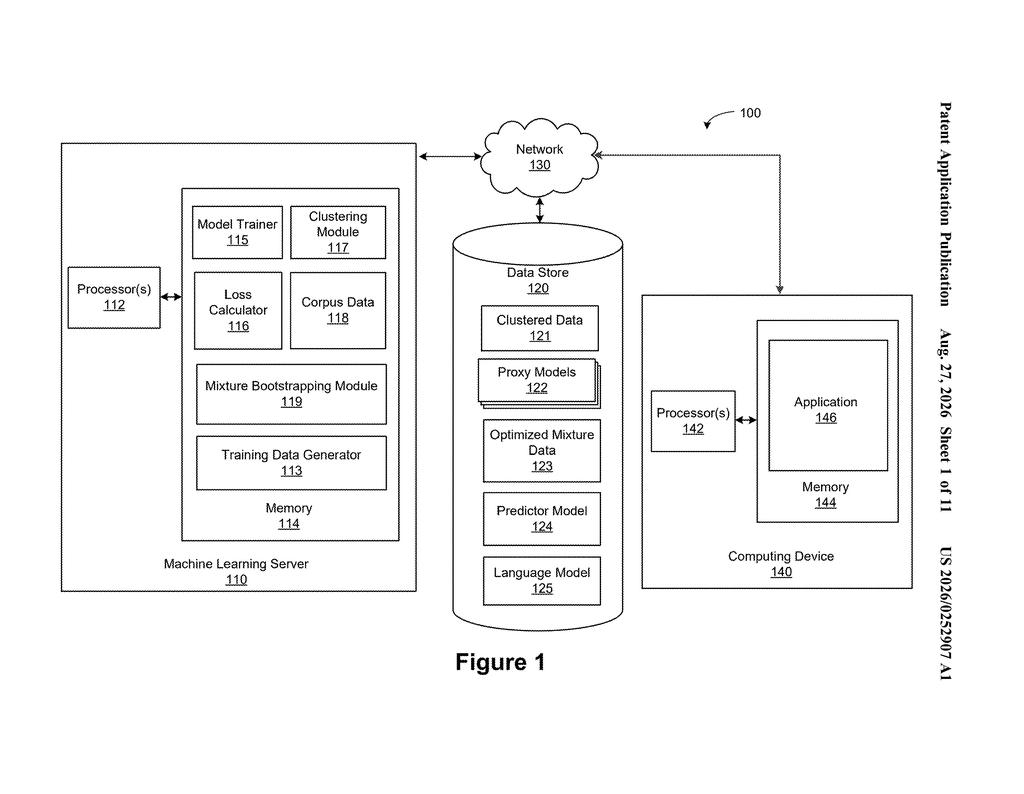
How Nvidia's data-mixing method trains AI more efficiently
You're a researcher trying to teach an AI to write, reason, and answer questions. The catch: you have billions of pages of text to train it on, and no one knows the right ratio of news articles to code to scientific papers to make it work well. Getting that mix wrong wastes months of compute time.
Nvidia's patent describes a system that figures out the best mix automatically. It groups your raw training text into clusters by topic or type, then runs a series of small trial-and-error experiments to learn which combinations produce the best results. That process builds a "recipe" for the training data, which is then used to train the actual AI model.
The big idea is that instead of researchers manually tuning data ratios (an expensive, slow process), a smaller helper model does the tuning work first, and the main model trains on the result. It's a smarter assembly line for AI, not a smarter AI itself.
… performing, based on the clustered data, a plurality of bootstrapping operations to train a first predictor model and generate a mixture configuration; …
Translation: The system uses categorized data to train an initial model that decides the best recipe for mixing future data.
Inside Nvidia's iterative bootstrapping training loop
The patent lays out a four-step process for training a language model with less human guesswork about data composition.
- Clustering: Raw corpus data (the giant pile of text used for training) is sorted into clusters, meaning groups of similar content. Think of it as separating a library into fiction, science, law, and code sections before deciding how many books from each shelf to assign as homework.
- Bootstrapping loop: A smaller predictor model is trained through repeated iterations (bootstrapping, meaning each round builds on the last) to figure out which mix of those clusters produces the best outcomes. Each round refines the answer.
- Mixture configuration: The predictor model outputs a recipe, a weighted formula describing how much data to pull from each cluster.
- Main model training: The full, target language model is then trained on that optimized data mix, called mixture data, rather than on unweighted raw text.
The key insight is that the expensive, large model only trains once, on data that's already been curated by the cheaper predictor. This separates the "what to learn from" problem from the "learn" problem.
… performing, based on the mixture data, one or more training operations to train a first untrained language model to generate a first trained language model …
Translation: The AI then uses this custom mixture of data to fully train a brand new language model.
What this means for the cost of building AI models
Data composition is one of the least glamorous but most consequential decisions in building an AI. Companies like OpenAI, Google, and Meta have all noted that the ratio of data types, not just the sheer volume, drives meaningful quality differences in the resulting model. An automated system that finds a near-optimal mix before the big training run starts could save significant GPU time and reduce the cost of each new model generation.
For Nvidia, this is also strategically self-serving in the best way: the company sells the GPUs that run these training jobs. Making AI training cheaper and more efficient increases the number of organizations that can afford to do it, which expands Nvidia's customer base. This particular filing sits at the intersection of AI training methodology and data engineering, an area generating steady Big Tech patent news as every major lab races to squeeze more capability from each training dollar.
This is the 26th Language AI filing from Nvidia we've tracked since May, adding to earlier applications like one on self-correcting specs and one on simplifying prompts.
The method described here is purely software, meaning no new chip or specialized machine is required to put it to work. Any team already building a large language model could, in principle, fold this approach into their existing setup tomorrow. The main prerequisite is already widely available: a body of training text and enough computing power to run the feedback loop that automatically figures out how to blend that text for best results.
The shortest route to a shipped feature is simply running this process as a behind-the-scenes step before each major training run. The practical promise is that getting the data recipe even roughly right through automation is faster and cheaper than having engineers guess and check by hand, which is how most teams currently operate.
If this saves meaningful time at that stage, it earns its place in the toolkit.
Get our take in your Top Stories
Liked this breakdown? Add Patentlyze as a preferred source on Google, and our plain-English take shows up more often in your Top Stories the next time Nvidia patent news breaks.
There are more where this came from
We read every patent application Big Tech publishes and send you the ones worth knowing. Plain English, free, every week.
The drawings
11 drawing sheets from US 2026/0252907 A1 · click any drawing to enlarge


Want this weekly breakdown for a company we don't cover? Patentlyze Pro →
Be the first to weigh in