Adobe
Adobe · AI / ML · Filed Feb 27, 2025 · USPTO published Aug 27, 2026 · Aug 27 release
Adobe Patents a System That Shows You Where an AI's Answer Came From
When an AI reads a document and gives you an answer, how do you know which part of the document it's actually pulling from? Adobe has filed a patent for a system that highlights the exact words in the original text that correspond to each piece of the AI's reply.
- Publication number
- US 2026/0252791 A1(US20260252791A1)
- Applicant
- Adobe Inc.
- Filed · Published
- Feb 27, 2025 · Aug 27, 2026
- Inventors
- Anirudh Phukan, Koustava Goswami, Apoorv Umang Saxena, Animesh Kumar
- Status when we published
- Waiting for an examiner
- Document
- 20 claims
- US classification
- 715/231
What Adobe's AI source-highlighting actually does
An AI reads your company's contract and tells you the termination clause requires 30 days' notice. But which sentence in that 40-page document is it drawing from? You have no easy way to check, so you either trust it blindly or read the whole thing yourself.
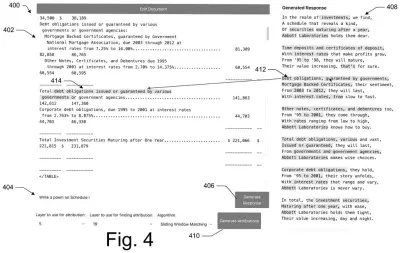
Adobe's patent describes a system that solves that verification gap. After a first AI generates an answer from a document, a second AI traces every word in that answer back to specific words in the original text. The result is an annotated document where the relevant source passages are visually flagged, so you can see at a glance exactly what the AI based its answer on.
This is less about making the AI more accurate and more about making it auditable. You get the speed of an AI summary without having to take its word for it.
… attributing, by a second machine-learning model and using hidden layer representations of the one or more answer tokens and the multiple document tokens, an answer token of the one or more answer tokens to one or more contiguous document tokens of the multiple document tokens …
Translation: A secondary AI analyzes the internal data patterns of the answer to pinpoint exactly which parts of the source text created it.
How hidden layer signals trace each word back to its source
The system works in two stages. First, a standard large-language model reads a document and produces an answer to a question. That part is familiar territory. The interesting piece is what happens next.
A second machine-learning model steps in and examines the hidden layer representations of both the answer and the document. Hidden layers are the internal numeric states inside a neural network, the intermediate calculations the model produces before it outputs text. Because those states carry information about which input words most influenced which output words, they can be used to map connections between the two.
The patent describes breaking both the answer and the document into tokens (small chunks: words, word fragments, punctuation). The second model then attributes each answer token to one or more contiguous document tokens, meaning consecutive words that appear together in the original text rather than scattered fragments.
Finally, the system produces an annotated document: the original file with visual markers linking answer phrases to the specific source passages they came from. The emphasis is on contiguous matches, which keeps the highlighted regions readable and meaningful rather than scattered across the page.
The processing device then generates an annotated document that includes at least one visual indication associating one or more answer tokens with one or more document tokens.
Translation: The system creates a highlighted version of the original document to show users exactly where the AI found its information.
What this means for trusting AI answers at work
The practical problem here is real and growing. Businesses are feeding AI tools their internal documents, legal contracts, research reports, and manuals, and asking those tools to generate answers. When the AI is wrong or imprecise, the error can be costly, and right now most systems give you no easy way to spot the mistake without re-reading the source material yourself. A highlighting layer that automatically flags source passages turns AI-assisted document review from a trust exercise into something closer to a verifiable process.
For Adobe, this fits a clear strategic direction: making its document tools, including Acrobat AI, more suitable for professional and regulated environments where accountability matters. AI attribution in document analysis is one of the more active areas covered by new Big Tech patents, and Adobe's approach of using internal model states rather than post-hoc text matching puts the sourcing logic closer to how the model actually reasons.
That makes this Adobe's fourth filing we've tracked in our AI guardrails race since July, following work on stopping broken database code and filtering wrong answers early.
Source: US 2026/0252791 A1 at the USPTO (PDF). Full patent text and figures are in the official publication.
Get our take in your Top Stories
Liked this breakdown? Add Patentlyze as a preferred source on Google, and our plain-English take shows up more often in your Top Stories the next time Adobe patent news breaks.
Add Patentlyze on Google
One click.
There are more where this came from
We read the new patents from Big Tech, carmakers and more and send you the ones worth knowing. Plain English, free, every week.
The drawings · 8 sheets
8 drawing sheets from US 2026/0252791 A1 · click any drawing to enlarge


More from Adobe
All 270 Adobe patents →
More in AI / ML
All 2,745 AI / ML patents →
IBM
IBM Patents a System That Catches Two Types of AI Lies in Summaries
IBM
IBM Patents a System That Finds Which Documents Disagree and Why
IBM
IBM Patents a System That Pits Multiple AI Models Against Each Other to Find the Best Answer
IBM