
Google
Google · AI / ML · Filed Mar 30, 2026 · USPTO published Aug 13, 2026 · Aug 13 release
Google Patents a System That Displays AI-Generated Info Cards During Video Playback
Google is working on a system that reads a video as it plays and automatically surfaces a pop-up information card about whatever person, place, or thing just appeared on screen, before you even think to pause and search.
- Publication number
- US 2026/0236531 A1(US20260236531A1)
- Applicant
- Google LLC
- Filed · Published
- Mar 30, 2026 · Aug 13, 2026
- Inventors
- Jonathan Matthew Malmaud, Nicolas Paul-Stringall Higuera, Jeff Hsu, Sarah Fay Smith, Gabriel Rubow Culbertson, Runmin Zhao
- Status when we published
- Waiting for an examiner
- Document
- 1 claim
- US classification
- 707/749
- Parent application
- Continuation of 18/775,977 (filed Jul 17, 2024)(18775977)
What Google's mid-video entity cards actually do
Right now, when something in a video sparks your curiosity, a celebrity you half-recognize, a product someone's using, a landmark in the background, your only option is to stop the video, switch apps, and search for it yourself. That friction causes a lot of people to just forget about it.
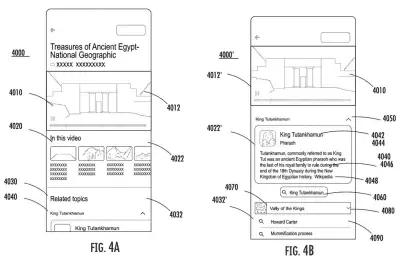
Google's patent describes a system that watches the video alongside you and predicts what you're likely to want to look up. When the right moment comes, a small card appears on screen with descriptive information about that entity, a person, brand, location, or object, while the video keeps playing.
The key detail is that the AI doesn't just recognize what's in the frame: it's trained to predict what a viewer would actually search for, which is a more selective and useful filter than simply labeling everything it sees.
… in response to a first entity occurring in the video, providing, for presentation on the display device while the video is being played, a first entity card which includes descriptive content relating to the first entity …
Translation: The system automatically shows an information box about a person or object while you are watching a video.
How the model predicts what you'd search for next
The system uses one or more machine-learned models (AI trained on large datasets) to process a video as it plays. The models analyze the content frame by frame, identifying what Google calls entities, people, places, brands, products, or concepts that appear or are referenced in the video.
Critically, the model's job isn't just object recognition. It's predicting which entities a viewer is likely to search for, a more refined goal that filters out background noise and focuses on things that carry genuine curiosity value. That predicted entity then triggers the generation of an entity card, a structured information panel displayed on the same screen while playback continues.
The patent describes the card as containing descriptive content relating to the entity, though it doesn't specify exactly what form that takes. Likely candidates include names, short bios, links, or Knowledge Graph-style summaries.
- Video is processed by AI models in real time or near-real time during playback
- Models output a ranked prediction of entities worth surfacing
- A card is generated and displayed on-screen without interrupting the video
- The card is tied to the moment the entity appears in the video
The first entity is identified by one or more machine-learned models based on the one or more machine-learned models processing, as an input, the video, and predicting, as an output, the first entity as an entity likely to be searched for.
Translation: AI analyzes the video to guess which people or items you might want to look up later.
What this means for YouTube's search-and-watch loop
For anyone who watches video on YouTube or Google TV, this would change the basic rhythm of how you consume content. Instead of the watch-pause-search-return loop that breaks viewing, relevant information would arrive at the right moment, on its own. That's a meaningful quality-of-life change, and it also keeps you inside Google's ecosystem rather than jumping to another app.
From a business angle, entity cards are an obvious surface for rich results, affiliate-style product links, or ad-adjacent placements, though the patent doesn't say any of that explicitly. The filing sits squarely in the broader race to make video as information-dense as text, an area where Big Tech patent news has tracked a steady stream of AI-driven video-understanding filings from Google and its rivals over the past two years.
Source: US 2026/0236531 A1 at the USPTO (PDF). Full patent text and figures are in the official publication.
Get our take in your Top Stories
Liked this breakdown? Add Patentlyze as a preferred source on Google, and our plain-English take shows up more often in your Top Stories the next time Google patent news breaks.
Add Patentlyze on Google
One click.
There are more where this came from
We read the new patents from Big Tech, carmakers and more and send you the ones worth knowing. Plain English, free, every week.
The drawings · 13 sheets
13 drawing sheets from US 2026/0236531 A1 · click any drawing to enlarge


Show the other 5 sheets


More from Google
All 1,127 Google patents →
More in AI image & video
All 226 AI image & video patents →
Samsung
Samsung Patents an AI System That Tunes Its Own Photo Processing Steps
Adobe
Adobe Patents an AI That Rewrites Your Prompts Before Generating Images
Nvidia
Nvidia Files Patent for AI That Restores Sharp Detail Lost in Compressed Images
Nvidia