
Samsung Patents an AI System That Tunes Its Own Photo Processing Steps
Every photo your phone takes passes through a chain of processing steps, and getting each step wrong can ruin the final image. Samsung's new patent describes a system where an AI model watches that chain and adjusts each step's settings on the fly.
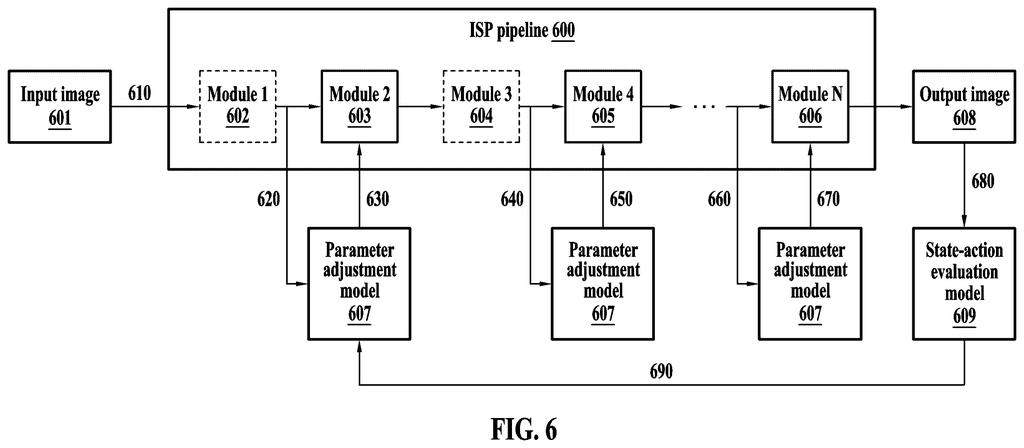
How Samsung's camera pipeline adjusts itself in real time
Imagine you're taking a burst of photos at a concert: low light, fast movement, people shuffling in and out of frame. Your phone's camera isn't just clicking a shutter, it's running your image through a long assembly line of adjustments (noise reduction, color correction, sharpening, and more), each of which has settings that need to be right for this specific moment.
The problem is that most cameras set those parameters in advance or use fixed rules. Samsung's patent describes a system where a trained AI model watches which step in the pipeline is running right now, then decides what adjustment to make, in real time. Each step gets its own tuned settings based on the current state of the whole pipeline, not just a one-size-fits-all value baked in at the factory.
The result, at least in theory, is a camera that's always tuning itself to the scene in front of you, step by step, rather than locking in decisions early and hoping for the best.
acquire current state information indicating which of the image processing stages is a current image processing stage that is a target of adjustment among the image processing stages; determine an adjustment parameter using a parameter adjustment model to which the current state information is input …
Translation: The system identifies which part of the photo processing pipeline needs an update and feeds that data into an AI model.
How the parameter model reads pipeline state and acts
The patent describes an image processing pipeline (a sequence of distinct stages, each handling one aspect of photo processing, such as demosaicing, noise reduction, tone mapping, or sharpening) where every stage can have its parameters adjusted dynamically by a machine-learning model.
Here's how the loop works:
- The system identifies which pipeline stage is currently being processed (called the current image processing stage).
- It packages up current state information, details about where in the pipeline execution currently sits, and feeds that into a parameter adjustment model (a trained neural network or similar AI model).
- The model outputs an adjustment parameter: a value or set of values that modify how the current stage behaves.
- The stage runs with those freshly computed settings rather than fixed defaults.
The key claim is that the model uses a parameter generation method that produces adjustments specific to the pipeline's current context, meaning later stages can be informed by what earlier stages did. This is different from tuning each stage independently in isolation.
The patent is broad enough to cover hardware implementations (dedicated image signal processors) as well as software pipelines running on general processors.
… adjusting a parameter of an image processing system including an image processing pipeline included of image processing stages, and the method includes: acquiring current state information indicating which of the image processing stages is a current image processing stage that is a target of adjustment …
Translation: The software automatically detects which specific step in the image editing process requires a settings change.
What self-tuning image pipelines mean for Galaxy cameras
Camera quality is one of the main battlegrounds in flagship smartphone competition, and the gap between manufacturers increasingly comes down to software processing rather than the physical sensor. A system that can tune its own pipeline parameters in real time, rather than relying on fixed presets, could produce better results in tricky conditions like mixed lighting, motion blur, or high-contrast scenes without requiring engineers to hand-tune every scenario.
Samsung already ships sophisticated image signal processors in its Exynos chips and relies on third-party processors for some Galaxy models. This patent suggests the company is exploring ways to make the processing chain itself more adaptive at a fundamental level. The latest Big Tech patents in computational photography show a clear push toward AI-driven image pipelines, and this filing puts Samsung squarely inside that trend.
The problem this patent attacks is real and persistent: image pipelines tuned for average conditions routinely fail at the edges, in exactly the moments when photos matter most. Whether an AI model that reads pipeline state and outputs per-stage adjustments actually outperforms well-engineered fixed heuristics in practice is an open question, and the patent is written at a level of abstraction that leaves that question unanswered. What the filing does show is that Samsung is investing engineering attention in making the pipeline itself the intelligent layer, rather than bolting AI onto the front or back end as an afterthought.
There are more where this came from
We read every patent application Big Tech publishes and send you the ones worth knowing. Plain English, free, every week.
The drawings
9 drawing sheets from US 2026/0237027 A1 · click any drawing to enlarge


Want this weekly breakdown for a company we don't cover? Patentlyze Pro →
Be the first to weigh in