
Google
Google · AI / ML · Filed May 15, 2025 · USPTO published Nov 19, 2026 · This week's release
Google Patents an AI Podcast That Rewrites Its Script to Slip in Ads
Google's patent filing describes an AI podcast that can hear your question mid-episode and rewrite its own script to bring in a product or other outside content. The goal is to make the pitch sound like part of the conversation.
- Publication number
- US 2026/0368250 A1(US20260368250A1)
- Applicant
- Google LLC
- Filed · Published
- May 15, 2025 · Nov 19, 2026
- Inventors
- Lakshmi Kumar Dabbiru, Raghavendra Rao Donamukkala
- Status when we published
- Examiner raised objections; the company can respond
- Document
- 20 claims
- US classification
- 700/94
- Examiner
- LIEBGOTT, TYLER MICHAEL (Art Unit 2694)
What Google's podcast-rewriting patent does
An AI podcast host is halfway through an episode about getting the best return on a new-build home. You ask it, "What are the best washers and dryers under $2,000?" Most shows would either ignore you or answer and move on.
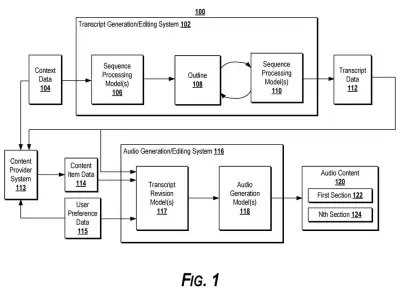
Google's patent describes a way to handle that moment. The system sends your question, plus a slice of what the show has been discussing, to a content provider. The provider sends back something relevant, such as a product and its description. The AI then rewrites the script so the show glides into that content, with a spoken transition that signals a shift.
The rewrite happens on the written script, before it becomes speech. The filing says it can be done while the earlier part of the episode is still playing, so you shouldn't hear an awkward gap.
… processing, by the computing system, the first content item with the machine-learned model to generate, as output from the machine-learned model an updated transcript for audio content, wherein the transcript comprises a transition from the initial transcript to a transcript that incorporates the first content item.
Translation: The AI rewrites the podcast script to naturally weave in the ad content.
How the AI script gets rewritten mid-show
The system starts with a big pile of source material, which the filing calls context data: text documents, audio files or video. A language model (the same kind of AI behind chatbots) reads it and writes an initial transcript, a script describing the topics in that material. Another step turns the script into spoken audio.
When you ask a question, the system sends a request to a content provider. The request holds your question plus a slice of the source material, so the reply fits the topic. What comes back, called a content item, can be:
- A product and a description of it
- An outline for a script
- A preselected voice for the audio
The model then writes an updated transcript that includes a transition into that content item. Because the rewrite happens on the script rather than the finished audio, the filing says the wording can be tailored to fit the show. A second updated transcript can be written while the first piece is still playing, so playback doesn't stall.
To save time, the filing also describes choosing candidate items ahead of time for each script. It describes the AI spotting natural breaks, which it calls 'commercial intent breaks,' where a pitch would fit.
The updated transcript incorporates the content item and seamlessly transitions from the initial transcript.
Translation: The revised script blends the advertisement smoothly into the conversation.
Why shoppable AI podcasts matter for you
If you listen to AI-generated podcasts, this is a preview of how they could pay their way. Ask about washers and dryers, and the show could answer with a specific product pitch, in the host's voice, without a hard cut to a recorded ad. The filing says two listeners on the same topic could hear different content items, and even different voices, depending on their preferences.
The same idea could sit inside a search page, where a link plays a short generated audio explanation of why a sponsored result is relevant. The examiner's first review rejected the claims as filed, which is routine at this stage and usually followed by amendments, so the final scope may shift. The filing describes a method, and says nothing about a product launch.
That makes this Google's 29th filing we've tracked in AI recommendation since May, adding to work like a weighting-each-signal engine and a keyword tool reading your site.
Source: US 2026/0368250 A1 at the USPTO (PDF). Full patent text and figures are in the official publication.
Get our take in your Top Stories
Liked this breakdown? Add Patentlyze as a preferred source on Google, and our plain-English take shows up more often in your Top Stories the next time Google patent news breaks.
Add Patentlyze on Google
One click.
There are more where this came from
We read every patent application Big Tech publishes and send you the ones worth knowing. Plain English, free, every week.
The drawings · 15 sheets
15 drawing sheets from US 2026/0368250 A1 · click any drawing to enlarge


Show the other 7 sheets


More from Google
All 1,127 Google patents →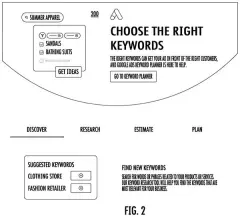
More in AI recommendation
All 91 AI recommendation patents →
Sony
Sony Patents a System That Sorts You Into Fan, Superfan or Hater
Sony
Sony Files Patent to Let AI Write the Code That Feeds Game-Testing Bots
Samsung
Samsung Files Patent to Stop AI From Making Up Details About Photos
Microsoft
No comments yet