
Google Patents an AI That Reads Your Home's Sensor Data and Writes You a Summary
Your smart home collects a huge amount of data every day, but most people never look at it. Google is patenting a way to have an AI read all of it and hand you a plain-text digest of what actually happened.
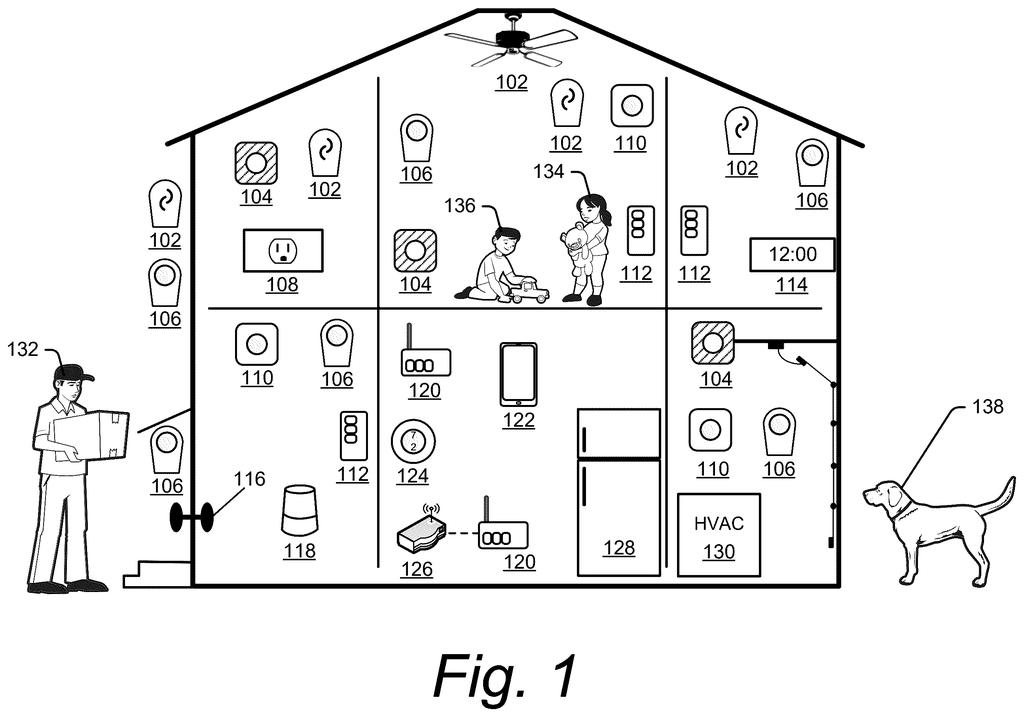
What Google's home-activity AI summary actually does
Imagine your security camera spotted your dog knocking over the trash at 2 a.m., your front-door sensor registered an unusual late arrival, and your thermostat logged a spike in temperature that same night. Right now, that information sits in separate apps and logs that most people never open.
Google's patent describes an AI that pulls together data from all the sensors in your home, looks for connections between events, and then writes you a readable summary. Instead of raw logs, you'd get something closer to: "Your back door opened three times between midnight and 6 a.m., which coincided with motion alerts in the kitchen."
The system is designed to surface what's relevant, not just what happened. It filters and groups events by the patterns it finds, so the output is a short, useful report rather than a data dump.
receiving, by a machine-learned (ML) model, home data generated by one or more home surveillance sensors; generating, by the ML model, one or more correlations based on the home data …
Translation: An AI reviews information collected by your home security devices to find patterns.
How the ML model finds patterns across sensor streams
The patent describes a pipeline with three main stages.
- Data ingestion: A machine-learned (ML) model receives raw data from "home surveillance sensors", a broad term that covers cameras, motion detectors, door and window contacts, thermostats, and similar devices.
- Correlation generation: The model looks for relationships across that data, for example that motion in the hallway consistently precedes a door opening, or that a specific camera triggers at the same time of night on weekdays. These are called correlations (basically, "these things tend to happen together").
- Summary generation: Using those correlations, the system writes a text summary covering only the subset of data tied to meaningful patterns. Unrelated or repetitive events are filtered out.
The final output, which the patent calls a "home output," is then delivered to the user. The patent doesn't specify a single delivery format, which leaves room for a notification, a card in an app, or a voice response from a smart speaker.
The claim is deliberately broad: it covers any ML model doing the correlation work, any set of home sensors doing the data collection, and any output format. That breadth is typical of foundational patent filings at this stage.
… generating, based on the correlations, a home summary including a text summary of a subset of the home data related to the correlations.
Translation: It writes out a plain text report explaining what those patterns mean for your household.
What this means for smart home privacy and usefulness
Most people with smart home devices end up ignoring the raw event logs because they're too noisy to be useful. A camera that sends 40 motion alerts a day trains you to tune them out. An AI that reads those logs and writes "your driveway camera fired 38 times between 7 and 9 a.m., all triggered by morning traffic" is genuinely more useful than the raw count.
Google's long bet on smart home AI makes this filing fit a clear pattern. But the privacy angle is real: a system that correlates events across multiple sensors in your home and generates behavioral summaries holds a detailed picture of how your household runs. Whether that data stays on-device or passes through cloud processing isn't addressed in this patent, and that gap is the part worth watching.
Google's 94th filing in our Language AI coverage since May follows a formula-writing system and an autonomous research tool among the applications we've tracked.
Smart home devices have become relentless data producers, and most people ignore the flood of alerts because sorting through them takes more effort than the information is worth. That gap between what a home system knows and what an owner actually understands is a real and daily frustration for millions of households.
Google's approach here is to have an AI read across all that raw activity, find patterns worth noting, and write a short plain summary a person can actually use. Whether that lands as useful or trivial depends entirely on how well the underlying model is trained, and this document says nothing about that.
For a company already selling cameras, doorbells, and thermostats under one roof, this fits naturally into a single app that already sits on users' phones. The problem is large enough to justify the effort; the question of execution is just left open.
There are more where this came from
We read every patent application Big Tech publishes and send you the ones worth knowing. Plain English, free, every week.
The drawings
12 drawing sheets from US 2026/0303403 A1 · click any drawing to enlarge


Want this weekly breakdown for a company we don't cover? Patentlyze Pro →
Be the first to weigh in