
Google Patents a Shortcut That Cuts the Math Behind 3D Sound in VR and AR
Every extra sound in a VR scene means more math for your headset. A new Google patent application cuts that math by grouping sounds that line up with your head.
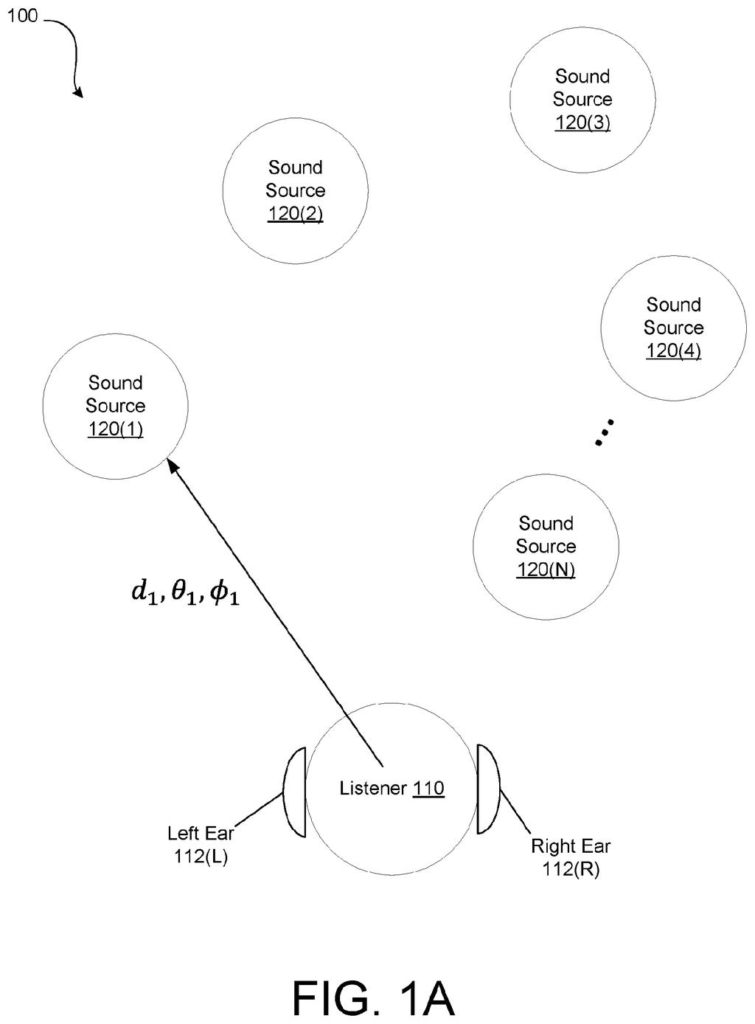
What Google's shared-sound shortcut actually does
Every time you put on a VR headset and a crowd, a waterfall and a few footsteps all start up around you, the device runs a pile of math so each sound seems to come from the right spot, in the right room. That math grows with every sound added, and it can slow things down or drain the battery.
A new Google patent application describes a shortcut. Two things shape how a sound reaches your ears: the direction it comes from and the distance it travels. If several sounds share a direction, or sit the same distance away, they can be blended first and processed once instead of one by one.
The filing also describes a way to find those groups automatically, so your headphones can do less work for the same effect.
… speaker positions along a circular arc in three-dimensional space have an identical reverb transfer function …
Translation: Speakers placed along a curved path share the exact same echo math.
How Google groups sounds by angle and distance
Spatial audio for headphones leans on two filters. A head-related transfer function (HRTF) describes how your head and ears reshape a sound depending on the direction it comes from. A reverb transfer function describes how a room's walls and furniture bounce the sound around. Applying a filter to a signal is called a convolution, a heavy bit of math. The usual method needs four per sound source: an HRTF and a reverb for each ear.
The filing observes that the HRTF depends only on direction, while reverb depends only on distance. That gives two shortcuts:
- Sources along the same line out from the listener share one HRTF. Their signals can be summed first and filtered once per ear, dropping the count from 4N to N+2 (N is the number of sources).
- Sources along the same circular arc around the listener share one reverb, dropping the count from 4N to 2N+2.
To find those groups, the description uses a grid search: try a series of candidate curves (for arcs, circles in half-meter steps), count how many sources fall within a threshold of each, and keep the winner. Sources need not sit exactly on the curve. The claims mention thresholds of 0.5 to 1.5 meters for arcs and 5 to 15 degrees for lines.
The independent claims are broader: line up sources on a curve defined by a parameter, combine their signals, and apply one function that depends on that parameter.
Why this matters for VR and AR headphone audio
If you wear a headset or AR glasses, audio work competes with graphics, tracking and battery for the same small chip. The filing says this approach can cut memory use, power draw and delay, and the savings grow when a scene has many sound sources, like a crowded street or a busy game level. For you, the gain would show up as more sounds in a scene or a bit more battery, not as a feature you tap.
The size of the saving depends on how many sources happen to line up. The filing counts convolutions and reports no measured speedups, so the real-world gain is open. Google's own description places this in VR and AR, where headphone audio has to sound right in real time.
Google's 44th filing we've tracked in our AR glasses race watchlist since May builds on earlier applications like two images at once and edge-to-edge brightness.
The path to shipping is short. It needs no new hardware, only a change to the software that turns a game's sounds into what comes out of your headphones. A headset that already filters sounds for head and room could, in principle, add this grouping step.
The hard part is the grouping itself. Sounds can share a filter only when they line up with the listener, and the filing accepts a loose fit, within about a meter for distance or 5 to 15 degrees for direction. A loose fit makes the result an approximation, and the filing offers no listening test of how it sounds. Its main example also keeps the listener still, so a moving listener would likely mean searching for new groupings.
If it ships, expect an invisible tune-up that frees up processing power or battery. It is sensible audio plumbing with a modest, believable payoff.
Get our take in your Top Stories
Liked this breakdown? Add Patentlyze as a preferred source on Google, and our plain-English take shows up more often in your Top Stories the next time Google patent news breaks.
There are more where this came from
We read every patent application Big Tech publishes and send you the ones worth knowing. Plain English, free, every week.
The drawings
9 drawing sheets from US 2026/0313308 A1 · click any drawing to enlarge


Show the other 1 sheets

Want this weekly breakdown for a company we don't cover? Patentlyze Pro →
Be the first to weigh in