
Google Patents a System That Recognizes Your Contacts and Habits When You Speak
Voice assistants often stumble on names and niche terms. Google's new patent describes a system that avoids the cost of personalized vocabulary until it's sure the conversation actually needs it.
What Google's on-demand voice model actually does
Imagine asking your phone to call "Dr. Ramirez" and it keeps hearing "drama rays." Voice assistants struggle with unusual names, specialized words, and personal contacts because they rely on giant, generic word lists that can't know everything about you.
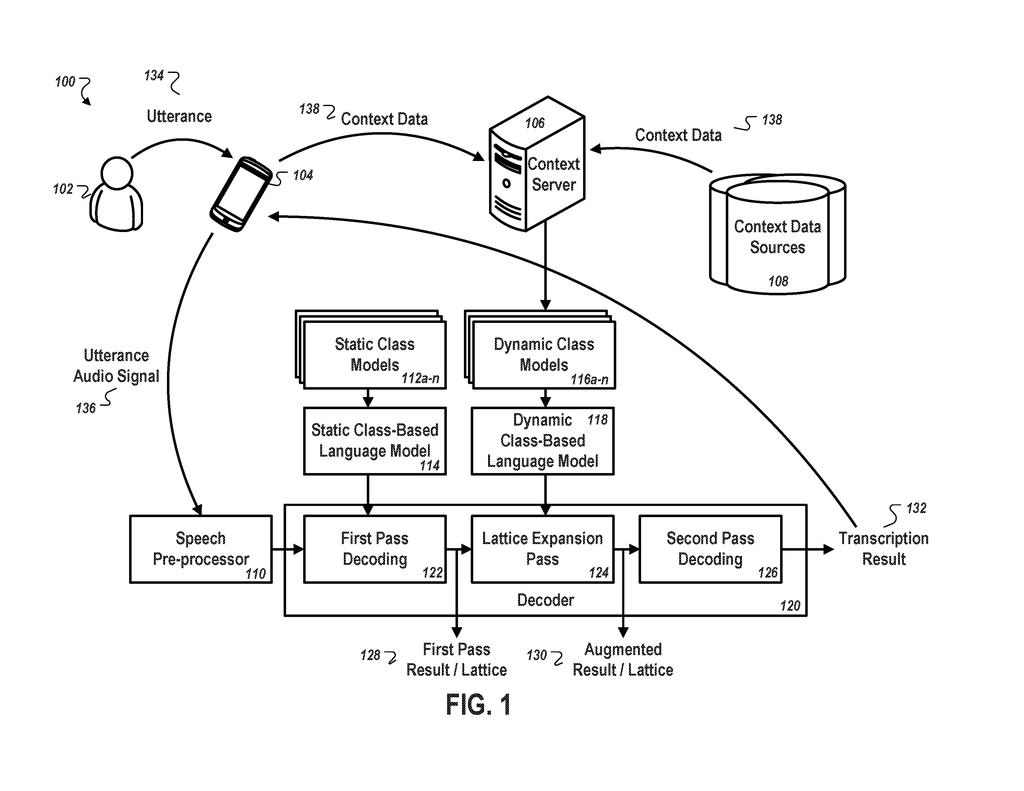
Google's patent describes a two-step approach. First, the system uses a standard word list to take a quick pass at what you said. If that quick pass picks up a word that could belong to a personal or context-specific category (like a contact name or a restaurant), it then loads a smaller, tailored word list built around your context to try again with better information.
The clever part is the "only if needed" logic. Loading a personalized model every single time you speak would be slow and resource-heavy. By checking the rough draft first, the system only does the expensive, personalized work when there's actually a good reason to.
How the two-stage language model pipeline works
The patent describes a two-stage speech recognition pipeline that balances speed against personalization.
- Stage 1 (Static model): A standard, pre-built language model (called a "static class-based language model") processes your speech and produces a set of candidate transcriptions. This model has fixed categories like "contact names" or "song titles," but those categories are filled with generic placeholder terms, not your actual contacts or music library.
- Stage 2 (Dynamic model, conditional): The system checks whether any of those candidate transcriptions triggered a category placeholder. If so, it builds a dynamic class-based language model populated with real, context-specific terms (your contacts, your location, your recent activity) and runs recognition again using that richer model.
- Skip if not needed: If Stage 1 produces a confident transcription with no category placeholders, the system skips Stage 2 entirely, saving time and compute.
The approach is essentially a gating mechanism (a decision filter that controls whether extra processing runs). By only invoking the personalized, heavier model when the first pass signals it might help, the system avoids loading and querying large personal datasets on every single utterance.
What this means for Google Assistant and voice search
For users, this kind of architecture is what separates a voice assistant that confidently dials the right person from one that makes you repeat yourself three times. The conditional design means the system can stay fast for simple requests while still pulling in personal context when your words actually warrant it.
For Google, it's also an efficiency argument. Google Assistant and Search handle billions of voice queries. Running a full personalized model on every query would be expensive at scale. A system that reserves the heavy lifting for ambiguous or personal-category cases could cut that cost significantly while keeping accuracy high where it counts.
This is solid, practical engineering rather than a headline-grabbing AI feature. The two-stage gating idea is genuinely useful for large-scale voice systems, and the patent's logic is clean and well-scoped. It won't make anyone's jaw drop, but it's exactly the kind of infrastructure work that makes voice assistants less frustrating to use day to day.
There are more where this came from
We read every patent application Big Tech publishes and send you the ones worth knowing. Plain English, free, every week.
The drawings
7 drawing sheets from US 2026/0221141 A1 · click any drawing to enlarge


Want this weekly breakdown for a company we don't cover? Patentlyze Pro →
Be the first to weigh in