
Wing · Filed Jul 14, 2026 · Published Nov 5, 2026

Wing Patents a Drone Pickup Stand With Barbs That Hold On in the Wind

A drone hovers, lowers a hook on a line, and picks up a package without ever landing. This patent application adds the piece that keeps a gust of wind from ruining the grab: small one-way barbs.
A drone pickup stand holds the handle of a delivery bag securely before an aircraft hovers overhead to reel it up. Drawing from patent filing US 2026/0347003 A1.
A drone pickup stand holds the handle of a delivery bag securely before an aircraft hovers overhead to reel it up.
See all 55 drawings from this filing ↓
Publication number US 2026/0347003 A1 US20260347003A1
Applicant Wing Aviation LLC
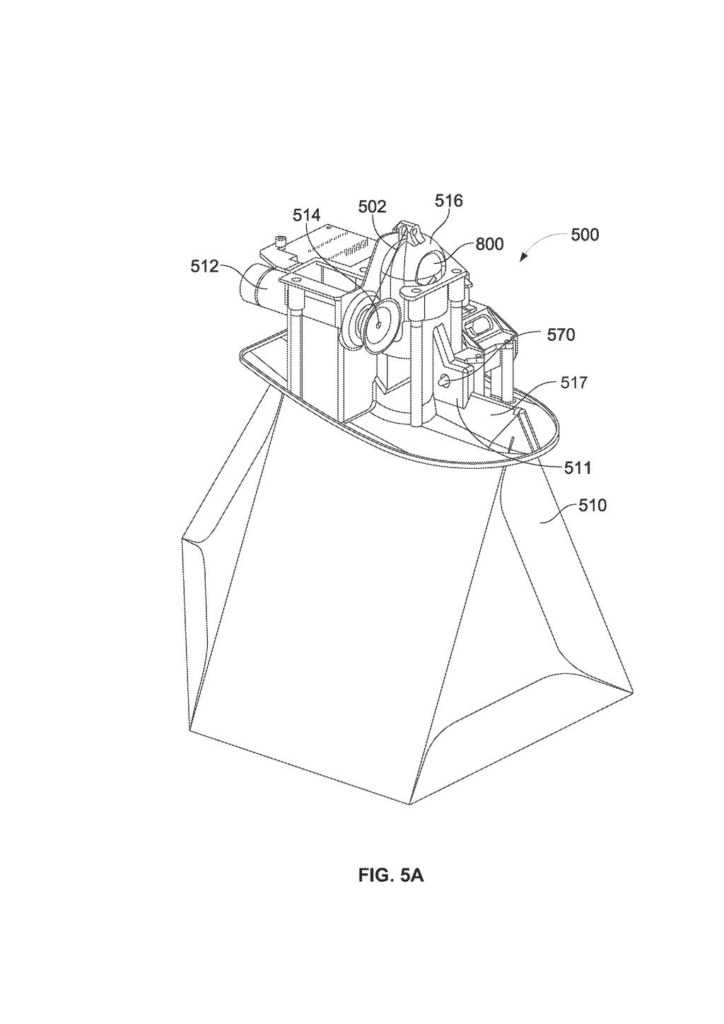
Filing date Jul 14, 2026
Publication date Nov 5, 2026
Inventors Jasper Lewin, André Prager, Ivan Qiu
US classification 258/1.2
Status when we published Waiting for an examiner (Jul 31, 2026)
Parent application is a Continuation of 18400751 (filed 2023-12-29)
Document 13 claims

What Wing's drone pickup stand actually does

Every time a delivery drone hangs over a pickup spot, the wind gets a say. The drone lowers a hook-carrying capsule on a line, and one gust can swing that capsule around just as it is trying to slip into place.

Wing's patent application describes a pickup stand built for exactly that moment. The drone never lands. Its line gets guided into a narrow slot, and the capsule rides through a channel until its hook catches the handle of a waiting package.

The new twist is a set of small barbs along the slot. They let the line in easily, then refuse to let it back out. A sudden downdraft or a swinging capsule can't shake the hook out of the channel before it reaches the package.

From the filing · CLAIM 1
a channel having a first end and a second end and first and second inner edges defining a tether slot therebetween, wherein the tether slot is configured to guide passage of a tether coupled to a payload retriever suspended from an uncrewed aerial vehicle (UAV) when the payload retriever is passing through the channel …

Translation: The stand uses a slotted channel to catch and guide the drone's hanging delivery line.

How the barbs trap the drone's line in the slot

The claims cover three things working together. First, a channel with a narrow slot along it, which guides the tether (the line hanging from the drone, tied to a hook-carrying capsule the filing calls a payload retriever). Second, a payload holder near the far end of the channel that holds a package in place. Third, a projection that sticks out from one inner edge of the slot, shaped to keep the tether from leaving once it has entered.

The filing's example sequence goes like this:

  • The drone hovers near the stand, and its line touches angled arms (called tether engagers) that funnel it toward the channel.
  • The drone moves forward or up, or winches the line in, pulling the line through the slot and the capsule into the channel.
  • The capsule exits the far end, its hook goes through a hole in the package handle, and it pulls the package off the holder's pins.
  • The drone winches the package up and flies off.

The claims name several forms for the projection: barbs, serrations (saw-tooth teeth), a leaf spring (a flat strip of springy metal), or a spring-biased lever. A second projection can sit on the opposite edge. The two can be offset to make a zigzag path, and they can be molded into the channel or bolted on. In the description, the barbs act like a one-way valve: the line slides in over them but can't back out.

From the filing · THE ABSTRACT
… a first tether engager that extends in a first direction from the first end of the channel adapted to guide the tether towards the channel, a payload holder positioned near the second end of the channel that is adapted to secure a payload …

Translation: Funnels at the top catch the line and direct it down toward a mechanism that holds the package in place.

Why gusts matter for no-landing drone pickups

If you ever order something by drone, the pickup end matters as much as the flight. The filing says the old way, where a person clips the package to the drone, leaves the drone waiting, or leaves a person waiting for a late drone. A stand that lets the drone collect a package without landing removes that handoff, and the barbs go after the most obvious way it could fail: wind.

The description names gusts, downdrafts and a swinging capsule as the cases that can make the line go slack and drop the capsule out of the channel. The setup is also meant to be portable. The filing says it can fold up like an umbrella stand and fit in a single parking space, so it could sit at shops or pickup points rather than needing a permanent installation.

Google's 26th filing in the Robotics patents we cover since May follows drone charging pad mapping and plain-English robot commands.

Editorial take

The shortest route to a product here is short. Barbs, serrations and leaf springs are cheap passive parts with no software, no sensors and no new drone hardware. The filing even says molding them into the channel cuts the part count and assembly time.

What has to exist first is everything around them: a drone with a winch and a hook capsule, the pickup stand itself, and a way to load packages onto its pins. The filing describes all of that, but this claim covers only the slot detail, so it is one improvement inside a larger system.

Expect it to matter only if that larger pickup system gets built. If it does, this is a plain, sensible fix for a problem anyone who has watched a kite in a gust would recognize.

Get our take in your Top Stories

Liked this breakdown? Add Patentlyze as a preferred source on Google, and our plain-English take shows up more often in your Top Stories the next time Google patent news breaks.

There are more where this came from

We read every patent application Big Tech publishes and send you the ones worth knowing. Plain English, free, every week.

The drawings

55 drawing sheets from US 2026/0347003 A1 · click any drawing to enlarge

A delivery drone designed for vertical takeoff and cruise flight, drawing sheet 1 from US 2026/0347003 A1
Sheet 1 A delivery drone designed for vertical takeoff and cruise flight
Airplane styles that rely on wings to glide forward, drawing sheet 2 from US 2026/0347003 A1
Sheet 2 Airplane styles that rely on wings to glide forward
A tail-sitting aircraft that lifts straight up before cruising, drawing sheet 3 from US 2026/0347003 A1
Sheet 3 A tail-sitting aircraft that lifts straight up before cruising
Quadcopter propellers enclosed in safety rings for steady hovering, drawing sheet 4 from US 2026/0347003 A1
Sheet 4 Quadcopter propellers enclosed in safety rings for steady hovering
Aircraft electronics that manage flight and the winch line, drawing sheet 5 from US 2026/0347003 A1
Sheet 5 Aircraft electronics that manage flight and the winch line
How dispatch centers coordinate multiple drones across launch hubs, drawing sheet 6 from US 2026/0347003 A1
Sheet 6 How dispatch centers coordinate multiple drones across launch hubs
Dropping a package to the ground while hovering high above, drawing sheet 7 from US 2026/0347003 A1
Sheet 7 Dropping a package to the ground while hovering high above
Motorized winch assembly clamped to a delivery bag handle, drawing sheet 8 from US 2026/0347003 A1
Sheet 8 Motorized winch assembly clamped to a delivery bag handle
Show the other 47 sheets
Drone winch holding a package snug against its body, drawing sheet 9 from US 2026/0347003 A1
Sheet 9 Drone winch holding a package snug against its body
Side profile of the package seated beneath the winch mechanism, drawing sheet 10 from US 2026/0347003 A1
Sheet 10 Side profile of the package seated beneath the winch mechanism
Three angles of the motorized hook that grabs package handles, drawing sheet 11 from US 2026/0347003 A1
Sheet 11 Three angles of the motorized hook that grabs package handles
Grooves guide the hook back into the drone, drawing sheet 12 from US 2026/0347003 A1
Sheet 12 Grooves guide the hook back into the drone
Slot under the drone holding the package handle, drawing sheet 13 from US 2026/0347003 A1
Sheet 13 Slot under the drone holding the package handle
How the hook releases a package on touchdown, drawing sheet 14 from US 2026/0347003 A1
Sheet 14 How the hook releases a package on touchdown
Locking pins stop the cargo from swaying midair, drawing sheet 15 from US 2026/0347003 A1
Sheet 15 Locking pins stop the cargo from swaying midair
Flexible grabber lip swinging out to catch cargo, drawing sheet 16 from US 2026/0347003 A1
Sheet 16 Flexible grabber lip swinging out to catch cargo
Adding embedded magnets or extra weight to orient the hook, drawing sheet 17 from US 2026/0347003 A1
Sheet 17 Adding embedded magnets or extra weight to orient the hook
Guiding a sweeping tether toward a waiting package, drawing sheet 18 from US 2026/0347003 A1
Sheet 18 Guiding a sweeping tether toward a waiting package
Front view of the pickup stand holding a package, drawing sheet 19 from US 2026/0347003 A1
Sheet 19 Front view of the pickup stand holding a package
Side view showing how the stand suspends a delivery box, drawing sheet 20 from US 2026/0347003 A1
Sheet 20 Side view showing how the stand suspends a delivery box
Step-by-step path of a drone hooking and lifting a box, drawing sheet 21 from US 2026/0347003 A1
Sheet 21 Step-by-step path of a drone hooking and lifting a box
Feeder belt lining up multiple packages for automatic pickup, drawing sheet 22 from US 2026/0347003 A1
Sheet 22 Feeder belt lining up multiple packages for automatic pickup
Internal tracks that funnel and align the hook during pickup, drawing sheet 23 from US 2026/0347003 A1
Sheet 23 Internal tracks that funnel and align the hook during pickup
Panels that guide a drifting tether to the box, drawing sheet 24 from US 2026/0347003 A1
Sheet 24 Panels that guide a drifting tether to the box
How the descending line hooks a package handle, drawing sheet 25 from US 2026/0347003 A1
Sheet 25 How the descending line hooks a package handle
Angled guide panels that direct incoming tether lines into place, drawing sheet 26 from US 2026/0347003 A1
Sheet 26 Angled guide panels that direct incoming tether lines into place
Side view of the stand holding a package for pickup, drawing sheet 27 from US 2026/0347003 A1
Sheet 27 Side view of the stand holding a package for pickup
Package handle resting against the top of the guide chute, drawing sheet 28 from US 2026/0347003 A1
Sheet 28 Package handle resting against the top of the guide chute
Close view of pins holding the package handle in place, drawing sheet 29 from US 2026/0347003 A1
Sheet 29 Close view of pins holding the package handle in place
Shielded enclosure that shields resting parcels from ground winds, drawing sheet 30 from US 2026/0347003 A1
Sheet 30 Shielded enclosure that shields resting parcels from ground winds
Rotating stand head swiveling to face an incoming drone hook, drawing sheet 31 from US 2026/0347003 A1
Sheet 31 Rotating stand head swiveling to face an incoming drone hook
Spring latches pushing the tether hook straight into the handle, drawing sheet 32 from US 2026/0347003 A1
Sheet 32 Spring latches pushing the tether hook straight into the handle
Funnel stand guiding a lowered line to the handle, drawing sheet 33 from US 2026/0347003 A1
Sheet 33 Funnel stand guiding a lowered line to the handle
Internal latch pins locking the hook into place during pickup, drawing sheet 34 from US 2026/0347003 A1
Sheet 34 Internal latch pins locking the hook into place during pickup
Curved track aligning the hook before grabbing the handle, drawing sheet 35 from US 2026/0347003 A1
Sheet 35 Curved track aligning the hook before grabbing the handle
Mounting post holding the package upright for the hook, drawing sheet 36 from US 2026/0347003 A1
Sheet 36 Mounting post holding the package upright for the hook
Tilted stand angles that catch windblown delivery lines, drawing sheet 37 from US 2026/0347003 A1
Sheet 37 Tilted stand angles that catch windblown delivery lines
Pivoting bracket swinging free as the line lifts the package, drawing sheet 38 from US 2026/0347003 A1
Sheet 38 Pivoting bracket swinging free as the line lifts the package
Empty support bracket reset and ready for the next package, drawing sheet 39 from US 2026/0347003 A1
Sheet 39 Empty support bracket reset and ready for the next package
Pickup cone showing how far drone lines can sway, drawing sheet 40 from US 2026/0347003 A1
Sheet 40 Pickup cone showing how far drone lines can sway
A roadside pickup stand fits neatly between parked cars, drawing sheet 41 from US 2026/0347003 A1
Sheet 41 A roadside pickup stand fits neatly between parked cars
Side and rear views of the winged package retrieval stand, drawing sheet 42 from US 2026/0347003 A1
Sheet 42 Side and rear views of the winged package retrieval stand
Where the drone hovers inside a parking space, drawing sheet 43 from US 2026/0347003 A1
Sheet 43 Where the drone hovers inside a parking space
Angled guide rods channel the lowered drone line into place, drawing sheet 44 from US 2026/0347003 A1
Sheet 44 Angled guide rods channel the lowered drone line into place
Hinged upper arms flex to catch incoming pickup lines safely, drawing sheet 45 from US 2026/0347003 A1
Sheet 45 Hinged upper arms flex to catch incoming pickup lines safely
Weighted ground bases keep the outdoor pickup pole steady, drawing sheet 46 from US 2026/0347003 A1
Sheet 46 Weighted ground bases keep the outdoor pickup pole steady
Slanted top brackets align the delivery line with the stand, drawing sheet 47 from US 2026/0347003 A1
Sheet 47 Slanted top brackets align the delivery line with the stand
Angled barbs inside the narrow central slot trap the line, drawing sheet 48 from US 2026/0347003 A1
Sheet 48 Angled barbs inside the narrow central slot trap the line
Angled barbs funnel the drone tether inside, drawing sheet 49 from US 2026/0347003 A1
Sheet 49 Angled barbs funnel the drone tether inside
Front view of the entry slot for hooks, drawing sheet 50 from US 2026/0347003 A1
Sheet 50 Front view of the entry slot for hooks
Twin spring tabs keep the tether from escaping, drawing sheet 51 from US 2026/0347003 A1
Sheet 51 Twin spring tabs keep the tether from escaping
Curved hooks trap incoming line inside the stand, drawing sheet 52 from US 2026/0347003 A1
Sheet 52 Curved hooks trap incoming line inside the stand
Rows of teeth lock drifting tether in place, drawing sheet 53 from US 2026/0347003 A1
Sheet 53 Rows of teeth lock drifting tether in place
Ridges on outer arms block wind from moving line, drawing sheet 54 from US 2026/0347003 A1
Sheet 54 Ridges on outer arms block wind from moving line
Toothed upper edges catch drifting tether line, drawing sheet 55 from US 2026/0347003 A1
Sheet 55 Toothed upper edges catch drifting tether line
Browse all the drawings 55 drawing sheets
Patent filing page

Source. Full patent text and figures from the official USPTO publication PDF.
Reader comments

Be the first to weigh in

Start the discussion

Real name or a handle, either is fine. Comments are read by a person before they appear, so allow a little time. Keep it about the filing.