
Google Files Patent to Make See-Through Glasses Readable in Bright Sunlight
Light from see-through glasses is added on top of the real world's light, so a sunny day can wash out the picture. Google's filing has the glasses change how hard their tiny LEDs run, and accept a more orange-looking red, to stay visible.
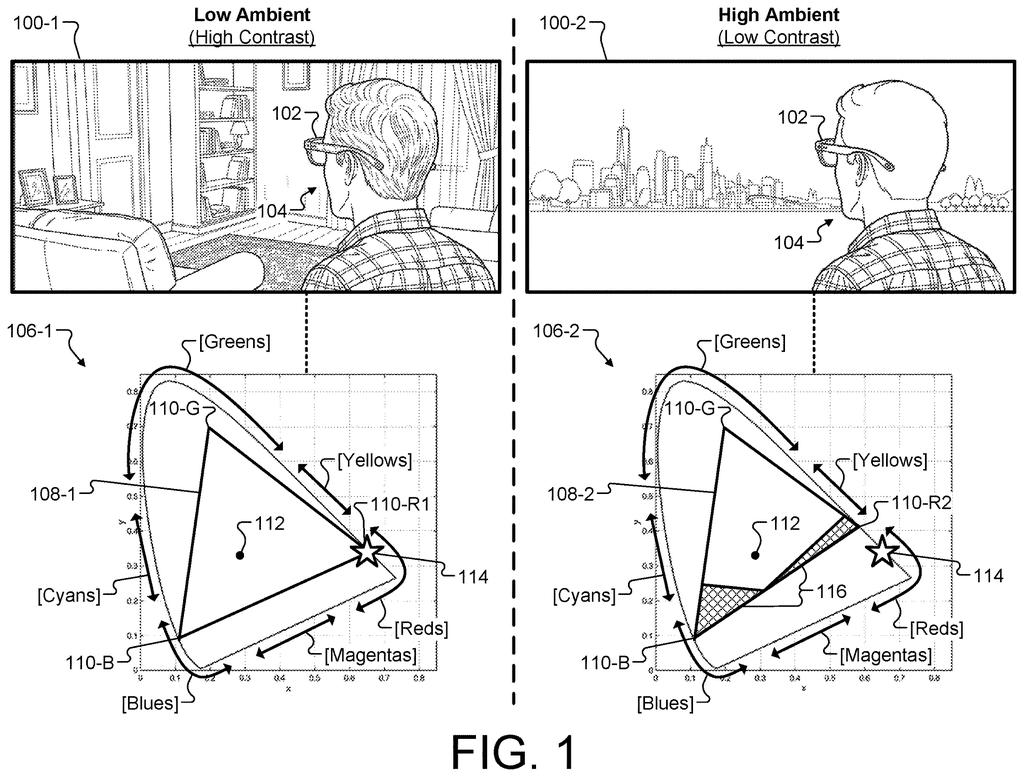
What Google's sunlight-ready glasses display does
Today, see-through glasses have a built-in handicap: the light they produce is added to whatever light is already reaching your eyes. Outside on a sunny day, that background glare can wash out the picture. The usual fix is cranking up the brightness, which drains the battery and heats up a device sitting on your face.
Google's filing describes a different approach. A light sensor reads how bright your surroundings are, and the glasses pick from a small set of saved settings. Indoors, they run the tiny LEDs gently, which keeps deep, rich reds. Outside, they push more electricity through the LEDs, giving up some color richness so the image stays visible.
There is a catch: more power makes the red drift toward orange. So the glasses also rebalance the mix of red, green and blue, which keeps white looking like white in every setting.
detecting an ambient level of light in an environment in which a transparent display with an array of emitters is operated; determining, based on the ambient level, a profile from a plurality of profiles associated with the transparent display …
Translation: The glasses measure how bright it is outside to pick the best display settings.
How the display swaps power modes by room light
The patent covers a method for a see-through display, the kind used in head-mounted augmented reality glasses, where tiny LEDs (called microLEDs) make the image while the real world shows through. A sensor, which can be a simple light sensor, a camera or an array of light detectors, reports how bright the surroundings are.
Based on that reading, a controller picks one profile from a saved set. A profile is a stored bundle of settings, including how much electric current to send to the LEDs of a primary color (red, green or blue). The filing says two profiles can be enough, a low-brightness mode and a high-brightness mode, and it also shows setups with three and four. One example uses labels like Standby, Indoor (low), Indoor (high) and Outdoor, each switching on a different combination of current sources in the pixel driver (the small circuit that powers each pixel).
Current has a side effect. Red LEDs made from aluminum indium gallium phosphorus shift toward orange as current rises. So the system also changes the mapping between image values and drive signals (the instructions telling each LED how bright to be). It adjusts the ratio of red, green and blue to keep the white point steady (the exact shade that counts as neutral white, such as the standard D65). Overall brightness is then set to hit a target contrast using pulse-width modulation (switching LEDs on and off very fast to dim them).
Profile boundaries can overlap, so the display does not flip back and forth when the light hovers near a switching point. The filing says the red shift can be at least 20 on a standard color-difference scale, which is easy to see.
Why sunlight is the hard test for smart glasses
If you wear glasses with a see-through display, sunlight is the hardest place to use them. This filing is about getting a readable picture outdoors without simply burning more power, which matters on a device that has to be light, cool and last all day. Indoors, you would keep the richer colors the hardware can make.
The filing describes head-mounted displays in general and names no product. It is a sign that display makers are tuning the physical behavior of the LEDs themselves, and the software that compensates for it, instead of only turning a brightness dial. It also admits the tradeoff: in bright light, some vivid reds will look different.
That makes this Google's 52nd filing we've tracked since May on smart glasses display work, following earlier applications on stopping wasted light and keeping brightness even.
The problem here is big for anyone hoping to wear a display on their face. A picture that vanishes in sunlight makes the product close to useless outdoors, and glasses are supposed to go everywhere with you. The standard fix, turning up the brightness, costs battery life and adds heat right next to your skin.
The answer in this filing is modest and matches the size of that problem. A handful of saved power modes, picked by a light sensor, plus a white-balance correction so neutral colors stay put. The authors even build in overlapping switch points so the screen does not flicker between modes when a cloud passes.
The honest cost is that some saturated reds will look more orange outside, and the filing says so. That seems a fair price for readable text in daylight. Verdict: practical engineering for a real obstacle, with no pretense of more.
Get our take in your Top Stories
Liked this breakdown? Add Patentlyze as a preferred source on Google, and our plain-English take shows up more often in your Top Stories the next time Google patent news breaks.
There are more where this came from
We read every patent application Big Tech publishes and send you the ones worth knowing. Plain English, free, every week.
The drawings
13 drawing sheets from US 2026/0342955 A1 · click any drawing to enlarge


Show the other 5 sheets


Want this weekly breakdown for a company we don't cover? Patentlyze Pro →
Be the first to weigh in