
Google Files Patent to Let Apps Redraw Their Buttons and Icons on the Fly
Google's filing swaps finished artwork for a small math formula that your device solves on the spot, so one button can look different for every screen, song or theme color.
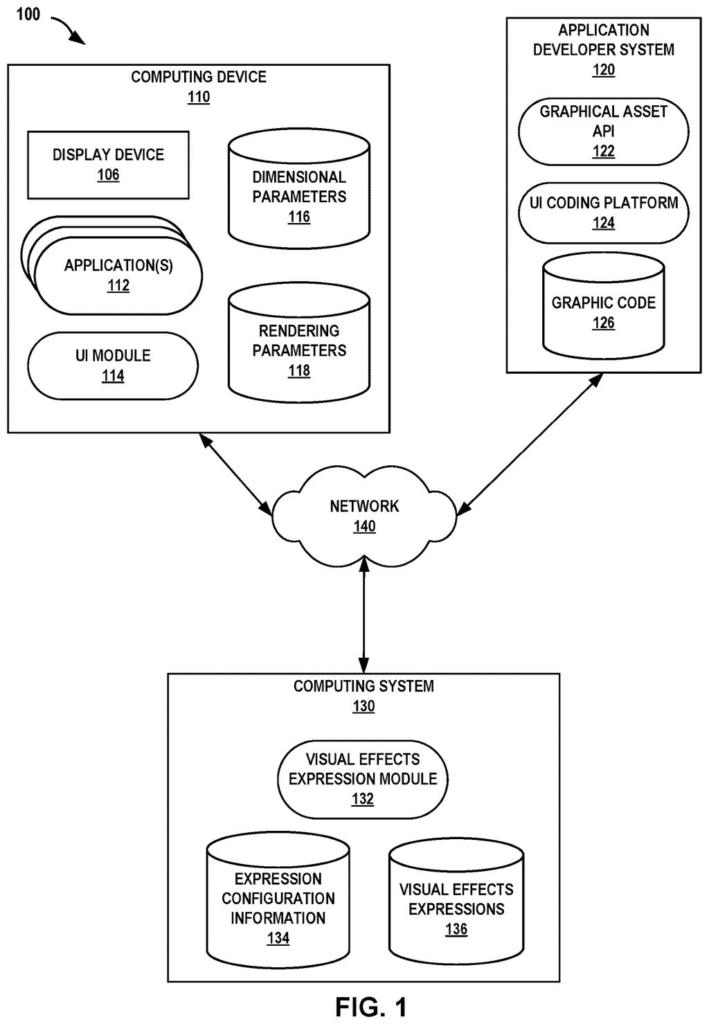
What Google's formula-drawn app graphics do
Ever watched a progress bar pulse along with the music you're playing? Behind the scenes, a developer usually has to code each of those looks by hand: one version per screen size, theme color or animation.
A new Google filing describes another route. Instead of shipping finished artwork or hard-coded drawing steps, an app carries a small math formula for each graphic. Your device feeds in live numbers such as screen size, the time, your theme color or how loud the audio is, and the formula works out how the graphic should look right then.
The device also remembers results it has already worked out, so if the same numbers come back, it reuses the earlier drawing. One example in the filing is a time indicator that ripples in step with the sound playing.
obtaining, by a computing device, a set of dimensional parameters for a graphical asset of a user interface for an application executing at the computing device, the set of dimensional parameters indicating one or more values for a visual effects expression, the visual effects expression configured to output information associated with visual effects for the graphical asset; …
Translation: The app reads measurements and style rules to figure out how a button or icon should change.
How a formula turns screen data into visuals
The core idea is a visual effects expression: a short mathematical formula stored inside an app's graphics code. The formula takes in dimensional parameters (plain input numbers, such as a graphic's width and height, its pixel density, time values, audio data, theme color or a phone sensor reading) and outputs rendering parameters (the values that say what shape, color or animation to draw).
Those outputs get plugged into the app's drawing commands, and the screen shows the result. Developers can also map a 'state' to an effect. For example, the formula's output can show that audio is playing, and the app's settings then say to draw a ripple whose frequency follows the sound.
A few more details from the claims and description:
- Formulas can be written in Reverse Polish Notation (a compact way of writing math with the operation after the numbers, which a computer can run quickly). The filing says the resulting tiny binary encodings can be smaller than typical image files like JPG, GIF or PNG.
- The device caches results (saves them) and reuses them when the same inputs come back.
- A whole graphic can ship as a single code file.
- A developer tool with a simulated screen (phone, wearable or car display) lets designers place and test these graphics.
… generate rendering parameters for graphic code by at least providing the dimensional parameters as input to the visual effects expression, wherein the rendering parameters indicate one or more visual effects; …
Translation: The system feeds those measurements into a formula to calculate new visual styles for the button.
Why app visuals could get lighter and livelier
If this works as described, the apps on your phone or watch could change how their graphics look without a full round of rewriting and rebuilding, since the look is calculated on your device instead of baked into the code. A button could adapt to your screen size and theme color, and a watch face could move in step with the time and your app data.
For developers, Google pitches less hand-written code and fewer computing resources spent loading large graphics with hard-coded effects. The filing lists phones, wearables and car interfaces among the screens its builder tool can simulate. It is a tool-maker's filing, so any benefit to you would show up as more varied, responsive app visuals.
This is the 957th Google filing in our Google coverage we've tracked since May, a run that includes patents like 3D scenes on phones and sorting plastic by chemistry.
Every shortcut has a bill, and here it goes to the people building the app. A designer who used to draw a button now has to describe it as math, and a formula that is slightly off shows up on your screen while the app runs instead of being caught before release.
The phone also does a little calculating each time a graphic changes, which is the price of skipping prepared pictures. The filing answers with a memory of past results, so repeat inputs reuse the earlier drawing, and that covers the obvious weak spot well.
For a button that never changes, the trade is a bad one. For a watch face or music screen that reacts to time, sound and theme color, one formula beats drawing dozens of versions, so the trade is worth it for those jobs.
Get our take in your Top Stories
Liked this breakdown? Add Patentlyze as a preferred source on Google, and our plain-English take shows up more often in your Top Stories the next time Google patent news breaks.
There are more where this came from
We read every patent application Big Tech publishes and send you the ones worth knowing. Plain English, free, every week.
The drawings
6 drawing sheets from US 2026/0340900 A1 · click any drawing to enlarge


Want this weekly breakdown for a company we don't cover? Patentlyze Pro →
Be the first to weigh in