
Google Files Patent for a Camera That Sorts Recyclable Plastic by Its Chemistry
A camera that records light your eyes can't see could tell whether a plastic item is clean enough to recycle, and it does the job while the item rides past on a conveyor belt.
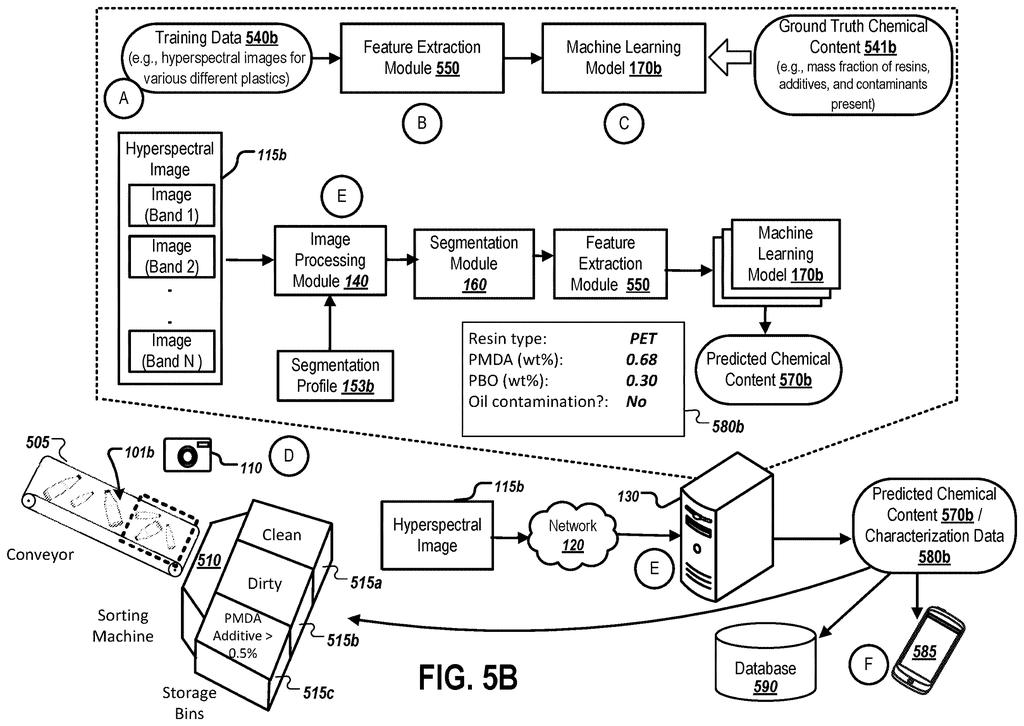
What X Development's recycling camera does
Ever wonder how a recycling plant knows whether that greasy takeout tub is worth keeping? You can't tell by eye, and a camera that only sees ordinary color can't either.
This patent application from X Development describes a special camera that records light in many narrow slices, including ones invisible to people, as items ride past on a conveyor belt. Different plastics and different kinds of grime soak up those slices differently, so each one leaves a kind of fingerprint.
Software then picks out the parts of each item worth reading, and a trained model guesses the type of plastic and how much contamination is on it. The final call is simple: recyclable or not.
obtaining, by the one or more computers, image data that includes how one or more objects interact with light at each of a plurality of wavelength bands, wherein the image data was collected while a conveyor belt moved the one or more objects …
Translation: The system captures how moving items on a belt reflect and absorb various light wavelengths.
How the camera reads plastic on a conveyor
The system starts with a hyperspectral camera (one that records how an object reflects or absorbs light in many narrow wavelength slices, not just red, green and blue) pointed at items on a moving conveyor belt. From there, the claims lay out four steps:
- Preprocess: pick a subset of the wavelength bands and build synthetic bands by combining two or more of them with simple math. The filing's example is a normalized index: the difference of two bands divided by their sum.
- Segment: automatically split each item into region types, such as clean plastic versus a patch of oil or food residue.
- Extract features: boil each region down to a short list of numbers instead of hundreds of raw readings.
- Predict: feed those numbers to a machine learning model that estimates the plastic type, the contaminant, and how much of each is present, then classifies the item as recyclable or non-recyclable.
Dependent claims add details. The data can be normalized against reference images taken with the light fully on and fully off. The system can look for where the slope of a spectrum crosses a threshold. It can also match the data against kernels (patterns that stand in for the light signature of particular chemicals). The camera can sit at about 40 to 50 degrees, 85 to 95 degrees, or under 15 degrees to the belt. The model can be a decision tree or a neural network, and the result can drive sorting of plastic out of a waste stream.
The system generates a prediction of a level of one or more chemicals in the object based on an output produced by a machine learning model in response to the set of feature values being provided as input to the machine learning model …
Translation: AI analyzes these light patterns to figure out the exact chemical makeup of the material.
Why cleaner sorting matters for recycling
Recycling only works well when what goes in is fairly pure. The filing points out that some plastics slip through unnoticed: PLA is often missed in PET sorting, and PVC can create corrosive byproducts during recycling. A camera that reads chemistry could catch those items and the greasy ones before they spoil a batch.
For you, the payoff would be indirect. Cleaner sorted streams could make recycled plastic more valuable and more of what you toss in the blue bin actually get reused. The same description also covers judging fruit sugar levels without cutting the fruit, but the claims here are about plastic on a belt.
This is the 51st Google patent we've tracked under Enterprise AI since May, following one on preserving early AI work and one on blocking fake photo details.
The big trade here is that the system leans on conditions and training. The filing says images are most reliable when lighting and distance are consistent, and the model learns from labeled examples of each plastic and contaminant. A recycling plant that gets a new type of packaging may need the system retrained before it can judge that item.
The camera also reads surfaces. A thin film of oil is easy to see this way, but contamination hidden under a label or buried in a pile of items is a harder case, and the background section admits that objects blocking each other cause trouble for image analysis.
Still, the cost looks worth paying. The design cuts each item down to a handful of numbers and uses only the light bands that matter, which keeps it quick enough for a moving belt. For a job where a human eye has no chance, a model that is right most of the time beats a sorter that cannot see chemistry at all.
Get our take in your Top Stories
Liked this breakdown? Add Patentlyze as a preferred source on Google, and our plain-English take shows up more often in your Top Stories the next time Google patent news breaks.
There are more where this came from
We read every patent application Big Tech publishes and send you the ones worth knowing. Plain English, free, every week.
The drawings
11 drawing sheets from US 2026/0340982 A1 · click any drawing to enlarge


Show the other 3 sheets


Want this weekly breakdown for a company we don't cover? Patentlyze Pro →
Be the first to weigh in