
Microsoft
Microsoft · AI / ML · Filed Feb 7, 2025 · USPTO published Aug 13, 2026 · Aug 13 release
Microsoft Patents AI System for Answering Questions on Evolving Data
Most AI question-answering systems treat your data like a frozen snapshot, which is a problem when the world keeps moving. Microsoft's latest patent describes a way to teach AI to respect the timeline of your data, so answers reflect what was true then, not just what's true now.
- Publication number
- US 2026/0236502 A1(US20260236502A1)
- Applicant
- Microsoft Technology Licensing, LLC
- Filed · Published
- Feb 7, 2025 · Aug 13, 2026
- Inventors
- Darren Keith EDGE, Jonathan Karl LARSON, Thu Ha TRINH
- Status when we published
- Examiner raised objections; the company can respond
- Document
- 20 claims
- US classification
- 707/736
- Examiner
- CURRAN, J MITCHELL (Art Unit 2169)
How Microsoft's time-sorted knowledge graph actually works
Ever tried to find one email in a ten-year archive and figure out not just what happened but when it changed? That's the everyday version of the problem this patent takes on.
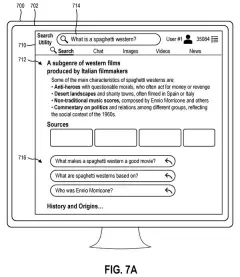
Microsoft is patenting a system that reads a large collection of documents, sorts them into time periods, and builds a kind of relationship map showing which ideas and topics were connected during each period. When you ask it a question, it figures out whether your question is about a specific time window, and if so, it only pulls answers from that window.
The practical payoff: instead of an AI that blurs together everything it has ever read, you get one that can tell you what the consensus was in 2019 versus 2023, or how a topic evolved across a decade of reports. For anyone working with corporate archives, news databases, medical records, or legal documents, that distinction matters a lot.
… inducing the extracted concepts into a graph structure; detecting period communities in the graph structure of individual periods; creating period summaries from the detected period communities; determining whether a user query relates to specific periods and/or communities; …
Translation: The system maps out concepts over time and figures out which time periods or topics the user is asking about.
How the system maps queries to the right time slice
The patent describes a pipeline called Temporal GraphRAG, an extension of the existing GraphRAG approach (a method for turning large text collections into a graph of connected concepts so an AI can reason over them).
Here's how the pipeline runs:
- Chunk and sort: The system breaks a document collection into text segments and tags each one with a time period, weekly, monthly, yearly, or whatever granularity fits the data.
- Extract and graph: It pulls out key concepts from each period's text and builds a graph structure showing how those concepts relate, separately for each period. Think of it as a different relationship map for each chapter of a long story.
- Detect communities: Within each period's graph, it identifies clusters of closely related ideas (called period communities) and writes a summary for each cluster. This is similar to how a news editor might write a weekly digest of related stories.
- Route the query: When a user asks a question, the system decides whether it's time-sensitive. If it is, it retrieves only the relevant period chunks or community summaries, runs the question over them, and assembles a final answer.
The routing step is the crux of the novelty. By deciding upfront whether a question is time-bound, the system avoids mixing information from different eras into a single muddled answer.
One example can obtain text chunks of the dataset grouped by period and extract concepts from the text chunks by period. The example can induce the extracted concepts into a graph structure and detect period communities in the graph structure of individual periods.
Translation: The software breaks down changing data by time periods and builds relationship webs to understand how information evolves.
What this means for AI tools built on live or historical data
The real-world cost of time-blind AI answers is easy to underestimate. A hospital system asking an AI about treatment guidelines needs to know whether it's reading 2018 evidence or 2024 evidence. A compliance team reviewing policy changes needs answers that track to specific regulatory periods, not a blend of everything on file. Today's standard retrieval-augmented generation (RAG) systems often produce answers that silently average across time, which can be worse than useless in those contexts.
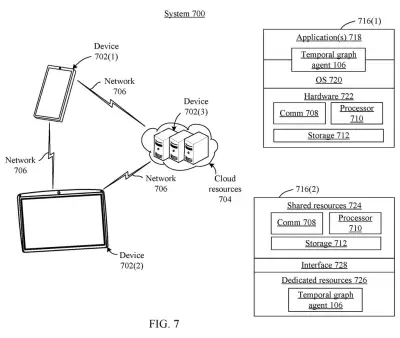
Microsoft's approach is architecturally modest, it layers time-sorting on top of an existing graph-based retrieval method rather than reinventing the underlying model, but that modesty is actually a strength. It can, in principle, be applied to any large text archive without retraining a model from scratch. The AI reasoning field is producing a steady stream of interesting tech patents around knowledge graphs and retrieval systems, and this filing sits squarely in that current, showing how companies are trying to make retrieval pipelines handle the one dimension most datasets have but most AI systems ignore: time.
Source: US 2026/0236502 A1 at the USPTO (PDF). Full patent text and figures are in the official publication.
Get our take in your Top Stories
Liked this breakdown? Add Patentlyze as a preferred source on Google, and our plain-English take shows up more often in your Top Stories the next time Microsoft patent news breaks.
Add Patentlyze on Google
One click.
There are more where this came from
We read every patent application Big Tech publishes and send you the ones worth knowing. Plain English, free, every week.
The drawings · 15 sheets
15 drawing sheets from US 2026/0236502 A1 · click any drawing to enlarge


Show the other 7 sheets


More from Microsoft
All 646 Microsoft patents →
More in AI / ML
All 2,637 AI / ML patents →
Nvidia
Nvidia Patent Explores Stacked Virtual Tokens to Transform AI Model Training
Google
Google Patents a Handwriting System That Turns Your Shorthand Into Full Words
Google
Google Patents a Ranking System That Scores Search Results With One Predictive Value Per Item
Google