
Google Patents a Method to Store AI Model Data in Fewer Bits
Google is patenting a method that lets AI models train using number formats that don't follow the usual rules, potentially squeezing more performance out of the same hardware by picking exactly the right level of numerical precision.
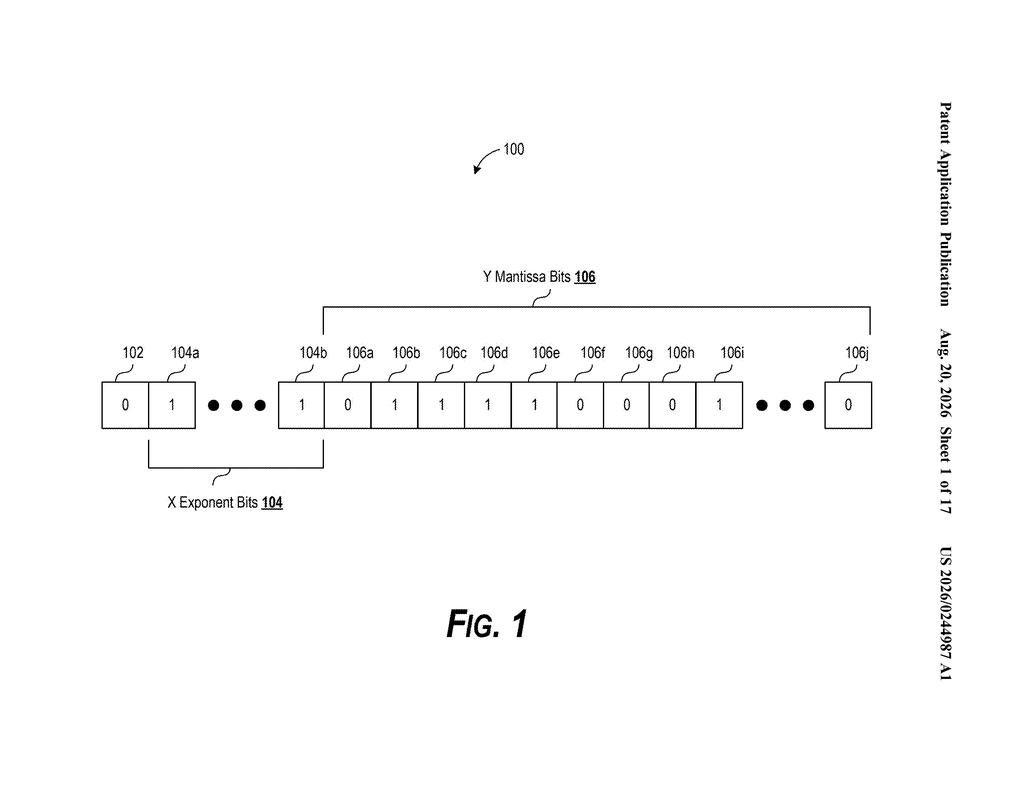
What Google's custom AI number format actually does
Every time a company trains a large AI model, thousands of chips crunch through billions of numbers, and those numbers have to be stored in a specific format. The format determines how precise each number is, and precision costs memory and power.
Right now, AI systems almost always store numbers in formats sized at standard powers of two: 8 bits, 16 bits, 32 bits. Google's patent covers a method that breaks that rule. It trains AI models using number formats with any combination of exponent and mantissa bits, even if the total doesn't land on a power of two. Think of it like choosing a ruler marked in thirds instead of halves, because thirds happen to be more useful for what you're measuring.
The idea is that for certain types of AI parameters, a non-standard format might capture exactly the right range and precision without wasting bits on detail the model doesn't need. That could mean faster training, less memory use, or both, without sacrificing how well the model performs.
obtaining, by a computing system comprising one or more computing devices, a first machine learning model comprising a first plurality of parameters having a first binary format comprising X exponent bits and Y mantissa bits, wherein a precision of the first binary format is not an integer power of two; …
Translation: The system loads an AI model built on an unusual number format that does not follow standard powers of two.
How the non-power-of-two bit format works in training
Every number stored inside an AI model has a binary format: a fixed number of bits split between the exponent (which sets the range, how large or small the number can be) and the mantissa (which sets the precision, how finely the number can be expressed). Standard formats like FP16 or BF16 have bit counts chosen because they fit neatly into hardware registers sized at powers of two.
This patent claims a training method where the model's parameters use a binary format whose total precision is not an integer power of two. So instead of being forced into 8-bit or 16-bit buckets, a format might use, say, 5 exponent bits and 6 mantissa bits (11 bits total) if that happens to suit the data better.
The training loop itself works conventionally otherwise:
- Input data is fed into the model each iteration.
- The model generates an output using parameters stored in this custom format.
- The parameters are updated based on the output, a process called backpropagation.
The patent also covers storing optimizer parameters (the extra numbers that guide how quickly and smoothly the model learns) in similarly non-standard formats. The core claim is that the format choice is decoupled from hardware register-size conventions, letting engineers pick whatever bit layout minimizes error for a given model type.
… generating, by the computing system based at least in part on the input values and based at least in part on the parameters having the binary format, an output.
Translation: The system runs the model using these custom sized bits to produce a result.
What this means for AI chip efficiency and training costs
For people who actually use AI products, the payoff from research like this shows up as lower costs and faster model updates. When companies can train models more efficiently, they can iterate more often, which means the AI assistant or image generator you use gets updated more frequently and with less computing expense passed on to you.
The deeper stakes are about who controls the numerical standards that underpin AI hardware. Google designs its own AI chips (the TPU line), and controlling the number formats those chips support is a way to keep competitors from easily replicating the efficiency gains. This kind of infrastructure-level patent sits in the same stream of new Big Tech patents around AI chip efficiency that will shape which companies can afford to train the largest models over the next decade.
Google's tenth filing we've tracked since July in the AI chip wars adds to earlier work like the noise-cancellation chip and the power-adjusting chip.
The benefit to ordinary users is real, even if invisible. You never see how numbers are stored inside an AI model, but you feel it when the model runs faster, costs less, or gives better answers. Engineers who can store those numbers more efficiently, using a custom format tuned to how a particular model actually behaves, can beat the standard approach while using less memory. That advantage multiplies across billions of calculations and months of training.
Google's chip team wins the most here. They can burn these custom number formats directly into their own hardware, instead of waiting years for the rest of the industry to agree on a standard.
There are more where this came from
We read every patent application Big Tech publishes and send you the ones worth knowing. Plain English, free, every week.
The drawings
17 drawing sheets from US 2026/0244987 A1 · click any drawing to enlarge


Want this weekly breakdown for a company we don't cover? Patentlyze Pro →
Be the first to weigh in