
Google · Filed Mar 17, 2025 · Published Nov 5, 2026

Google Files Patent for Radar Gestures That Learn From Your Second Try

Wave at your smart display, get ignored, wave again: Google's patent treats that second try as a free lesson. The device saves the failed attempt so it can recognize your version of the gesture next time.
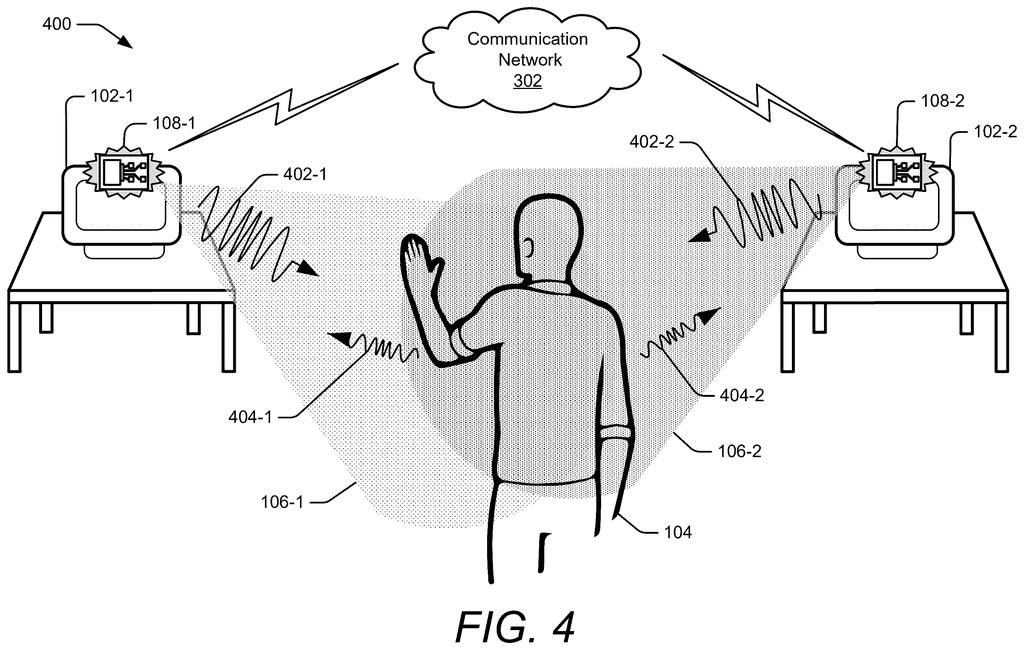
A person waves a hand to control two connected tabletop smart displays across a room. Drawing from patent filing US 2026/0349520 A1.
A person waves a hand to control two connected tabletop smart displays across a room.
See all 46 drawings from this filing ↓
Publication number US 2026/0349520 A1 US20260349520A1
Applicant Google LLC
Filing date Mar 17, 2025
Publication date Nov 5, 2026
Inventors Leonardo Giusti, Nicholas Edward Gillian
US classification 715/863
Status when we published Waiting for an examiner (Aug 11, 2026)
Parent application is a National Stage Entry of PCTUS2022077430 (filed 2022-09-30)
Document 20 claims

What Google's self-correcting gesture radar does

Today, a gesture-controlled device either catches your wave or it doesn't. When it misses, you wave again, a little bigger or slower, until it responds. Nothing about that miss helps the device do better next time, so the same thing happens tomorrow.

Google's filing changes that. When a radar sensor sees a motion it can't match to a known gesture, and then you try again within a couple of seconds and the device does recognize it, the device assumes your first attempt was meant to be the same thing. It saves the radar signature of that failed try as another example of how you make that gesture.

Over time, your quirky version of a swipe gets recognized on the first go. There is no training session to sit through. The learning happens in the background as you use the device.

From the filing · CLAIM 1
… comparing the first radar-signal characteristic to one or more stored radar-signal characteristics, the comparing not effective to correlate the ambiguous gesture to a first gesture; detecting another gesture performed by the user, the other gesture associated with a second radar-signal characteristic …

Translation: The system initially fails to recognize a confusing first wave pattern until a clearer follow up wave is performed.

How the radar matches a miss to a retry

Google's filing covers a method for a radar-equipped device to learn from its own misses. The device sends out radio waves and reads the reflections as a radar-signal characteristic (basically a fingerprint of a motion's shape and speed over time). It compares each new motion against fingerprints it has stored for known gestures, like a swipe or a tap.

If a motion lands in the gray zone, the filing calls it an ambiguous gesture: the device can't match it to any known gesture with enough confidence, or it matches several about equally. When the user then performs another gesture that the device does recognize, the system concludes the earlier one was the same gesture and stores the fingerprint of the failed attempt too.

The filing adds ways to make that guess safer:

  • A time window: the retry counts when it comes two seconds or less later, with no other gesture in between.
  • A confidence weight that is higher for quick retries and lower for slow ones.
  • Extra context saved with the sample, such as where you stood and which way you faced, or readings from a camera or microphone.
  • A prompt asking you to repeat the motion, or a non-gesture command that confirms what you meant.

It also describes watching continually, with no wake-up cue, and letting a second device in the home supply the successful retry.

From the filing · THE ABSTRACT
Techniques and devices for continual in-line learning for radar-based gesture recognition are described in this document. Through continual in-line learning, a computing device may improve recognition of even the hardest-to-recognize gestures by gradually storing characteristics of ambiguous gestures performed by a user.

Translation: Google's new radar system gets better at catching messy hand movements over time by learning from your follow up attempts.

Why gesture controls on Google devices could stick

If you have ever given up on touch-free controls because a device kept ignoring your wave, this is aimed at you. Misses are what make people drop gestures, and the filing says accuracy can improve through normal use, without a separate training session. Because people wave differently, learning from your own retries could fit the device to you.

The description uses a Nest Hub style smart display with 60 GHz radar as an example, and lists watches, TVs, glasses and cars as other possible hosts. Radar also works without a camera, which matters in a bedroom or kitchen. It is a patent filing, so nothing here says any product will do this.

Google's 26th filing we've tracked since May in our wearables that read your body watchlist follows their tips that sense chewing application and one on fixing sleep misreads.

Editorial take

The design bets that a quick second try means the first try was the same gesture. That bet pays off when you wave twice at the same lights, and it can go wrong when you change your mind and do something different. A bad guess gets saved as a lesson, and the device could slowly get worse at the very gesture it was supposed to learn.

The filing hedges against this. It trusts a retry less as more time passes, and it can ask you to repeat the motion or give a non-gesture command to confirm. Each of those hedges costs a little convenience, since the device may occasionally pester you.

The trade is worth it. A gesture feature that misses you three times in a row gets abandoned, and a small risk of mislearning is cheaper than losing the user.

Get our take in your Top Stories

Liked this breakdown? Add Patentlyze as a preferred source on Google, and our plain-English take shows up more often in your Top Stories the next time Google patent news breaks.

There are more where this came from

We read every patent application Big Tech publishes and send you the ones worth knowing. Plain English, free, every week.

The drawings

46 drawing sheets from US 2026/0349520 A1 · click any drawing to enlarge

Radar spotting an unfamiliar guest in the living room, drawing sheet 1 from US 2026/0349520 A1
Sheet 1 Radar spotting an unfamiliar guest in the living room
Everyday gadgets that can house the gesture-sensing parts, drawing sheet 2 from US 2026/0349520 A1
Sheet 2 Everyday gadgets that can house the gesture-sensing parts
Connected home hubs tracking people across different rooms, drawing sheet 3 from US 2026/0349520 A1
Sheet 3 Connected home hubs tracking people across different rooms
Two networked displays bouncing waves off a waving hand, drawing sheet 4 from US 2026/0349520 A1
Sheet 4 Two networked displays bouncing waves off a waving hand
Internal radar parts that transmit pulses and read echoes, drawing sheet 5 from US 2026/0349520 A1
Sheet 5 Internal radar parts that transmit pulses and read echoes
Four ways the system tells family members apart, drawing sheet 6 from US 2026/0349520 A1
Sheet 6 Four ways the system tells family members apart
The AI model that identifies people from radar echoes, drawing sheet 7 from US 2026/0349520 A1
Sheet 7 The AI model that identifies people from radar echoes
How echoed radio waves turn into hand commands, drawing sheet 8 from US 2026/0349520 A1
Sheet 8 How echoed radio waves turn into hand commands
Show the other 38 sheets
How the AI breaks down radar images of hand movements, drawing sheet 9 from US 2026/0349520 A1
Sheet 9 How the AI breaks down radar images of hand movements
How the AI tracks gesture changes over time, drawing sheet 10 from US 2026/0349520 A1
Sheet 10 How the AI tracks gesture changes over time
Accuracy gains when training radar with synthetic gesture samples, drawing sheet 11 from US 2026/0349520 A1
Sheet 11 Accuracy gains when training radar with synthetic gesture samples
Radar snapshots tracking a user tapping in the air, drawing sheet 12 from US 2026/0349520 A1
Sheet 12 Radar snapshots tracking a user tapping in the air
Comparing radar reflections across taps and swipes, drawing sheet 13 from US 2026/0349520 A1
Sheet 13 Comparing radar reflections across taps and swipes
Background body motions the radar learns to ignore, drawing sheet 14 from US 2026/0349520 A1
Sheet 14 Background body motions the radar learns to ignore
Gesture detection accuracy during everyday room movement, drawing sheet 15 from US 2026/0349520 A1
Sheet 15 Gesture detection accuracy during everyday room movement
Recognition rates when testing against tricky lookalike hand motions, drawing sheet 16 from US 2026/0349520 A1
Sheet 16 Recognition rates when testing against tricky lookalike hand motions
Testing how accurately radar separates gestures from random movement, drawing sheet 17 from US 2026/0349520 A1
Sheet 17 Testing how accurately radar separates gestures from random movement
Tracking hand recognition accuracy at different distances and angles, drawing sheet 18 from US 2026/0349520 A1
Sheet 18 Tracking hand recognition accuracy at different distances and angles
Microphone audio confirms presence when radar view is blocked, drawing sheet 19 from US 2026/0349520 A1
Sheet 19 Microphone audio confirms presence when radar view is blocked
Tightening privacy settings automatically when a guest sits down, drawing sheet 20 from US 2026/0349520 A1
Sheet 20 Tightening privacy settings automatically when a guest sits down
Recognizing the same unregistered visitor across different rooms, drawing sheet 21 from US 2026/0349520 A1
Sheet 21 Recognizing the same unregistered visitor across different rooms
Transferring your news read during a morning walk, drawing sheet 22 from US 2026/0349520 A1
Sheet 22 Transferring your news read during a morning walk
Continuing gesture setup across connected home screens, drawing sheet 23 from US 2026/0349520 A1
Sheet 23 Continuing gesture setup across connected home screens
Onscreen content helps the device read sloppy swipe gestures, drawing sheet 24 from US 2026/0349520 A1
Sheet 24 Onscreen content helps the device read sloppy swipe gestures
Three hand traits radar tracks to recognize gestures, drawing sheet 25 from US 2026/0349520 A1
Sheet 25 Three hand traits radar tracks to recognize gestures
Learning different hand habits in different rooms, drawing sheet 26 from US 2026/0349520 A1
Sheet 26 Learning different hand habits in different rooms
Predicting who is nearby based on device location, drawing sheet 27 from US 2026/0349520 A1
Sheet 27 Predicting who is nearby based on device location
Using room surroundings to decipher ambiguous hand waves, drawing sheet 28 from US 2026/0349520 A1
Sheet 28 Using room surroundings to decipher ambiguous hand waves
Matching gestures to active timers across rooms, drawing sheet 29 from US 2026/0349520 A1
Sheet 29 Matching gestures to active timers across rooms
Choosing between an incoming call and a background timer, drawing sheet 30 from US 2026/0349520 A1
Sheet 30 Choosing between an incoming call and a background timer
Daily schedules help predict what a wave means, drawing sheet 31 from US 2026/0349520 A1
Sheet 31 Daily schedules help predict what a wave means
Picking snooze over dismiss when a wave is unclear, drawing sheet 32 from US 2026/0349520 A1
Sheet 32 Picking snooze over dismiss when a wave is unclear
Retrying a sloppy wave helps radar learn your personal motion, drawing sheet 33 from US 2026/0349520 A1
Sheet 33 Retrying a sloppy wave helps radar learn your personal motion
Speaking a voice command clarifies an unclear hand wave, drawing sheet 34 from US 2026/0349520 A1
Sheet 34 Speaking a voice command clarifies an unclear hand wave
Teaching the device a brand new gesture using your voice, drawing sheet 35 from US 2026/0349520 A1
Sheet 35 Teaching the device a brand new gesture using your voice
Different rooms choose between cameras or radar based on privacy, drawing sheet 36 from US 2026/0349520 A1
Sheet 36 Different rooms choose between cameras or radar based on privacy
Radar senses your gaze direction to confirm you want attention, drawing sheet 37 from US 2026/0349520 A1
Sheet 37 Radar senses your gaze direction to confirm you want attention
Passing user tracking across multiple devices in your home, drawing sheet 38 from US 2026/0349520 A1
Sheet 38 Passing user tracking across multiple devices in your home
Matching confusing hand motions by checking current device context, drawing sheet 39 from US 2026/0349520 A1
Sheet 39 Matching confusing hand motions by checking current device context
Saving a failed gesture after a clearer retry, drawing sheet 40 from US 2026/0349520 A1
Sheet 40 Saving a failed gesture after a clearer retry
Radar tracks hand movements to trigger smart commands, drawing sheet 41 from US 2026/0349520 A1
Sheet 41 Radar tracks hand movements to trigger smart commands
Saving an ambiguous wave until another action confirms it, drawing sheet 42 from US 2026/0349520 A1
Sheet 42 Saving an ambiguous wave until another action confirms it
Teaching the device a custom gesture and command, drawing sheet 43 from US 2026/0349520 A1
Sheet 43 Teaching the device a custom gesture and command
Picking the best room sensor to read hand signs, drawing sheet 44 from US 2026/0349520 A1
Sheet 44 Picking the best room sensor to read hand signs
Choosing the safer action when a gesture is unclear, drawing sheet 45 from US 2026/0349520 A1
Sheet 45 Choosing the safer action when a gesture is unclear
Adjusting settings based on how close you stand, drawing sheet 46 from US 2026/0349520 A1
Sheet 46 Adjusting settings based on how close you stand
Browse all the drawings 46 drawing sheets
Patent filing page

Source. Full patent text and figures from the official USPTO publication PDF.
Reader comments

Be the first to weigh in

Start the discussion

Real name or a handle, either is fine. Comments are read by a person before they appear, so allow a little time. Keep it about the filing.