
Google Files Patent to Tell Guests From Family by Radar, Without Faces or Names
Google describes a home gadget that tells you apart by how you walk and swipe your hand, then gives every visiting stranger a made-up ID so it remembers them next time. No face scan, no name, and no camera required.
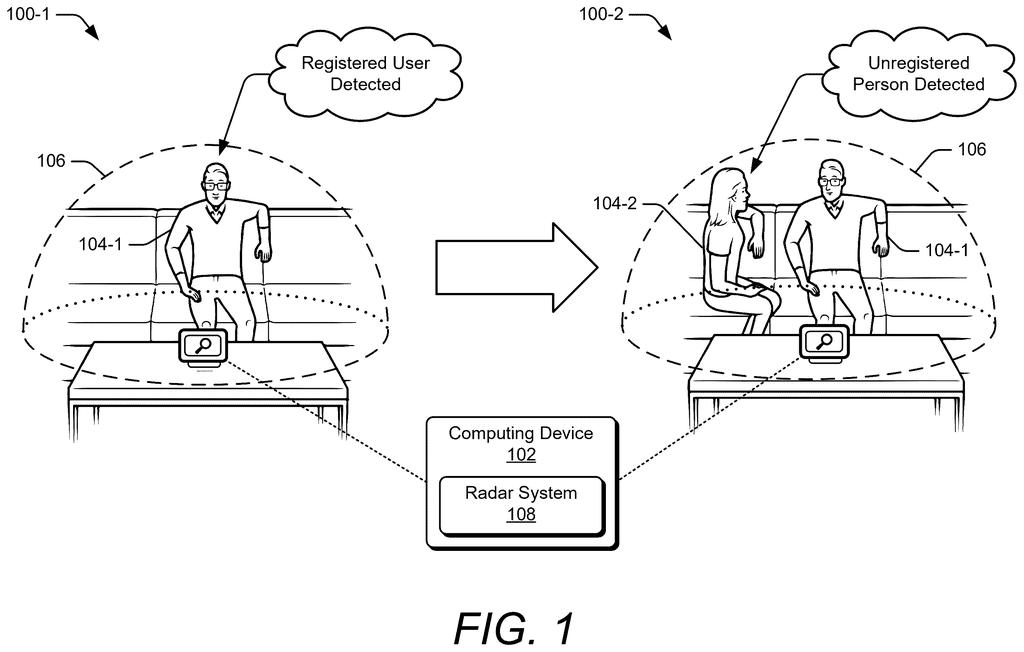
How Google's radar tells you from your guests
You're on the couch with a friend you've invited over, and your home speaker cheerfully starts reading out tomorrow's doctor appointment. That's the problem Google is chasing here: most gadgets can't tell who is in the room, so they can't tell when to keep quiet.
Google's patent describes a device with a built-in radar that bounces radio waves off the people nearby and reads the echoes. Your height and build, the way you walk, how you swipe your hand to skip a song, even the time you usually sit down can all become clues. It doesn't need a face scan, your name or a recording of what you say.
Meet a stranger and the device gives them a made-up ID tied to their echo pattern. On the next visit it recognizes that guest, picks up their gesture lessons where they left off, and can hold back your private reminders.
… determining, based on the radar characteristic of the object, that the object is an unregistered person, the unregistered person not a registered user associated with the computing device; assigning, to the unregistered person, an unregistered user identification; …
Translation: The system figures out that someone is not a registered user and gives them a temporary ID.
How the radar builds a profile of a stranger
The device sends out a radar signal (radio waves, the same basic idea as a weather or speed radar) and listens for the reflection. From the returning signal it pulls out a radar characteristic, a set of measurements about whatever bounced the signal back.
The filing groups the clues into four types:
- Shape and size: height, geometry and surface texture, taken from the radar cross-section (how much signal a body reflects).
- Movement over time: a motion signature such as gait, arm swing, weight distribution or breathing.
- Gesture style: how far and how fast you push and pull your hand.
- Context: habits like sitting on the couch around 5:30 pm.
If a new pattern matches nobody stored, the device decides it has met an unregistered person. It assigns an unregistered user identification (a pseudo identity) and saves it with the radar pattern, so later echoes can be compared against it. A machine-learned model can sharpen the matching over repeat visits. When certainty is low, the device can probe again or use a microphone to analyze pitch and tone without working out any words.
Other claims cover a per-person gesture training history, and ignoring a second person's gesture that tries to change something already running, such as an oven timer someone else started.
A user may be distinguished without determining personally identifiable information, and the computing device may record radar characteristics to distinguish each user at a later time and provide tailored experiences.
Translation: It tells people apart without knowing who they are, so it can give them customized experiences later.
What this means for homes full of guests and kids
If you share a home with kids, roommates or regular visitors, a speaker that knows who is in the room could mean fewer awkward moments. Your calendar reminders could go quiet when a guest sits down, and a child's swipe could be ignored while your oven timer is running. The filing says all of this can work without your name, face or conversations being captured.
For Google, the appeal is a privacy pitch for devices people already feel watched by. The description lists speakers, TVs, watches, thermostats, baby monitors and cars as places the radar could live. The open question is trust: even a nameless profile of a guest is still a stored record of a person, and the filing leans on user controls to settle that.
Google's 41st filing we've tracked since May in our AI assistants that remember you watchlist follows one letting you reopen past chats and one adjusting tone by recipient.
The shortest route to a shippable feature is mostly software. The filing describes the radar as a sensor that can sit inside a speaker, TV, watch, thermostat or router, so a device that already carries one would need new code, a place to store each person's pattern, and a model that matches fresh echoes against old ones.
The hard part is accuracy. The description admits that distance and furniture can leave the device unsure, and its fix is to probe again or listen with a microphone. A home assistant that mistakes a guest for you would announce the wrong thing at the wrong time, so the matching has to be very good before anyone trusts it.
Privacy will decide how this lands. Guests would get a stored profile they never asked for, even without a name. The filing leans on user controls to answer that, and a real product would need those controls to be easy to find.
Get our take in your Top Stories
Liked this breakdown? Add Patentlyze as a preferred source on Google, and our plain-English take shows up more often in your Top Stories the next time Google patent news breaks.
There are more where this came from
We read every patent application Big Tech publishes and send you the ones worth knowing. Plain English, free, every week.
The drawings
12 drawing sheets from US 2026/0328903 A1 · click any drawing to enlarge


Show the other 4 sheets


Want this weekly breakdown for a company we don't cover? Patentlyze Pro →
Be the first to weigh in