IBM
IBM · AI / ML · Filed Apr 10, 2026 · USPTO published Aug 27, 2026 · Aug 27 release
IBM Patents a System That Finds Which Documents Disagree and Why
Figuring out whether two sources agree on something sounds simple, but for computers reading thousands of documents at once, it is one of the harder problems in AI. IBM has filed a patent for a system that automatically groups sentences by the positions they take, then uses those groupings to judge where an entire document stands on a given claim.
- Publication number
- US 2026/0252800 A1(US20260252800A1)
- Applicant
- INTERNATIONAL BUSINESS MACHINES CORPORATION
- Filed · Published
- Apr 10, 2026 · Aug 27, 2026
- Inventors
- Futoshi Iwama, MD MARUF HOSSAIN, Mikio Takeuchi
- Status when we published
- Waiting for an examiner
- Document
- 23 claims
- US classification
- 704/9
- Parent application
- Division of 18/356,660 (filed Jul 21, 2023)(18356660)
What IBM's stance-detection system actually does
A fact-checker reads twenty news articles about the same event and has to figure out which ones support a claim, which ones push back, and which ones are just neutral. That kind of work takes time even for a trained reader, and it gets overwhelming fast when you scale up to hundreds of sources. IBM wants a machine to do it.
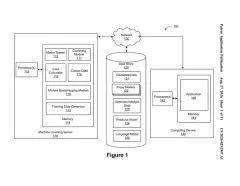
The system reads a large pile of documents, pulls out individual sentences, and sorts them into groups based on two things: how similar the sentences are to each other, and what stance each sentence takes. A stance here means whether a sentence supports, contradicts, or neither supports nor contradicts a given idea. The result is a tidy set of representative sentences, one for each major position that shows up across the documents.
That set of sentences then becomes a measuring stick. Feed any new document through the system and it can tell you, automatically, where that document falls in the debate. Think of it as a compass that points toward agreement or disagreement across a sea of text.
Sentences from the documents are clustered into a plurality of clusters. Sentences in a cluster of the clusters have stance scores with respect to other sentences in the cluster that satisfy a stance criteria. At least one similarity group of sentences is formed in the clusters having similarity scores satisfying a similarity criteria.
Translation: The system groups sentences together based on how similar they are and whether they take opposing viewpoints.
How IBM clusters sentences to map opposing views
The patent describes a multi-step pipeline for identifying and organizing stances (positions of agreement or disagreement) across a large collection of text documents.
Here is how the process flows:
- Clustering: The system groups sentences from across all the documents into clusters. Within each cluster, every sentence must have a stance score that meets a set threshold relative to the other sentences in that group. A stance score is a numerical measure of how strongly one sentence supports or opposes another.
- Similarity grouping: Inside each cluster, sentences that are close in meaning are grouped further into similarity groups. This is essentially a finer sort: cluster first by position taken, then by how closely the wording and meaning match.
- Selection: From each similarity group, the system picks the sentences whose stance scores are most representative of that group's overall position. These become the hypothesis set, a curated shortlist of sentences that cover the main viewpoints present in the full document collection.
- Evaluation: Finally, every document in the collection is scored against the hypothesis set to determine where that document lands on each viewpoint.
The practical effect is that instead of comparing every document to every other document (a computation that grows explosively with scale), the system reduces the problem to comparing each document against a small, carefully chosen set of representative sentences.
What this means for AI research and fact-checking tools
The problem this patent attacks is real and expensive. Any organization that needs to monitor large volumes of text for conflicting claims, whether a news organization tracking misinformation, a legal team reviewing depositions, or a pharma company auditing clinical trial literature, currently relies on either human reviewers or blunt keyword search. Neither scales well. A system that can automatically surface which positions exist and which documents hold them could cut significant time and cost out of that work.
IBM has long positioned itself in enterprise AI, and this filing fits squarely in that strategy: boring-sounding infrastructure that large organizations actually pay for. Whether it reaches product form or stays as a research contribution, it sits alongside other interesting tech patents in the document-AI space that are shaping how businesses handle information overload.
This is the 39th IBM filing we've tracked since May in our AI guardrails race, following ones on catching private data leaks and finding safety filter gaps.
Source: US 2026/0252800 A1 at the USPTO (PDF). Full patent text and figures are in the official publication.
Get our take in your Top Stories
Liked this breakdown? Add Patentlyze as a preferred source on Google, and our plain-English take shows up more often in your Top Stories the next time IBM patent news breaks.
Add Patentlyze on Google
One click.
There are more where this came from
We read the new patents from Big Tech, carmakers and more and send you the ones worth knowing. Plain English, free, every week.
The drawings · 6 sheets
6 drawing sheets from US 2026/0252800 A1 · click any drawing to enlarge


More from IBM
All 481 IBM patents →
More in AI / ML
All 2,745 AI / ML patents →
Adobe
Adobe Patents a System That Shows You Where an AI's Answer Came From

Nvidia
A New Nvidia Patent Tackles AI Prompt Complexity Before Models Process Them
IBM
IBM Patents a System for Scoring AI Bias Toward Protected Groups
Nvidia