
IBM
IBM · AI / ML · Filed May 13, 2025 · USPTO published Nov 19, 2026 · This week's release
IBM Files Patent for Using Reading-Level Scores to Clean Up AI Training Text
IBM's filing proposes grading the documents used to train an AI chatbot by reading level, the way a teacher might grade essays, then tossing the outliers. A small practice model decides how aggressive that cutoff should be.
- Publication number
- US 2026/0368530 A1(US20260368530A1)
- Applicant
- International Business Machines Corporation
- Filed · Published
- May 13, 2025 · Nov 19, 2026
- Inventors
- Hajar Emami Gohari, Xuan-Hong Dang, SYED YOUSAF SHAH, Bishwaranjan Bhattacharjee, Nirmit V Desai, David Cox, Petros ZERFOS
- Status when we published
- Waiting for an examiner
- Document
- 20 claims
- US classification
- 706/25
What IBM's reading-level filter does to AI data
Every time a company trains a chatbot, someone has to decide which of the billions of pages it collected are actually worth learning from. Some are rambling, some are garbled, and some are so stripped down they teach almost nothing.
IBM's patent application describes a filter that scores each document by reading level, the same kind of grade-level score a school might use on a textbook. It charts those scores for a batch of documents and trims the ones at the extremes, the text that is unusually hard or unusually plain for its subject area.
The clever part is how it picks the cutoff. IBM trains a small practice chatbot on the trimmed data, checks how well it does on a standard test, and then tightens or loosens the cutoff until the scores stop improving.
… establishing, a statistical distribution of the set of documents, according to a readability metric of each document in the set of documents based on a domain …
Translation: The system measures how hard or easy a group of documents is to read.
How the test model tunes the filter's cutoffs
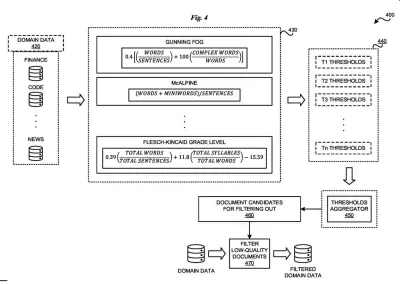
The filing covers a way to clean up the raw material used to train a large language model (the software behind chatbots). A sampling component pulls a representative batch of documents for one subject area, or domain, such as education, medicine or code. Each document gets a readability score from formulas like the Automated Readability Index or Gunning Fog, which estimate the school grade level needed to follow the text.
Those scores form a statistical distribution (a bell-curve-style chart of scores). Documents past a cutoff are captured and removed. Claim 1 describes cutting those scoring below a threshold, while the description also covers trimming both ends of the curve.
To set the cutoff, the system trains a small test model (the description gives a 1.4 billion parameter example) on the filtered data and measures it against a benchmark dataset such as FineWeb. Then it loops:
- If performance improves, the cutoffs tighten and more documents get cut.
- If it drops, the cutoffs loosen.
- When results stop changing, those cutoffs are saved as optimal.
When several formulas flag different documents, the filing aggregates them: if one flags A, B, C and D, another A, B, E and X, and a third A, B and C, only A and B get cut. The saved cutoffs then filter new data for training the production model.
… filtering, the subset of documents from the sample domain data such that a second subset comprising documents remaining in the sample domain data after the extracting comprises filtered data …
Translation: It throws out the documents that do not meet the reading level standards.
Why cleaner training text could cut AI costs
If you use a chatbot, the quality of its answers starts long before you type anything. It depends on what the model read while it was being built. A cheap, automatic way to throw out weak text before training could mean fewer odd or unreliable answers, and that is the pitch IBM makes in the filing.
IBM also argues that better-selected data can train the same model with less data, less energy and less retraining. That matters because training runs eat up a huge amount of computing power. The filing reports a single chart against a public dataset and gives no savings figure, so the size of any benefit is unknown.
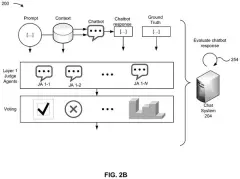
That makes this IBM's 55th filing we've tracked in AI assistant & agent coverage since May, a topic that already includes one hiding company data from AI and AI judges rating chatbots.
Source: US 2026/0368530 A1 at the USPTO (PDF). Full patent text and figures are in the official publication.
Get our take in your Top Stories
Liked this breakdown? Add Patentlyze as a preferred source on Google, and our plain-English take shows up more often in your Top Stories the next time IBM patent news breaks.
Add Patentlyze on Google
One click.
There are more where this came from
We read every patent application Big Tech publishes and send you the ones worth knowing. Plain English, free, every week.
The drawings · 8 sheets
8 drawing sheets from US 2026/0368530 A1 · click any drawing to enlarge


More from IBM
All 481 IBM patents →
More in AI assistant & agent
All 436 AI assistant & agent patents →
Microsoft
Microsoft Files Patent for Giving AI Coding Helpers Better Background Reading
Google
Google Files Patent for AI Models That Unpack Only the Data They Need
OpenAI
OpenAI Files Patent for Shared AI Project Folders With Built-In Instructions
AMD
No comments yet