
IBM Files Patent to Dock Points From Resume Scores That Lean on Gendered Words
IBM describes a way to dock a resume's match score when it and the job posting lean on the same gendered words, like 'he' and 'man.' It uses a simple word list and a bit of arithmetic, with no retraining of the AI.
What IBM's bias-dictionary patent actually does
Every time a hiring tool ranks a stack of resumes against a job posting, it boils each pair down to one number: how closely the two texts match. If the posting leans on words like 'he' and 'man,' and a resume does too, that number can end up rewarding the wording instead of the person.
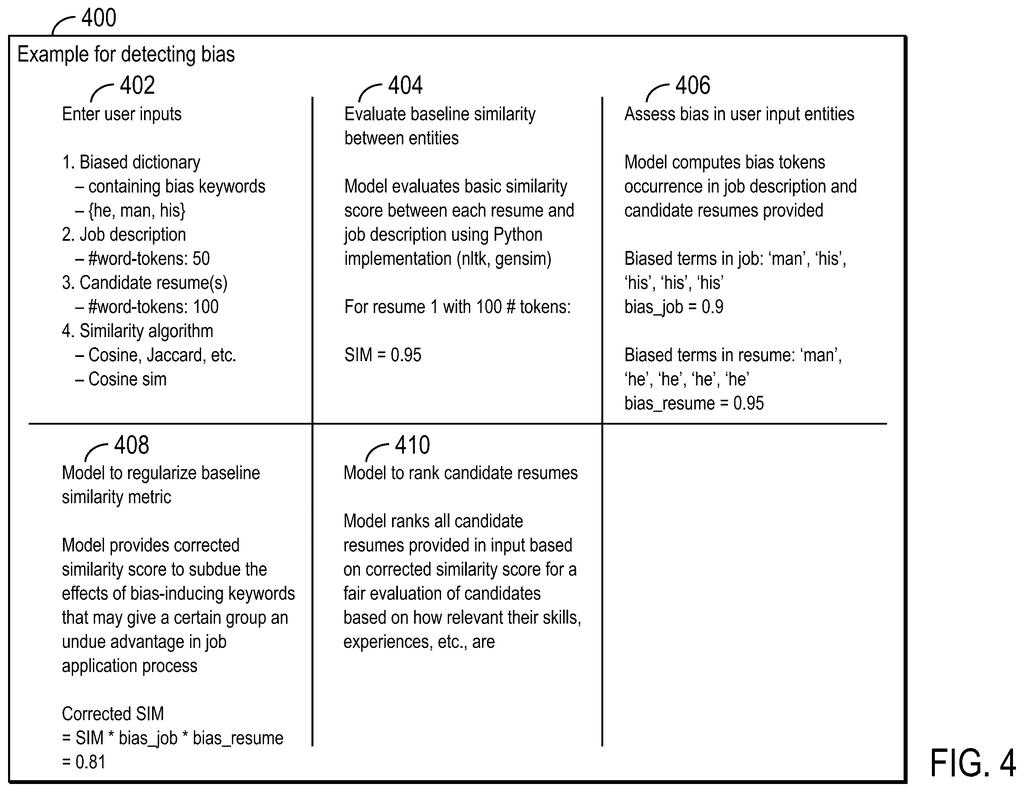
IBM's patent application describes a fix that sits on top of the matching step. Someone who knows the field builds a bias dictionary, a list of words to watch for, such as 'he,' 'man' and 'his.' The software counts those words in each text and marks the match score down. When both texts share the same loaded words, it marks the score down a bit more.
The pitch is that you skip the slow, costly job of retraining the AI itself. In the filing's example, a score of 0.95 drops to 0.81, and candidates are then ranked on the corrected number.
… receiving as input a dictionary including bias inducing keywords for monitoring in the language model to detect bias, wherein the dictionary further comprises bias tokens specific to a use case …
Translation: The system uses a custom word list to catch problematic terms.
How the resume score gets marked down
The claims cover a method (plus matching system and software-product versions) built around a word embedding model. That is software that turns each word into a list of numbers so words used in similar ways land close together. The model is trained on a domain collection of text, or built on top of an existing large language model.
A subject-matter expert supplies a dictionary of bias-inducing keywords, tailored to the use case. Documents are split into logical blocks of text, and two blocks (Text A and Text B) are compared. The software computes a cosine similarity score, a standard measure of how closely two sets of numbers point the same way, used here as a 'how alike are these texts' score.
Then the score gets penalized in steps:
- Bias ratio: for each text, 1 minus (bias words divided by total words).
- Multiplication: the original score is multiplied by both ratios.
- Overlap term: an extra deduction, scaled by a constant between 0 and 1, when both texts contain the same bias words.
The description also mentions collecting user feedback on the new score and flagging models whose scores shift because of bias. Its worked example is a gender-bias check for resumes and job descriptions.
Why hiring software teams may care
If software ranks job candidates, a match score that rewards gendered wording can tilt who gets a callback. IBM's filing offers a cheap check: a company defines its own list of risky words, and the software adjusts scores and flags models whose scores shift because of them. You would feel it as a candidate pool ranked a little more on skills and experience.
The filing also describes a second use: testing a business chatbot built on a model trained on public internet data, then warning the user when its answers favor one gender for certain roles. Because it skips retraining, which the filing says can take hours to days, it is pitched as an add-on feature for many applications.
This is the 71st IBM filing we've tracked since May in the AI guardrails race, following earlier applications like one checking AI against the law and tracing text to its author model.
If you have ever sent a resume into a hiring portal, you know you never see the score it gets. The benefit of this idea would reach you only if an employer's software used it, and even then you would notice it indirectly, in who gets shortlisted.
The failure it targets is easy to picture: a job post and a resume both full of 'he' and 'his' look like a great match, and the software rewards them for it. Docking that score is a simple, cheap fix, and the filing's example moves a number from 0.95 to 0.81, enough to reshuffle a ranking.
The catch is that the fix is only as good as the word list. Words a person forgets to add slip through, and a count of 'he' and 'man' cannot spot subtler slant. As a quick check a team can run without retraining anything, it is a practical idea with modest reach.
Get our take in your Top Stories
Liked this breakdown? Add Patentlyze as a preferred source on Google, and our plain-English take shows up more often in your Top Stories the next time IBM patent news breaks.
There are more where this came from
We read every patent application Big Tech publishes and send you the ones worth knowing. Plain English, free, every week.
The drawings
6 drawing sheets from US 2026/0340292 A1 · click any drawing to enlarge


Want this weekly breakdown for a company we don't cover? Patentlyze Pro →
Be the first to weigh in