
Qualcomm Patents an Indoor Location System That Filters Out Positions Through Walls
Your phone's location system sometimes thinks you walked through a wall. Qualcomm has filed a patent for a method that catches that mistake by checking whether your predicted path would have passed through a physical obstacle.
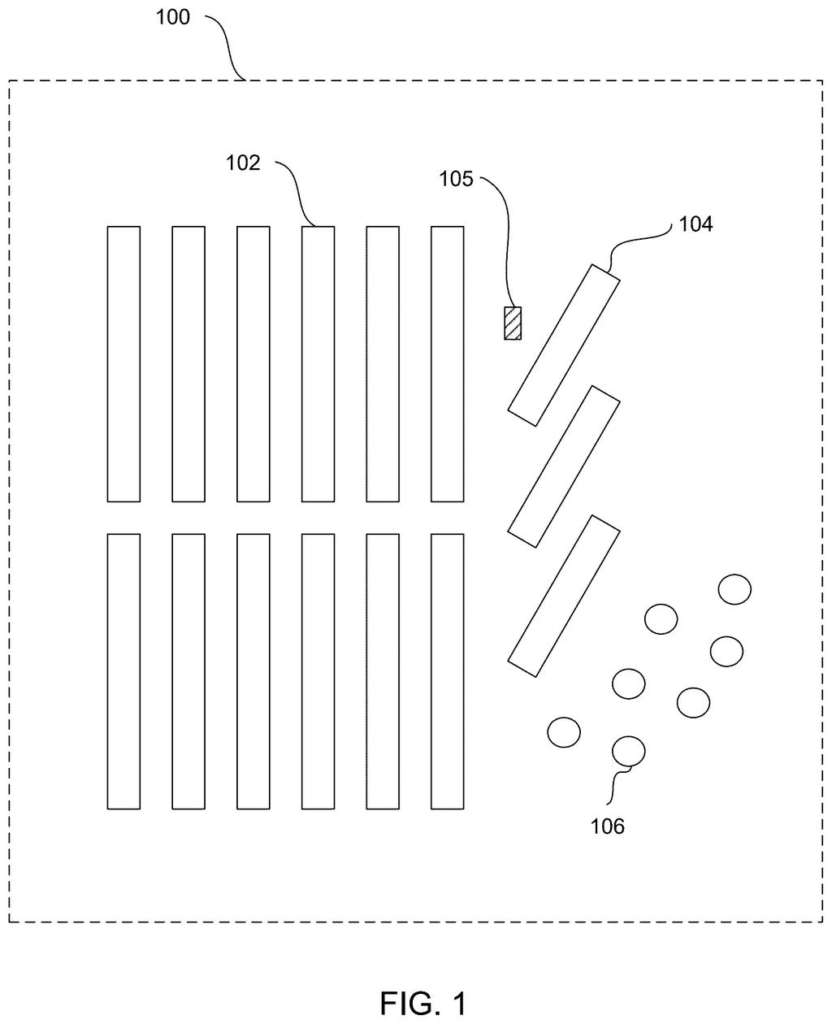
How Qualcomm's indoor location filter uses a wall map
Every time a mapping app tries to place you inside a building, your phone is essentially making educated guesses. It doesn't have GPS satellites to rely on, so it calculates a few candidate positions and picks the most likely one. The trouble is, those guesses can land on the wrong side of a wall or suggest you teleported through a pillar.
Qualcomm's patent describes a system that checks each position guess against a grid map of the building's obstacles. Before accepting a candidate location, the system draws a straight line from where you were last known to be to where it thinks you might be now. If that line passes through a wall or barrier marked on the map, the candidate gets thrown out.
What's left after the bad guesses are removed is a cleaner set of possible positions, and from those the system picks your actual location. The result is indoor positioning that respects the physical reality of the building you're in.
… determining one or more intermediate propagation positions between a previous position corresponding to the given predicted position and the given predicted position, wherein the one or more intermediate propagation positions represent a straight-line trajectory between the previous position corresponding to the given predicted position and the given predicted position; …
Translation: The system maps out the direct path a person would walk from their last known spot to a new guess.
How the exclusion mask removes impossible positions
The patent describes a positioning filter designed for indoor environments where GPS is unavailable or unreliable. The filter generates multiple predicted positions (candidate guesses about where a device might be) and then winnows them down.
The key tool is what Qualcomm calls a position estimation exclusion mask: a grid overlaid on a floor plan where each cell is tagged as either containing an obstacle (a wall, column, or other barrier) or being open space. Think of it as a digital version of a building blueprint divided into small squares, each labeled "blocked" or "clear."
For each candidate position, the system also calculates one or more intermediate propagation positions (IPPs), points along the straight-line path between the device's last known location and the new candidate. It then checks every cell that the straight-line path crosses:
- If any cell along the path is marked as containing an obstacle, the candidate position is discarded.
- If the path is clear, the candidate stays in contention.
After removing physically impossible candidates, the system uses the remaining ones to calculate a final position estimate. The approach is designed to slot into an existing positioning filter framework (a mathematical process, similar to what's used in navigation systems, that continuously refines location estimates as new data arrives) rather than replacing it entirely.
… determining cell(s) of a position estimation exclusion mask that correspond to the IPP(s) and the given predicted position, where each cell of the exclusion mask corresponds to an area in the environment, where each cell includes a first indication based on the area including obstacle(s) or a second indication based on the area not including an obstacle; …
Translation: It checks a digital map grid to see if those potential walking paths run right into walls or furniture.
What this means for indoor navigation on your phone
Indoor navigation is one of those problems that sounds simple until you try to do it reliably. Hospitals, airports, shopping malls, and warehouses all stand to benefit from accurate indoor positioning, and right now the experience on most phones is frustrating enough that apps often don't bother offering it. A system that can rule out physically impossible locations before they corrupt a position estimate is a meaningful step toward making indoor maps actually usable.
For you as a user, the practical difference would be a blue dot that stays in the corridor instead of jumping through the wall into the store next door. the pattern in Qualcomm's indoor positioning filings suggests the company is trying to own the foundational location layer that mobile devices depend on indoors, which puts this work squarely in the chipset business rather than the app business.
Qualcomm's 465th filing in our Qualcomm coverage since May adds to a run that includes work on linking distance to objects and battery-saving 3D call sync.
Anyone who has tried to navigate a large airport, hospital, or shopping mall with a phone knows the experience: the blue dot spins, jumps, or plants itself confidently in the wrong corridor. That failure has real costs, measured in missed gates, wrong wards, and wasted minutes multiplied across millions of people daily.
What this patent adds is a basic physical sanity check. If a person's calculated path runs straight through a concrete wall, that path is wrong, and the system should throw it out. Floor plans already exist for most large buildings, and testing a candidate route against a grid of obstacles is not a heavy computation.
The honest limitation is that this fix only works where digital floor plans are available and accurate. The approach is well-matched to the problem inside that boundary; how far that boundary extends is still a question the broader mapping industry, not this patent alone, will answer.
There are more where this came from
We read every patent application Big Tech publishes and send you the ones worth knowing. Plain English, free, every week.
The drawings
9 drawing sheets from US 2026/0304377 A1 · click any drawing to enlarge


Want this weekly breakdown for a company we don't cover? Patentlyze Pro →
Be the first to weigh in