
Qualcomm Patents a Way for Cell Towers to Use Signal Repeaters for Precise Indoor Location
GPS doesn't work well inside buildings, and cell towers alone can be imprecise. Qualcomm's new patent describes a way for networks to rope in signal-boosting repeaters as active helpers for pinpointing exactly where your phone is.
How Qualcomm's repeater location fix actually works
Every time an app on your phone asks "where are you?" inside a mall or airport, your device struggles. GPS signals don't penetrate walls well, so the phone falls back on cell tower signals, which are often too coarse to tell the difference between floor two and floor three.
Qualcomm's patent describes a smarter setup for that fallback. When a location server needs to find your phone, it can now check whether a nearby network-controlled repeater (a small device that amplifies cell signals indoors) is available and ready to help. If it is, the server learns what that repeater can do and then sends it instructions to broadcast specific reference signals, which are like precise timing pings your phone can use to calculate its position.
The result is that a building's existing signal-boosting hardware could double as a location aid, without your phone needing a new chip or extra hardware of its own.
receive, via the at least one network interface, an indication that a network-controlled repeater (NCR) is available for a positioning session of a user equipment (UE); receive, via the at least one network interface, capability information related to the NCR …
Translation: The system checks if a signal repeater is nearby and what its specific technical features are before using it.
How the network configures repeaters for positioning signals
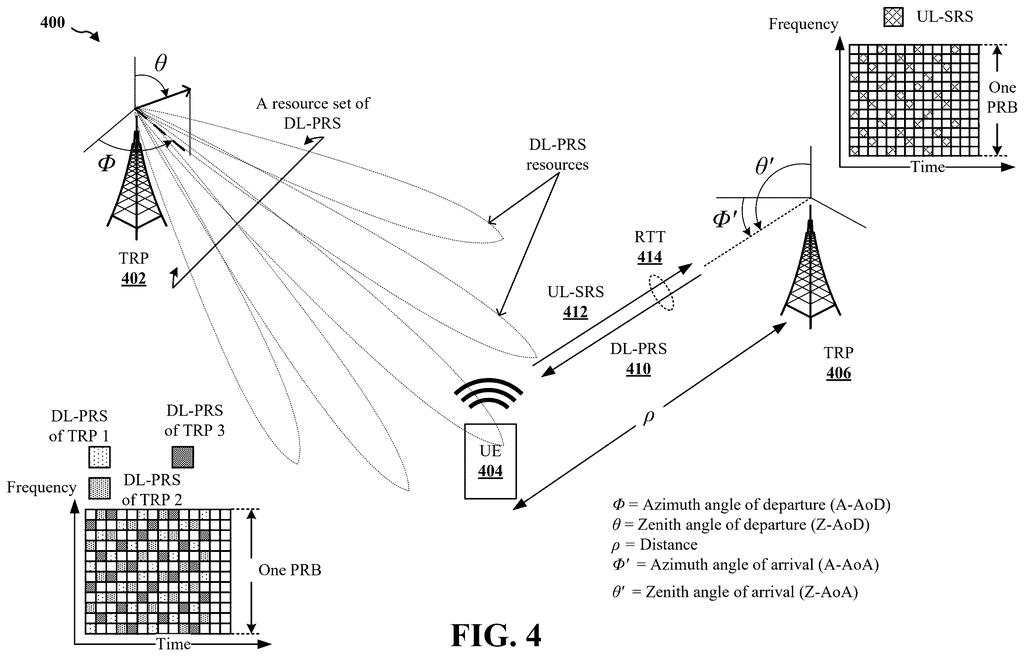
Standard cellular positioning works by having your phone measure signals from multiple base stations and triangulate a position. The problem indoors is that those base stations are far away and their signals arrive weakened or bounced off walls, making the measurements noisy.
Network-controlled repeaters (NCRs) are relay boxes already deployed inside large venues to extend coverage. This patent teaches the location server (called a Location Management Function, or LMF) to treat those repeaters as positioning instruments, not just signal amplifiers.
The process, as described in the claim, works in three steps:
- The LMF receives an availability indication: a nearby NCR announces it can participate in a positioning session for a specific phone.
- The LMF receives capability information from the NCR: what reference signal formats it supports, its timing accuracy, and similar technical specs.
- Based on that capability data, the LMF transmits a tailored configuration back to the NCR, telling it exactly which reference signals to send and how, so the phone can use those signals to compute a precise location.
The key word in the patent is "configuration based on availability and capability." The network doesn't just assume all repeaters behave the same; it asks each one what it can do and adjusts accordingly.
Aspects presented herein may enable a network entity (e.g., a location server, a location management function (LMF), etc.) to provide configurations related to network-controlled repeater (NCR), thereby improving the overall performance and accuracy of network-based positioning that utilizes one or more NCRs.
Translation: This technology helps a central server manage signal repeaters to track the precise location of your phone more accurately.
What this means for indoor location without GPS
For consumers, better indoor location means more accurate navigation inside airports, hospitals, and shopping centers, and faster emergency response when a 911 call comes from inside a large building. Today, carriers and venue operators already install repeaters to fix dead zones; this patent suggests those boxes could serve a second purpose without a hardware swap.
For Qualcomm specifically, positioning technology is a steady business tied to its modem chips, and 5G networks are bringing a new generation of NCR hardware into buildings worldwide. The company's positioning-related work sits alongside a wide range of interesting tech patents that show how wireless infrastructure is being repurposed beyond simple connectivity.
That makes this Qualcomm's 334th filing in our Qualcomm coverage since May, adding to work like keeping network models current and routers flagging antenna faults.
The core change described here lives on network servers, not inside your phone. A carrier could flip this on without asking customers to buy anything new. The signal-boosting boxes this relies on already exist in 5G buildings and stadiums.
They would need a software update to follow location commands, which carriers can push remotely, the same way your router gets patches overnight. The remaining gate is a standards vote.
Qualcomm writes a lot of the rules that cellular equipment makers follow worldwide, and a patent like this typically travels alongside a proposal to those rule-making bodies. If the approach gets adopted there, every compliant booster vendor builds it in, and indoor location accuracy improves across the industry whether or not anyone notices Qualcomm's name on it.
Get our take in your Top Stories
Liked this breakdown? Add Patentlyze as a preferred source on Google, and our plain-English take shows up more often in your Top Stories the next time Qualcomm patent news breaks.
There are more where this came from
We read every patent application Big Tech publishes and send you the ones worth knowing. Plain English, free, every week.
The drawings
14 drawing sheets from US 2026/0255304 A1 · click any drawing to enlarge


Show the other 6 sheets


Want this weekly breakdown for a company we don't cover? Patentlyze Pro →
Be the first to weigh in