Intel
Intel · AI / ML · Filed Feb 25, 2026 · USPTO published Jul 2, 2026 · Jul 2 release
Intel Patents an AI System That Decides How to Move Tasks Between Servers
Every time a data center shifts a running task from one server to another, something can go wrong. Intel's latest patent describes an AI that watches those moves, scores them, and learns to make better decisions the next time.
- Publication number
- US 2026/0186822 A1(US20260186822A1)
- Applicant
- Intel Corporation
- Filed · Published
- Feb 25, 2026 · Jul 2, 2026
- Inventors
- Aravindan MUTHUKUMAR, Satwik KARRA, Jaishankar RAJENDRAN, Preethi KIRUBA, Prakhar VISHWAKARMA
- Status when we published
- On hold at the patent office
- Document
- 20 claims
- US classification
- 718/1
What Intel's workload migration AI actually does
Imagine a busy airport routing passengers between gates. If a gate closes, staff have to move passengers to another gate quickly without missing flights. Data centers face the same challenge constantly: they move running software tasks from one server to another to balance loads, save power, or handle failures. But deciding when and where to move something, and whether the move actually helped, is genuinely hard.
Intel's patent describes a system that keeps a kind of living map of all the servers and tasks in a data center. Every time a task moves, the system records where it came from, where it landed, and how well the move went. A type of AI called a Graph Neural Network then reads that map and recommends what to do next.
The key idea is that the AI doesn't just look at one move in isolation. It sees the whole picture: every server, every task, and every connection between them. Over time, it can learn which kinds of moves tend to work well and which tend to cause slowdowns.
How the Graph Neural Network maps and scores each move
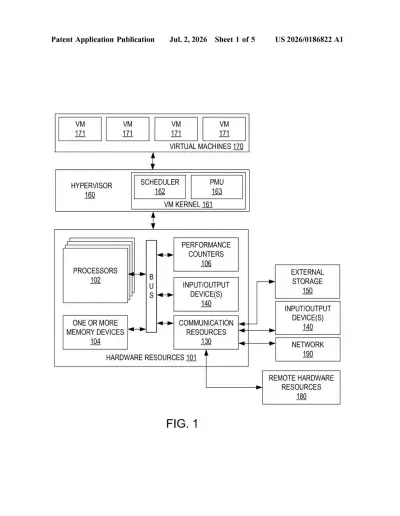
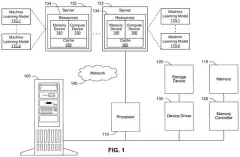
The patent describes an apparatus with a processor and memory that maintains a graph data structure (think of it as a dynamic map made of dots and lines) representing every computing resource and active task in a system.
When a workload (a running software process or application) moves from one server to another, the system:
- Creates a new node (a dot on the map) capturing the task's state before the move, at the original server.
- Links that node to an existing node representing the task's state after the move, at the new server.
- Labels the connecting line (edge) with a performance metric, such as how long the migration took or how the task's speed changed.
Once the graph is updated, a Graph Neural Network (GNN) processes it. A GNN is a type of AI designed specifically to reason about connected structures, like social networks or road maps. Here, it reads the whole map of servers, tasks, and past migrations to recommend an action: perhaps completing the move, rolling it back, or triggering a follow-up adjustment.
This is meaningfully different from rule-based schedulers, which apply fixed logic without learning from outcomes. The GNN can, in principle, improve its recommendations as more migration data accumulates.
What this means for data center efficiency
Data centers, whether running cloud services, enterprise software, or AI training jobs, spend enormous effort keeping tasks running efficiently across thousands of servers. Poor migration decisions waste power, slow applications, and can cause brief outages that users actually notice.
Intel positions itself as a supplier of both the chips and the platform software that runs these environments. A patent like this fits that strategy: the company wants its silicon paired with AI-driven management software that competitors can't easily replicate. If this approach ships in a real product, cloud operators and large enterprises would be the first to benefit, though end users would feel the effects indirectly through faster, more stable services.
Source: US 2026/0186822 A1 at the USPTO (PDF). Full patent text and figures are in the official publication.
Get our take in your Top Stories
Liked this breakdown? Add Patentlyze as a preferred source on Google, and our plain-English take shows up more often in your Top Stories the next time Intel patent news breaks.
Add Patentlyze on Google
One click.
There are more where this came from
We read the new patents from Big Tech, carmakers and more and send you the ones worth knowing. Plain English, free, every week.
More from Intel
All 199 Intel patents →
More in AI training & infrastructure
All 324 AI training & infrastructure patents →
Nvidia
Nvidia Patents a Processor That Tunes Its Own AI Settings on the Fly
Nvidia
Nvidia Patents a Random-Bit Trick to Keep AI Training Math Accurate
Samsung
Samsung Patents a Cache System That Keeps AI Training From Sitting Idle
Qualcomm