
Finger Muscle Signals Could Soon Control Your 3D Workspace, Meta Patent Shows
Meta is working on a way to control augmented-reality headsets without moving your hands at all, just squeeze your fingers slightly, and the headset responds. The input is invisible to anyone watching.
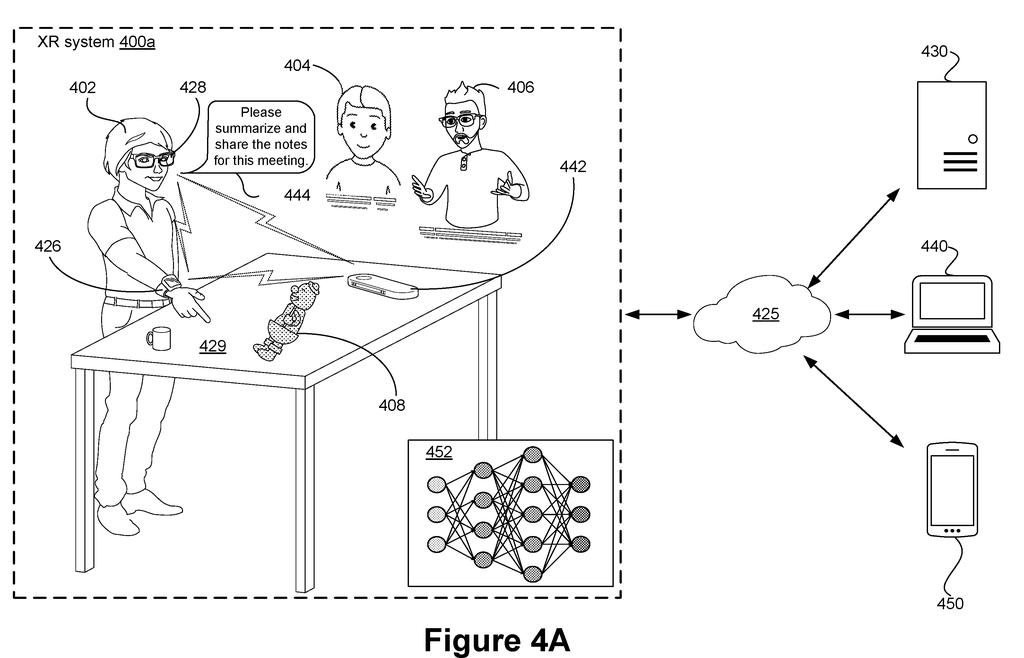
What Meta's muscle-reading wristband actually does
Ever tried to swipe through menus on a headset while holding something in both hands? The current answer is awkward: you have to put things down, wave a hand, or use a physical controller.
Meta's patent describes a wristband that picks up the faint electrical signals your muscles produce when your fingers tense up, even if your fingers don't actually move. That kind of muscle activity is called an isometric contraction. Press your index finger against your thumb without bending either one, and your muscles still fire. The wristband catches that signal and translates it into a command for your AR headset.
The result: you could scroll, select, or confirm things in a virtual menu just by tensing a finger, hands at your sides, in a meeting, or while cooking. Nobody around you would see you do anything at all.
a neuromuscular sensor configured to detect a neuromuscular signal indicative of muscular contraction within a hand; and a processor configured to: receive the neuromuscular signal from the neuromuscular sensor; determine based on the neuromuscular signal that one or more fingers of the hand are performing one or more isometric contractions …
Translation: The device uses sensors to detect electrical signals from your hand muscles to identify when you are tensing your fingers.
How the wristband detects tension without movement
The patent describes a wearable device (think a wristband or armband) fitted with a neuromuscular sensor. This sensor measures electromyography (EMG) signals, the tiny electrical pulses your muscles generate when they contract. Crucially, the system is tuned to detect isometric contractions, which means muscle tension without joint movement. Your finger can be pressing against air or against another finger with almost no visible result, and the sensor still sees it.
A processor inside the wearable receives that raw signal stream and does two things:
- Identifies which fingers are contracting and how strongly.
- Matches that pattern to a predefined input command for the connected XR (extended-reality) device.
Once a match is confirmed, the wearable sends an indication of the command to the XR headset over a wireless link. The headset then carries out the associated operation, whether that is selecting an object, scrolling a list, or triggering a shortcut.
The system is designed to work with XR hardware broadly. The patent does not lock it to a specific headset, which means the wristband could pair with a range of AR glasses or VR headsets as those products evolve.
The processor is also configured to determine that the one or more isometric contractions are associated with a particular input at an XR device configured to perform a particular operation in response to the particular input.
Translation: The system maps specific finger muscle movements to digital commands that trigger actions inside your virtual reality headset.
What this means for hands-free AR control
The real friction in everyday AR use is not screen quality or field of view. It is that interacting with a floating interface in public feels socially strange and physically demanding. Raising your arm to pinch a virtual button for the twentieth time in a meeting is exhausting. A wristband that reads invisible muscle tension sidesteps that problem entirely: your hands stay at rest, and only you know you are giving a command.
This lines up with where Meta's hardware roadmap appears to be heading, with the Ray-Ban smart glasses already out in the market and more capable AR eyewear reportedly in development. Isometric input would make those devices usable in contexts where hand gestures are impractical, and it connects to a broader set of AR-control filings that Patentlyze tracks in its plain-English patent summaries of Big Tech's XR bets.
The problem this patent attacks is real and under-appreciated. Hand-gesture control of AR headsets has a high social cost: people simply do not want to wave their arms around in public, and fatigue sets in quickly during longer sessions. Isometric input addresses both issues at once by keeping the control signal entirely internal to the user's body. Whether the approach scales cleanly, whether a consumer-grade EMG sensor can distinguish a deliberate thumb-press from ordinary hand tension during a walk, is the hard question the patent leaves open. If Meta can solve the false-positive problem, this approach has a genuine shot at making AR interaction feel normal.
There are more where this came from
We read every patent application Big Tech publishes and send you the ones worth knowing. Plain English, free, every week.
The drawings
9 drawing sheets from US 2026/0236099 A1 · click any drawing to enlarge


Want this weekly breakdown for a company we don't cover? Patentlyze Pro →
Be the first to weigh in