
Meta's New Patent Hides Headset Hardware Where Your Eyes Can't See It
Your eyes have a natural blind spot at the edge of your vision — and Meta wants to stuff the hardware of a mixed-reality headset right into it, making the device look far thinner and more like ordinary glasses than anything on the market today.
How Meta tucks hardware where your eyes can't see it
Imagine you're wearing a pair of mixed-reality glasses. The lenses project digital images in front of you, but the chunky electronics — processors, batteries, sensors — are usually visible as thick frames or side pods sitting right there in your field of view.
Meta's patent takes a different approach. Because of the angle at which the lenses project their image, there's a region around the edge of your vision that you literally cannot see while wearing them. It's a geometric side effect of how the optics work — think of it as a built-in blind zone.
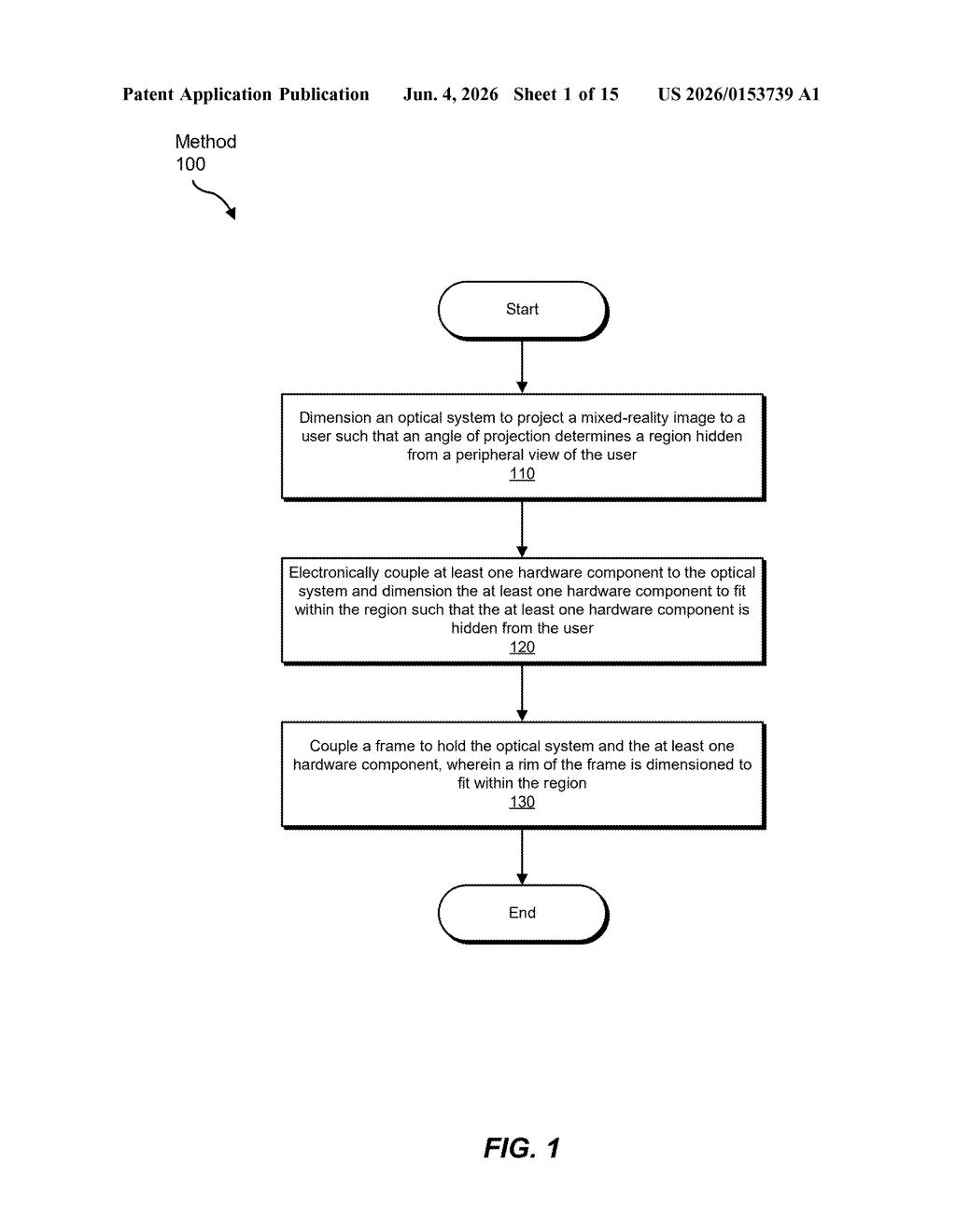
The idea here is to deliberately size and position all the hardware components — plus the frame rim itself — to fit inside that invisible zone. The result is a headset where you'd never notice the bulk because it's always just outside where your eyes naturally look. It's a clever optical trick that could make future Meta mixed-reality glasses look a lot more like normal eyewear.
How the optics define the hidden region Meta exploits
The core idea is using the geometry of the optical projection system to define a hidden region — a zone in your peripheral field that the display's projection angle naturally excludes from your view while the headset is in use.
Meta's patent claims a display system with three coordinated elements:
- An optical system that projects the mixed-reality image at a specific angle, which as a side effect creates the hidden peripheral region
- Hardware components (think compute, sensors, or power elements) physically sized to fit within that hidden zone, so the wearer never sees them
- A frame and rim also dimensioned to stay within that region — meaning even the glasses' physical border is tucked out of sight
The key insight is that the hidden region isn't accidental — it's determined by the projection angle. So if you design the optics first, you can mathematically define exactly how large that blind zone is, and then engineer everything else to fit inside it. It's more of a systems-design constraint than a single invention: the optics set the rules, and the hardware has to comply.
What this means for the future of slim MR glasses
Bulk is the single biggest reason mixed-reality headsets don't look like glasses. Every battery, chip, and sensor that has to go somewhere visible forces designers toward ski-goggle form factors or thick temples. If Meta can consistently hide that hardware in a projection-defined blind zone, it's a real path toward socially wearable MR glasses — devices people might actually put on in public.
This also signals that Meta is thinking about optical geometry as a design constraint to engineer around, not just a display property. That's a meaningful shift in how you approach headset miniaturization, and it fits squarely with the company's reported push toward thin-and-light smart glasses that go beyond what Ray-Ban Meta currently offers.
This is a legitimately clever framing of an old problem. Hiding hardware in the optical blind spot isn't magic, but treating the projection angle as a design input that defines where you're *allowed* to put things is the kind of systems thinking that actually produces thinner headsets. It's worth watching — this is the kind of patent that quietly underpins a product announcement, not just a defensive filing.
There are more where this came from
We read every patent application Big Tech publishes and send you the ones worth knowing. Plain English, free, every week.
Want this weekly breakdown for a company we don't cover? Patentlyze Pro →