
Meta Patents AR Glasses That Read Your Eye Position Without Extra Hardware
Meta is working on a way to track exactly where your eyes are looking inside a pair of AR glasses — not with bulky infrared sensors, but with polarized-light cameras hidden in the frame itself.
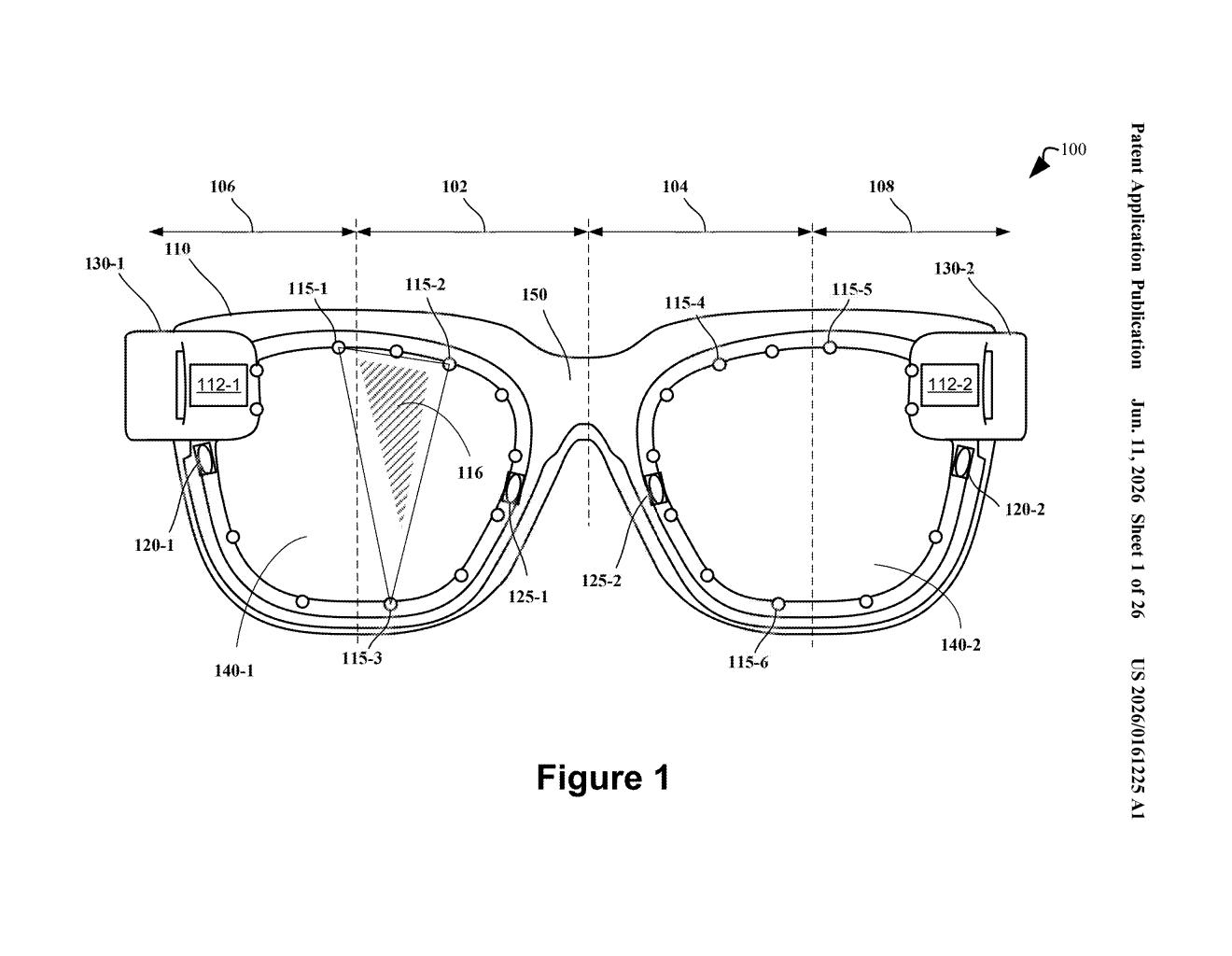
What Meta's polarized eye-tracking actually does
Imagine putting on a pair of glasses that know exactly where you're looking at any given moment — without any obvious cameras staring back at you. That's the goal behind this Meta patent, which describes a system for following your gaze built directly into the rims of a head-mounted display.
The trick is using polarized light — the same filtering principle used in sunglasses to cut glare. Your eyes interact with polarized light in a distinctive way, and cameras sensitive to that effect can pinpoint your gaze more precisely than standard cameras. Meta's design hides two of these cameras in the frame: one near your nose, one near your temple, giving the system two angles on each eye.
Why does this matter to you? Eye-tracking is what lets AR glasses know which virtual object you want to select, where to sharpen the image, or how to adjust what's displayed as your attention shifts. Getting that tracking accurate — and doing it in a slim, wearable frame — is one of the hardest unsolved problems in AR hardware.
How polarization cameras map your gaze from two angles
The patent describes a head-mounted display (think AR glasses, not a bulky VR headset) with a purpose-built eye-tracking system baked into the frame rather than bolted on as an afterthought.
At the core of the system are two polarization-sensitive cameras per eye. One sits in the nasal region of the frame — the part near your nose — and the other in the temporal region, near your temple. Placing cameras on opposite sides of the lens gives the system two distinct sight-lines to triangulate exactly where your pupil is pointing, much like how having two eyes gives humans depth perception.
The cameras are polarization-sensitive, meaning they're specifically tuned to detect how light waves are oriented. The cornea and sclera (white) of your eye reflect and transmit polarized light differently than the surrounding frame material, making it much easier to isolate the eye in the image and find the gaze direction accurately — even in varied lighting conditions.
All of this is communicatively coupled (wired or wirelessly linked) to the display engines on the glasses, so gaze data can feed directly into what gets rendered on the lenses in real time.
What this means for the next generation of Meta AR headsets
Eye-tracking is foundational to making AR glasses actually useful rather than just impressive in demos. It enables foveated rendering — only drawing sharp detail where you're looking, which dramatically reduces the computing power needed — and it's the primary input method when your hands aren't free. Without accurate, low-profile tracking, AR headsets either drain batteries fast or require you to point and click like it's 2005.
Meta has been vocal about wanting lightweight, all-day-wearable AR glasses (think Ray-Ban form factor, not Quest headset). Fitting eye-tracking into a slim frame without sacrificing accuracy is a core engineering challenge. This patent suggests Meta is betting that polarization-based sensing is the path that works at that scale — which, if it pans out, could be a meaningful differentiator against Apple's Vision Pro and other headsets that rely on infrared illumination arrays.
This is a real, substantive hardware patent — not a vague software process claim. The specific placement of polarization cameras in the nasal and temporal frame regions shows Meta has thought carefully about the physical constraints of slim AR glasses. It won't make headlines the way a new headset announcement would, but it's exactly the kind of foundational IP that determines whether next-generation AR glasses feel like glasses or feel like a gadget strapped to your face.
There are more where this came from
We read every patent application Big Tech publishes and send you the ones worth knowing. Plain English, free, every week.
Want this weekly breakdown for a company we don't cover? Patentlyze Pro →