
Microsoft Patents a Way to Let AI Summarize Just the Slice of a Document You Need
Every AI assistant has a reading limit — feed it a long enough document and it simply stops. Microsoft's new patent describes a way to let you pick a specific time window from a document so the AI only reads the part that fits, and only the part you need.
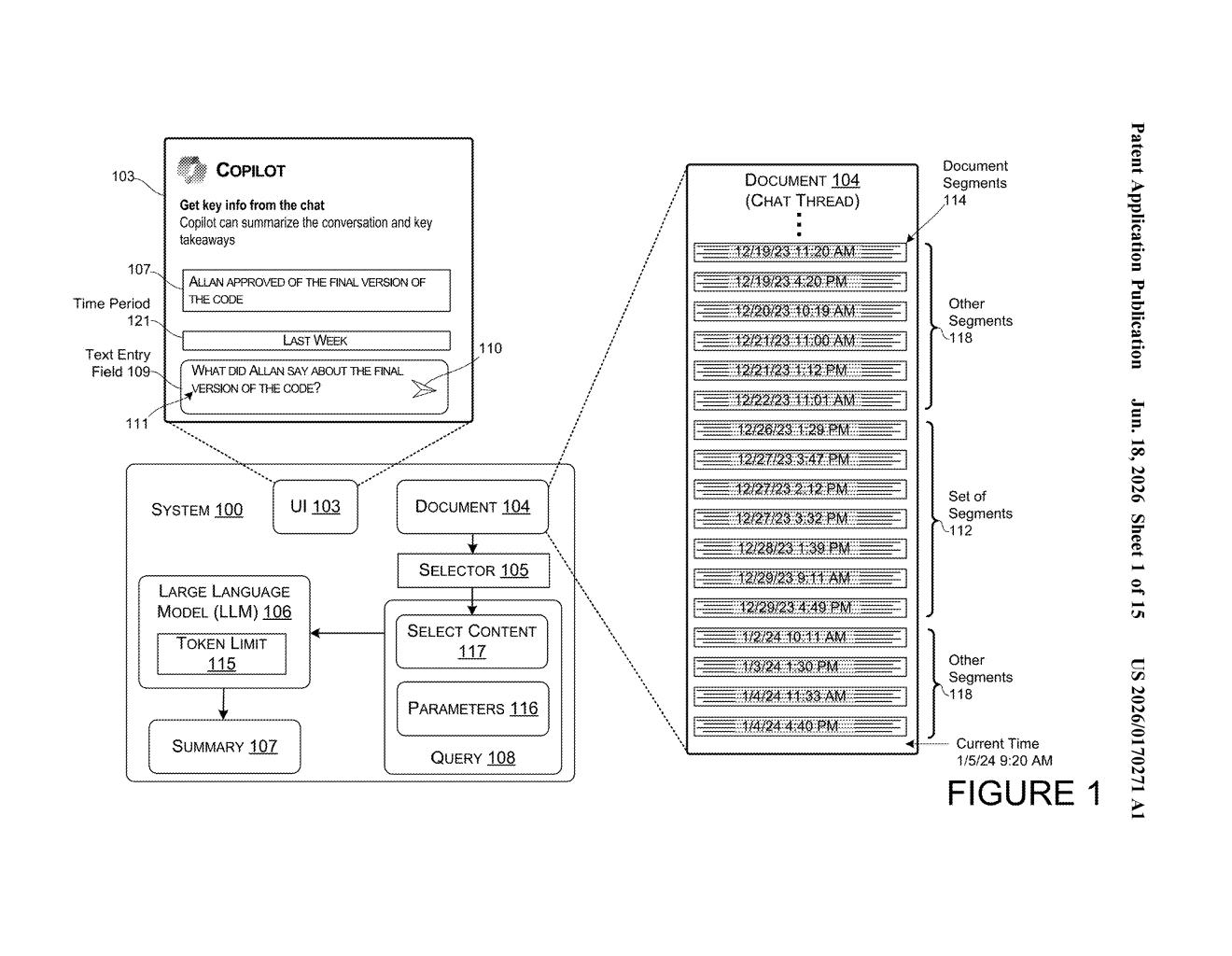
How Microsoft's time-sliced AI summaries work
Imagine you have a meeting transcript from a three-hour all-hands call and you only want a summary of the last 30 minutes. You paste the whole thing into an AI tool, but the AI can only handle so many words at once — so it either chokes, cuts off early, or gives you a half-baked result.
Microsoft's patent tackles that head-on. Instead of dumping the whole document at the AI, the system breaks the document into chunks organized by time — think sections of a meeting recording, a log file, or a long report. It then shows you which time windows are small enough for the AI to handle, and lets you pick one. The AI only gets that chunk, paired with specific instructions, and summarizes it cleanly.
The result: you get a focused, accurate summary of the slice you care about — not a garbled attempt at the whole thing. It's a practical fix for a frustrating everyday limitation of AI summarization tools.
How the system picks segments without busting the token limit
Large language models (LLMs) — the AI engines behind tools like Copilot or ChatGPT — have a token limit, meaning they can only process a certain amount of text in one go. A "token" is roughly three-quarters of a word, so a 100,000-token limit sounds big until you're dealing with a six-hour meeting transcript or a year's worth of system logs.
This patent describes a method that breaks a long document into segments tied to specific time periods — for example, 9:00–9:30 AM, or Q1 vs. Q2. The system then measures how many tokens each segment contains and figures out which time windows fall within the AI's limit.
The key steps look like this:
- The document arrives and gets divided into time-stamped segments.
- The system calculates which combinations of segments fit under the token ceiling.
- The user sees a visual display of those valid time windows and picks one.
- The system packages only that segment's text into a query — along with user-defined instructions — and sends it to the LLM.
- The AI returns a summary scoped exactly to that window.
Critically, the patent also notes that segment selection can weigh user activity signals — for instance, prioritizing the parts of a document a user spent the most time on — so the system can surface what's most relevant before you even ask.
What this means for AI tools handling long files
AI summarization already exists in Microsoft 365 Copilot, but long documents remain a genuine weak point. When a file exceeds an AI's context window, the system either silently truncates it or produces unreliable output. This patent describes an explicit, user-controlled mechanism to handle that gracefully — letting you define scope rather than letting the AI guess.
The time-period framing is the interesting design choice here. It suggests the primary target isn't generic documents but time-structured content: meeting recordings, call logs, audit trails, telemetry files. If this lands in Copilot or Teams, it could meaningfully change how workers interact with lengthy meeting records — turning "summarize this whole call" into "summarize the part where we talked about budget."
This is a real, practical solution to one of the most annoying daily frustrations with AI tools — not a moonshot. The token-limit problem affects anyone who's tried to summarize a long document and gotten a confused or truncated result. Microsoft is filing this at exactly the right moment, as Copilot pushes deeper into workplace documents where meeting transcripts and logs routinely blow past context windows.
There are more where this came from
We read every patent application Big Tech publishes and send you the ones worth knowing. Plain English, free, every week.
Want this weekly breakdown for a company we don't cover? Patentlyze Pro →