
Netflix
Netflix · AI / ML · Filed Jan 28, 2026 · USPTO published Nov 19, 2026 · This week's release
Netflix Files Patent to Explain Its Picks Using Shows You Already Watched
Netflix has filed a patent application for recommendations that explain themselves by pointing to shows you already watched and liked, with an AI doing the writing and a filter checking the result.
- Publication number
- US 2026/0370919 A1(US20260370919A1)
- Applicant
- Netflix, Inc.
- Filed · Published
- Jan 28, 2026 · Nov 19, 2026
- Inventors
- Nan Wang, Linas Baltrunas, Hakan Ceylan, Erik Michael Schmidt
- Status when we published
- Waiting for an examiner
- Document
- 20 claims
- US classification
- 725/46
- Examiner
- SALCE, JASON P (Art Unit 2421)
- Parent application
- Continuation of 18/904,663 (filed Oct 2, 2024)(18904663)
What Netflix's recommendation explainer actually does
Imagine Netflix suggests a new series and, instead of a plain plot blurb, tells you it has the same fantasy world and heartbreak as a show you finished last month. That is the idea behind this patent application: explaining why a title was picked for you, in terms of things you already know.
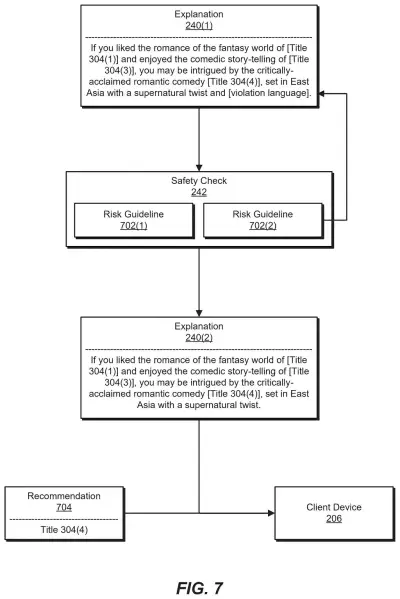
Here is how the filing says it would work. The system finds a few shows in your history that resemble the new pick, and it skips anything you gave a thumbs down or barely watched. It pulls descriptive tags and synopses for those shows, then hands the key words to an AI writing tool that drafts a short explanation.
Before anything reaches your screen, a safety check reviews the text. It trims or throws out wording that breaks the rules, such as harmful or nonsensical language. Only then do you see the pick and its explanation together.
… selecting, by the computing device, a set of previous titles from the profile history that exceeds a threshold similarity score for the recommended title; …
Translation: The system finds past watches that are similar enough to the new recommendation.
How Netflix picks the shows it compares you to
When the recommender system picks a title for you, it sends a request containing that title and your profile history (what you watched, for how long, your ratings, and account details). The system scores each past title for similarity to the new one using embeddings (numerical fingerprints built from co-viewing patterns and descriptive tags). Your own behavior adjusts the scores: a thumbs down pushes a title out, a high rating or long watch time pushes it up, and a prediction model fills in when you never rated something.
Titles that clear a threshold are kept. For each one, the system fetches categories such as genre and tone, plus synopses, and maps each keyword to a matching phrase in the synopsis. The filing's example ties the genre 'fantasy' to a line about a demon. These mappings can be cached (saved for fast reuse).
Next comes a prompt for a generative AI model (a text-writing AI). It can include:
- Background on the task
- An instruction to explain the pick using your earlier titles
- Settings such as length and style
- The keyword mappings
- A sample explanation
A safety check then tests the text against risk guidelines (harmful, nonsensical or biased wording) and cuts the offending parts or drops the explanation entirely. To save time and cost, the filing also describes pre-writing explanations for combinations of titles and storing them.
… automatically prompting, based on the set of keywords, a generative artificial intelligence (AI) model to generate the explanation of the recommendation using the set of previous titles.
Translation: An AI writes the text explaining why you might like the new show based on your history.
What this means for choosing your next show
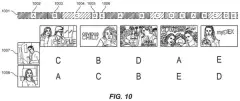
If you have ever stared at a row of thumbnails wondering why Netflix picked something, this is aimed at you. The filing says explanations tied to shows you know can build trust in a suggestion and help you decide faster, with less browsing.
For Netflix, the appeal is scale. Writing a personal blurb by hand for every viewer and every title would cost too much, and new shows arrive all the time. Pre-writing explanations and screening them with automated checks keeps cost and delay down. The safety step matters because AI text can go wrong, and a bad line sitting next to a recommendation would be right in front of you.
Netflix's second patent application in our Netflix coverage since November follows self-updating trailers as the second filing we've tracked.
Source: US 2026/0370919 A1 at the USPTO (PDF). Full patent text and figures are in the official publication.
Get our take in your Top Stories
Liked this breakdown? Add Patentlyze as a preferred source on Google, and our plain-English take shows up more often in your Top Stories the next time Netflix patent news breaks.
Add Patentlyze on Google
One click.
There are more where this came from
We read the new patents from Big Tech, carmakers and more and send you the ones worth knowing. Plain English, free, every week.
The drawings · 10 sheets
10 drawing sheets from US 2026/0370919 A1 · click any drawing to enlarge


Show the other 2 sheets


More from Netflix
All 2 Netflix patents →More in AI / ML
All 2,745 AI / ML patents →
Microsoft
Microsoft Patents an Email Summary That Learns Which Topics You Ignore
Samsung
Samsung Files Patent for Rewriting Your Vague AI Questions With Your Own Phone Data
Samsung
Samsung Files Patent for AI Text Replies That Know Who You're Talking To
Microsoft
No comments yet