
Microsoft
Microsoft · AI / ML · Filed May 13, 2025 · USPTO published Nov 19, 2026 · This week's release
Microsoft Patents an Email Summary That Learns Which Topics You Ignore
Microsoft has filed a patent application for an email summary that watches what you delete and favorite, then redraws its topic groups to match your habits.
- Publication number
- US 2026/0370621 A1(US20260370621A1)
- Applicant
- MICROSOFT TECHNOLOGY LICENSING, LLC
- Filed · Published
- May 13, 2025 · Nov 19, 2026
- Inventors
- Cristina Elena DAESCU, Yuchen LI, Partha Prateem TRIPATHY
- Status when we published
- Examiner raised objections; the company can respond
- Document
- 20 claims
- US classification
- 709/206
- Examiner
- WOOLCOCK, MADHU (Art Unit 2451)
What Microsoft's learning email digest does
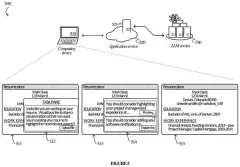
A woman opens her work inbox on Monday morning and finds a wall of unread email: coworker updates, canceled meetings, and a pile of marketing she never reads. You probably know the feeling, and AI summaries of an inbox are already a common way to cope.
Microsoft's patent application adds a twist. The first time, a language model (the AI behind modern chatbots) sorts your unread messages into topics like Work Items or Marketing. Then it watches what you do. If you bulk delete the marketing without opening it, or tap a Favorites button on a topic, it remembers.
Next time, the groups change to fit you. Work Items might split into Team Updates and Bug Reports, while marketing stays one broad lump tagged Consider Deleting. Your digest slowly becomes yours.
… recording a user interaction with the first iteration of the topic digest in the user interface of the messaging software application, wherein the user interaction demonstrates a user preference with respect to one or more topics of the initial plurality of topics; …
Translation: The system tracks how people interact with their email summaries to figure out what they actually care about.
How the digest learns from your deletions
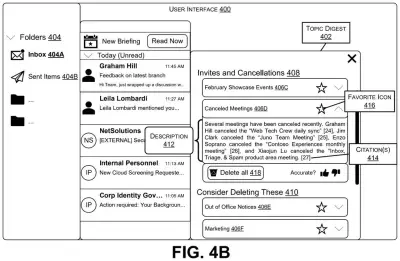
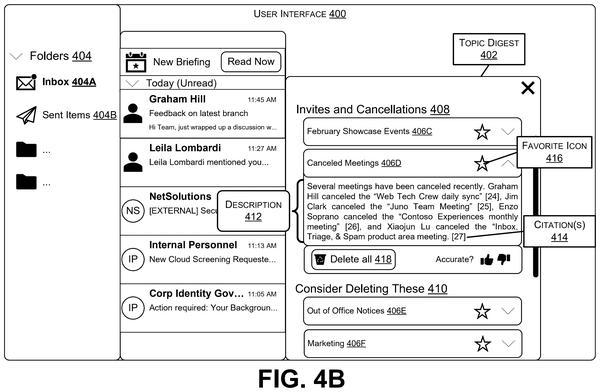
On the first run, the system gives your unread messages to a language model (an AI trained on huge amounts of text) and asks it to pick topics from the content alone. With no history on you yet, the topics come out broad. Each message is sorted into a topic, and each topic shows a title, keywords, a short summary and citations (clickable references) back to the original emails.
The system then records what you do. Implicit signals (such as bulk deleting a topic unread) and explicit ones (such as a Favorites button) go into stored records. On the next run, that history becomes an initialization input, which is extra guidance added to the model's prompt. It nudges the results in three ways:
- Favorited topics get priority and can be split into finer topics.
- Topics you ignore stay broad and can be grouped under a "Consider Deleting" label.
- Topics are ranked by how often you interact with them, with an optional minimum (the filing's example is five percent over the last week).
The filing also describes extras. Messages can be grouped by sender and recipient before the model reads them, so related emails sit together. A brand-new user's Sent Items folder can "warm up" the model. And when a message fits several topics, a relevancy competition scores each match and the highest total wins.
… a language model-based approach that consumes sequences of messages (e.g., emails), outputs a topic digest organizing the sequence of messages into individual topics, and aligns successive iterations of the topic digest to user feedback …
Translation: An artificial intelligence reads through email chains, groups them by subject, and updates future summaries based on user habits.
Why a self-adjusting inbox summary matters
If this ever reached an email app, your inbox summary would stop being identical for everyone. You could read the topics you care about first, in finer detail, and clear piles of marketing in one click. Because every message lands in some topic and links back to the original, nothing should disappear from view.
The application is far from granted: the examiner's first review rejected the claims as filed, which is routine and usually followed by amendments. The filing frames the idea as a way to personalize AI summaries for huge numbers of users without building a custom system for each person. That is a practical goal for any company selling AI features inside everyday mail and chat apps.
This is the 21st Microsoft filing we've tracked since June on AI assistants that remember you, building on one for coding context and one for cheaper conversation storage.
Source: US 2026/0370621 A1 at the USPTO (PDF). Full patent text and figures are in the official publication.
Get our take in your Top Stories
Liked this breakdown? Add Patentlyze as a preferred source on Google, and our plain-English take shows up more often in your Top Stories the next time Microsoft patent news breaks.
Add Patentlyze on Google
One click.
There are more where this came from
We read every patent application Big Tech publishes and send you the ones worth knowing. Plain English, free, every week.
The drawings · 8 sheets
8 drawing sheets from US 2026/0370621 A1 · click any drawing to enlarge


More from Microsoft
All 681 Microsoft patents →
More in AI / ML
All 2,738 AI / ML patents →
Samsung
Samsung Files Patent for Rewriting Your Vague AI Questions With Your Own Phone Data
Samsung
Samsung Files Patent for AI Text Replies That Know Who You're Talking To
Google
Google Patents AI That Recommends Products Through Natural Conversational Dialogue
Adobe
No comments yet