
Nvidia Patents a System That Figures Out Where to Put Cameras So Nothing Gets Missed
Placing cameras in a large space so every corner gets covered, with no redundant angles eating up budget, is harder than it sounds. Nvidia is filing a patent for software that solves it automatically.
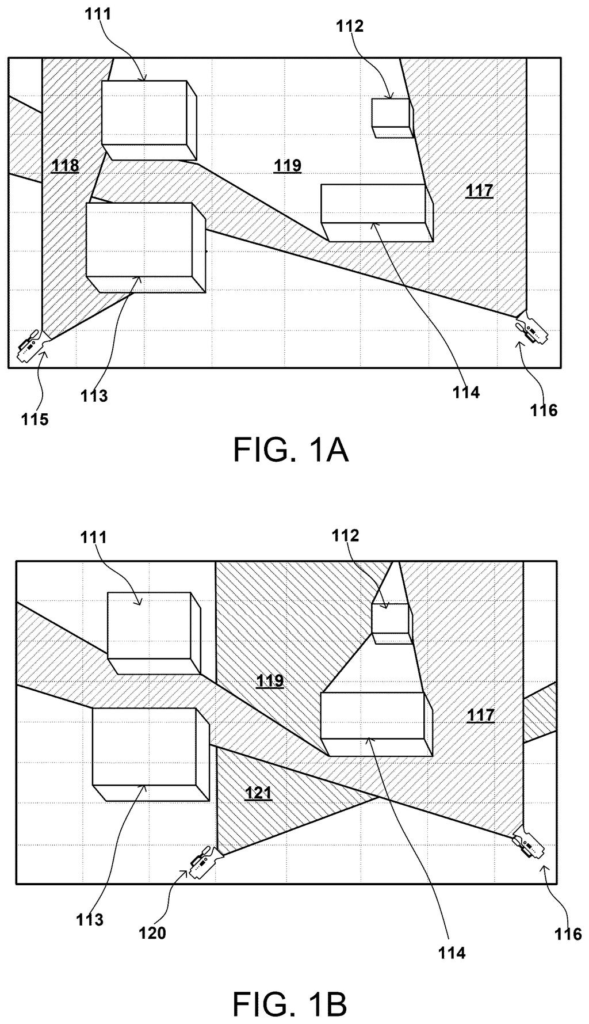
What Nvidia's automatic camera placement system actually does
A security camera stares at an empty hallway all night while the stairwell two feet away has no coverage at all. You've seen this problem in parking garages, warehouses, and film sets, and it's usually solved by a person walking the space and guessing.
Nvidia's patent describes software that maps a space on a virtual grid, figures out which spots are naturally visible from many angles (it calls these focus points), and then calculates exactly where to put each camera so the whole area is covered with as few cameras as possible. Each time a camera is placed, the system updates its map and recalculates what's still missing before picking the next location.
The approach leans on light transport simulation, a technique borrowed from computer graphics that traces imaginary rays of light through a 3D model to check whether one point can actually see another. The result is a placement plan that a human operator couldn't easily work out by hand.
… identifying one or more focus points within the spatial representation based at least on the connectivity information; selecting one or more camera placement locations for at least one of the one or more identified focus points based at least on a set of placement constraints; …
Translation: The software figures out what areas need watching and picks the best spots to mount the hardware.
How the grid map and raycasting pick each camera spot
The system starts by building a grid model of an environment, a digital map divided into small cells, each tagged as either accessible (open floor, walkable space) or inaccessible (walls, obstacles).
For every accessible cell, the system counts how many unobstructed straight lines it shares with neighboring cells in predefined directions. This count is called a connectivity value. Cells with high connectivity sit at natural crossroads of visibility, places where a single camera can watch a lot of the space. Those become the focus points the system tries to cover first.
Next, a raycasting process (firing simulated rays of light through the 3D model, the same math used in video game rendering) checks candidate camera positions one by one. It confirms that a proposed location actually has a clear line of sight to its assigned focus point, and then computes the full field of view the camera would cover from there.
After each camera is placed, the grid updates: already-covered cells are marked off, and the system repeats the process for whatever is left uncovered. This loop continues until every part of the space meets the predefined coverage threshold, minimizing overlap and keeping the total camera count as low as possible.
A raycasting process is applied to validate camera positions to ensure an unobstructed view of the focus point.
Translation: It checks digital lines of sight to make sure walls or pillars will not block the lens.
What this means for security, film sets, and simulation
Camera placement is one of those problems that sounds simple but scales badly. A single warehouse, film soundstage, or autonomous-vehicle test track can have hundreds of viable mounting spots, and checking each one manually against every constraint (walls, lighting, overlapping angles) takes hours. A software tool that does this in minutes has obvious value for facility security teams, film production crews, and robotics labs that need to instrument a space for training data.
Nvidia has been filing around simulation-based environment modeling since at least 2023, and this patent fits that pattern. The raycasting approach also lines up with Nvidia's existing graphics and simulation infrastructure, which means the technique could slot into tools like Omniverse without requiring a separate compute pipeline.
Nvidia's 490th filing in our Nvidia coverage since May adds to a run that includes a two-memory simulation system and AI-written simulation scripts.
Bad camera placement is a quiet, expensive failure mode. Security gaps in hospitals, airports, and warehouses typically go unnoticed until something goes wrong, and by then the cost is measured in incidents, lawsuits, and emergency hardware retrofits.
The method here treats coverage as a geometry problem: map the space, find the spots that matter most, then mathematically confirm that a camera placed at a given location actually sees what it needs to see. That rigor matches the stakes.
Whether this becomes a practical tool depends on how it ships, but the underlying problem it addresses costs real money at real scale.
There are more where this came from
We read every patent application Big Tech publishes and send you the ones worth knowing. Plain English, free, every week.
The drawings
20 drawing sheets from US 2026/0278187 A1 · click any drawing to enlarge


Want this weekly breakdown for a company we don't cover? Patentlyze Pro →