
Nvidia Files Patent for Fixing Podcast Slip-Ups by Retyping the Words
Say the wrong name in a podcast and today you have to re-record. Nvidia's filing describes retyping the word and letting software drop in a matching synthetic voice for just that spot.
What Nvidia's retype-to-fix audio patent does
Right now, fixing one wrong word in a finished podcast is a pain. You can re-record the whole thing, or re-record just that sentence and hope the new take sounds like the same person on the same day. Using a computer voice for the entire episode wipes out the way the speaker actually talks.
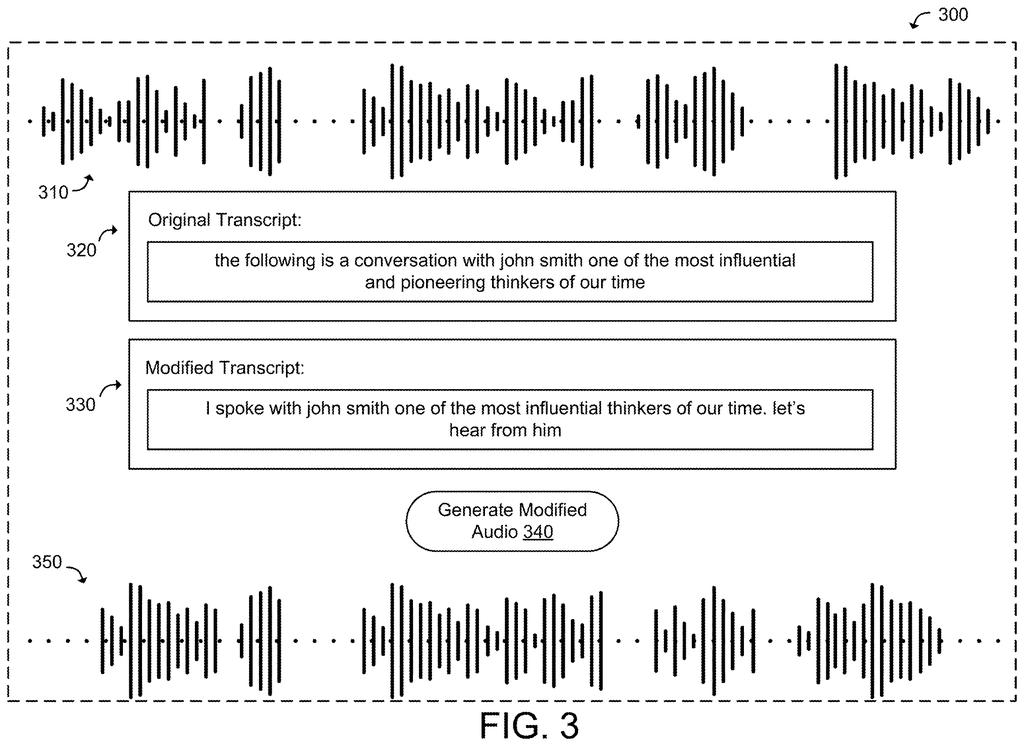
Nvidia's filing describes a third route. The software writes out what was said, you edit the text (or let an AI language model do it), and only the changed words get replaced with computer-made speech tuned to sound like the original speaker. The rest of the recording stays exactly as the person said it.
The result is meant to keep the speaker's rhythm and tone, and even the background hiss, so the patched spot doesn't stick out.
… generating synthetic audio using a text-to-speech machine learning model based at least on the set of modified words; generating modified synthetic audio using a voice match machine learning model based at least on the synthetic audio and at least a portion of the input audio; …
Translation: An AI turns your typed corrections into spoken audio that mimics the original speaker's voice.
How the AI voice gets matched and stitched in
The pipeline starts with a speech-to-text model (automatic speech recognition, software that writes down what it hears). It produces a transcript with timestamps marking where each word sits in the audio. Someone then edits that transcript, or a language model rewrites it. The description gives examples like fixing grammar, removing offensive content, or making a script about one company instead of another.
The system compares the original and edited transcripts to find the changed words. It can also include a couple of neighboring words on each side so the join sounds smoother. From there, three things happen:
- Synthetic speech: a text-to-speech model reads the changed words aloud, adjusted for how fast the speaker talks.
- Voice match: a second model, trained to pick up inflection, pronunciation, intonation and rhythm, reshapes that speech to resemble the original speaker, using the real recording as its reference. A cleanup model can polish that reference first.
- Stitching: the new clip is transcribed again to get fresh timestamps, lined up with the original, and dropped in, with volume and pitch evened out.
A noise model can also capture the recording's background sound and lay it over the synthetic clip, so the room tone doesn't vanish for a second. The claims name podcasts, video background audio, presentation narration and audiobooks as example recordings.
… generating an output audio by combining the input audio and the modified synthetic audio.
Translation: The system patches the newly generated words back into the original recording seamlessly.
Why this matters for podcasters and narrators
For anyone who produces spoken audio, a correction could become a text-editing job instead of a recording session. The filing lists podcasts, narrated presentations and audiobooks, where re-recording is slow or the speaker may be unavailable. It also names Nvidia's own speech tools (Riva and Maxine) as example parts, so it could fit software the company already sells.
It is early days. The examiner's first review rejected the claims as filed, which is routine and usually followed by amendments. The same technique that fixes a stumbled word can also change what a person appears to say, and the description itself mentions removing controversial content and swapping company names.
Nvidia's 27th filing in our voice and speech AI coverage we've tracked since May joins earlier work like one on face-reading game difficulty and one on retaining text during speech learning.
The design trades simplicity for a chain of guesses. Several models run in a row: transcribe, generate speech, match the voice, transcribe again, mix the noise. A small error early on travels to the end, so even a short patch could sound slightly off to a careful listener.
Patching only the changed words keeps the speaker's natural delivery and uses far less computing than synthesizing a whole episode. For a fixed name or a flubbed number, that trade reads as clearly worth it.
The bigger cost sits outside the engineering. Editing a transcript to change what someone says is a short step from putting words in their mouth, and the description we read mentions no consent step. Whoever ships something like this will need one.
Get our take in your Top Stories
Liked this breakdown? Add Patentlyze as a preferred source on Google, and our plain-English take shows up more often in your Top Stories the next time Nvidia patent news breaks.
There are more where this came from
We read every patent application Big Tech publishes and send you the ones worth knowing. Plain English, free, every week.
The drawings
10 drawing sheets from US 2026/0360380 A1 · click any drawing to enlarge


Show the other 2 sheets


Want this weekly breakdown for a company we don't cover? Patentlyze Pro →
Be the first to weigh in