
Nvidia Files Patent for a Screen That Tells You Why a Dead Server Died
When a server crashes or loses power, its screen goes blank and the clues vanish with it. Nvidia's patent application describes a paper-style tag that keeps the last message on display with no power at all.
What Nvidia's e-paper server tag actually does
You're walking down a row of servers at 3 a.m. One has gone dark. The power is out, nothing is blinking, and whatever it could have told you about what went wrong disappeared along with its electricity.
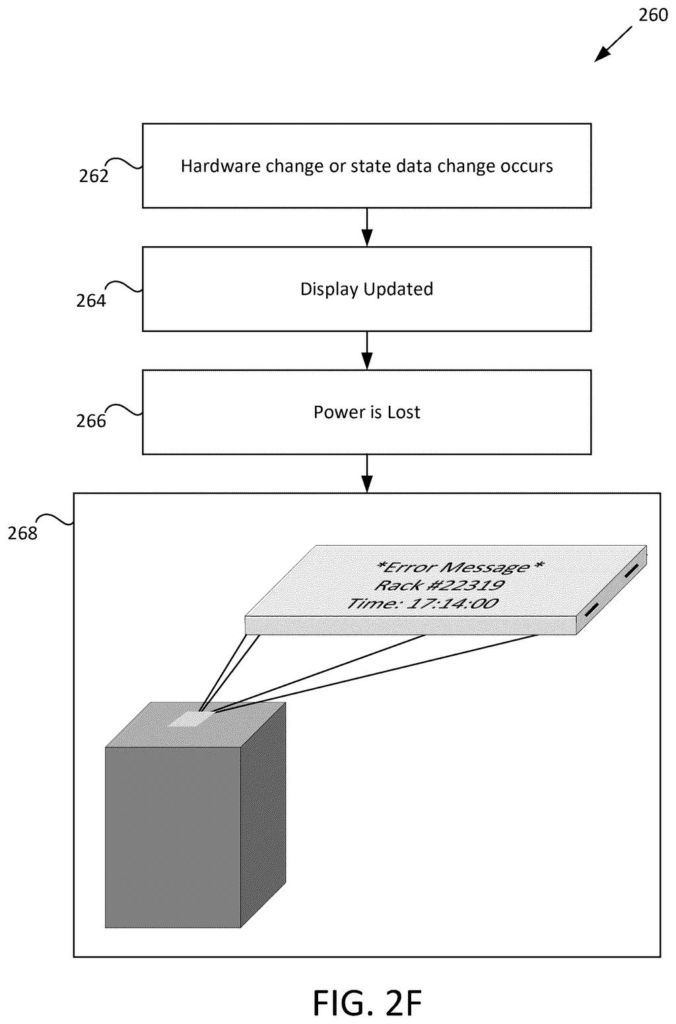
Nvidia's patent application describes a small paper-like screen, the same kind of display used in e-readers, stuck to the outside of a server or slid into a slot on it. While the machine runs, it feeds the screen status updates and error messages. When the power cuts, the screen simply keeps showing the last thing it was told.
So you can read what happened without a scanner or a trip to a central database. An administrator can also write notes onto the tag, such as "Checked: Server Rack 1."
… circuitry, including a processor and a memory, to store at least a most recent portion of the state data and to process the state data before allowing the persistent display to display the state data …
Translation: An onboard chip saves the latest system logs before showing them on the screen.
How the tag keeps the last error on screen
The patent covers a small display unit that attaches to data center equipment such as a server, a graphics chip board or a network switch. It has a persistent display, an electronic paper screen (the technology in many e-readers) that holds its image without power. It also has a data connection to the equipment, plus its own processor and memory.
While the equipment runs, it sends state data (status details) to the tag. The tag's processor checks and formats that data before showing it, and the memory saves the most recent portion. The filing lists error codes, post codes (short codes a machine reports while starting up), log messages, serial numbers and the current software setup.
E-paper moves tiny black and white particles with an electric charge. It needs power to change the picture but none to keep it, so the last message stays readable after a crash. The claims cover a flexible tag that sticks to the outside of the machine, or one that slides partway out of a slot so you can read it.
The filing also describes a button to recall the latest data, wireless requests (such as NFC, the tap-to-read tech in phones) for a stored history, and a way to write notes onto the screen even with no power.
Persistent displays such as E-ink persistent displays can convey information related to hardware components such as servers, GPUs, and network switches, regardless of the operational status or power state of those displays.
Translation: Low power screens show server stats even when the main machine completely loses power.
Why dead servers could be easier to diagnose
If you run a data center, the first question after a crash is what the machine was doing right before it stopped. Today, answers often come from stickers, barcodes, handheld scanners and a central database that may be out of date. A tag that shows the last error right on the machine could save technicians time during repairs and upgrades, when parts are swapped often.
The patent office has approved this application, and once Nvidia pays the final fee it should be issued as a granted patent. It is not a product announcement, but it fits Nvidia's world of racks packed with GPUs, where every minute of downtime is expensive. For everyday readers, it is a reminder that the AI boom depends on very ordinary maintenance problems.
Nvidia's 564th filing we've tracked since May adds to a self-driving thread that includes trailer detection and move previewing.
The cost here is one more thing that can break. Every machine gets an extra little device with its own processor, memory and wiring. In a building with thousands of servers, that is a lot of parts to buy, attach and keep working.
There is also a timing catch. The screen needs power to change, so it can only show what the server managed to tell it before the lights went out. If a machine dies suddenly, the last message on the tag may describe the moment before the real trouble.
Even so, the trade reads as a good one. A paper-style screen uses no power to hold an image, and it answers the question every technician asks at a dead machine: what was it doing? Stickers and barcodes can't answer that.
Get our take in your Top Stories
Liked this breakdown? Add Patentlyze as a preferred source on Google, and our plain-English take shows up more often in your Top Stories the next time Nvidia patent news breaks.
There are more where this came from
We read every patent application Big Tech publishes and send you the ones worth knowing. Plain English, free, every week.
The drawings
15 drawing sheets from US 2026/0321219 A1 · click any drawing to enlarge


Show the other 7 sheets


Want this weekly breakdown for a company we don't cover? Patentlyze Pro →
Be the first to weigh in