
Nvidia Patents a Single Chip Instruction That Cuts AI Math Steps in Half
Every time an AI model weighs its options, it runs millions of tiny math operations to produce probabilities. Nvidia just patented a way to make those operations faster by cramming two steps into one hardware instruction.
What Nvidia's mixed-precision AI math shortcut actually does
Every time an AI model picks the next word, translates a sentence, or describes an image, it runs a calculation called SoftMax. Think of SoftMax as the step where the model converts raw numbers into percentages so it can pick the most likely answer. That calculation runs constantly, millions of times per second, on Nvidia chips.
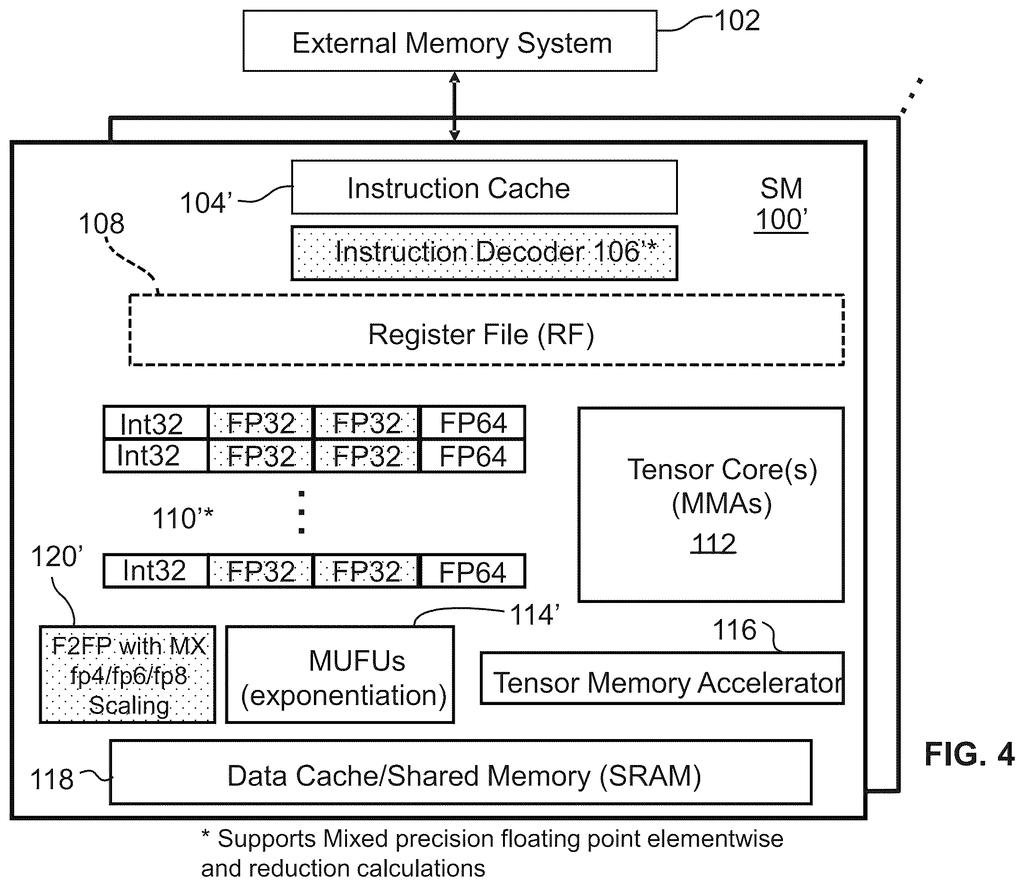
The problem is that AI chips often need to switch between two levels of numerical precision mid-calculation, the way a contractor might need to measure in both feet and millimeters on the same job. Each switch adds extra steps. Nvidia's patent describes a single hardware instruction that handles the calculation and the precision conversion at the same time, cutting the total instruction count roughly in half.
You won't feel this directly, but fewer instructions means less work per chip cycle. In AI data centers where thousands of chips run the same math all day, that adds up to real speed and power savings.
… a hardware instruction decoder configured to decode a single instruction call controlling hardware to (a) compute a value in first precision floating point and (b) convert the computed first precision floating point value to a second precision floating point value having a second floating point precision different than the first precision floating point.
Translation: A special command tells the hardware to calculate numbers and change their precision all at once.
How one instruction handles two precision levels at once
The patent covers a hardware instruction for neural network processors (the specialized chips that run AI models). It targets a math operation called SoftMax, which converts a list of raw scores (called logits) into a probability distribution where every output falls between 0 and 1 and all outputs add up to 1. SoftMax is foundational to nearly every modern AI model, including the attention mechanisms inside large language models.
Currently, running SoftMax on a chip requires separate instructions: one to do the math in a high-precision format, and another to convert the result to a different precision format for the next stage. That conversion is overhead. The patent describes a fused mixed-precision instruction where a single instruction call tells the hardware to (a) compute a value in one floating-point precision and (b) immediately convert it to a second floating-point precision, with the conversion baked into the hardware decoder itself.
Floating-point precision refers to how many decimal places a number carries. Higher precision is more accurate but costs more memory and compute power. AI workloads frequently toggle between precisions to balance accuracy against speed.
The patent also mentions Flash Attention (a popular, memory-efficient version of the attention calculation at the heart of models like GPT) and MX microscaling formats (a newer compact number format that multiple chip makers have been adopting to shrink AI model memory footprints). Both can benefit from the same fused instruction approach.
Using the new mixed precision instructions reduces the instruction count in half in example SoftMax/Flash Attention implementations.
Translation: These combined commands cut the number of steps needed for AI math right down the middle.
What this means for AI chip speed and power efficiency
SoftMax and attention calculations are not edge cases. They sit at the center of every transformer-based AI model, which means every chatbot, image generator, and translation tool running on Nvidia hardware hits this code path constantly. Halving the instruction count for those operations frees up chip cycles that can go toward running bigger models or processing more requests at the same throughput.
For data center operators, fewer instructions per inference pass can translate directly to lower energy costs and higher utilization per chip. Nvidia's long bet on AI inference acceleration shows up across a growing set of filings like this one, where the gains look incremental on paper but compound across billions of daily AI requests.
Nvidia's 43rd filing we've tracked in the AI chip wars since July adds to a run that includes running two networks at once and pre-reserving AI resources.
Baking two conversion steps into a single instruction means the chip assumes upfront which two numerical formats you need to move between. If future AI models settle on different pairings, that instruction sits idle, and the efficiency gain evaporates for anyone working outside the assumed pattern.
For now, the bet looks sound. The calculations being accelerated run millions of times per second in production AI systems, the format pairings are stable and widely used, and cutting the instruction count in half on work that never stops is a real and repeatable saving.
The cost is specificity locked into silicon. The return is permanent speed on a narrow but extremely common job. Given how much of modern AI depends on exactly these calculations, that trade reads as reasonable.
There are more where this came from
We read every patent application Big Tech publishes and send you the ones worth knowing. Plain English, free, every week.
The drawings
17 drawing sheets from US 2026/0278351 A1 · click any drawing to enlarge


Want this weekly breakdown for a company we don't cover? Patentlyze Pro →
Be the first to weigh in