
Nvidia
Nvidia · AI / ML · Filed May 15, 2025 · USPTO published Nov 19, 2026 · This week's release
Nvidia Patents One Transcription System for Phone Calls and Studio Audio
Most speech-to-text tools are built for one kind of recording and stumble on the rest. Nvidia's patent application describes a single model that adapts to how each clip was recorded, from tinny phone calls to studio-quality audio.
- Publication number
- US 2026/0369278 A1(US20260369278A1)
- Applicant
- Nvidia Corporation
- Filed · Published
- May 15, 2025 · Nov 19, 2026
- Inventors
- Harishchandra Dubey, Myungjong Kim, Oluwatobi Olabiyi
- Status when we published
- Waiting for an examiner
- Document
- 20 claims
- US classification
- 704/232
- Examiner
- FANG-WU, JOHN HONG (Art Unit 2653)
What Nvidia's one-model speech-to-text does
Every time a phone call, a podcast and a meeting recording land in the same transcription service, they arrive in very different shapes. A phone call captures a thin slice of sound detail, while a studio recording captures far more. Most systems are built for one kind of audio. They either convert everything else to fit, which can throw away detail, or they keep a separate model for each kind.
Nvidia's patent application describes one package instead. It holds several front ends tuned for different recording qualities, plus a single shared piece that writes out the words. The system checks how your clip was recorded and sends it to the matching front end, so the lossy conversion step is skipped.
The filing says the practical payoff is one model to store, update and retrain instead of a pile of near-duplicates.
select, based at least on one or more properties of an input speech signal, at least one of an encoder from the plurality of encoders or a subset of audio channels from the set of audio channels; and generate an output corresponding to the input speech signal using at least the selected encoder or the selected subset of audio channels.
Translation: The system looks at the audio input and picks the best tools to process it into text.
How Nvidia picks the right encoder per clip
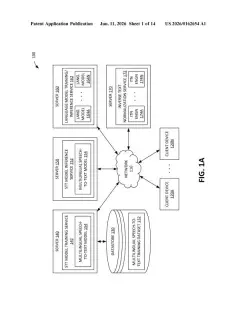
The system has several encoders (the parts of a speech model that listen to the audio and boil it down to an internal numerical summary) and one shared decoder (the part that turns that summary into words). Each encoder is tied to a different sampling rate, meaning how many times per second a recording measures the sound. The filing lists examples from 8 kHz phone audio up to 192 kHz professional recordings.
When a clip arrives, the system reads its properties, mainly the sampling rate and the number of audio channels (mono, stereo, surround), and routes it to the matching encoder. The audio is first chopped into short overlapping windows (one example uses 20 millisecond windows that overlap by 10), then converted into a spectral representation (a picture of which pitches are present over time). The model is built for a fixed number of channels, such as 16, and unused ones are set to zero. During training, empty channels can instead hold copies of real audio with added noise or echo.
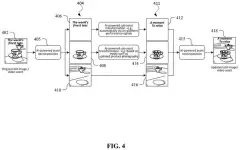
Training is where the pieces get tied together. Clips of different qualities pass through their own encoders, and a joint fusion network combines the results before the shared decoder writes text. The errors from each path are combined as a weighted sum, with the weights adding up to one. At use time only one encoder runs, so the fusion step is skipped. The same setup can also be pointed at translation, such as German speech into English text.
Approaches presented herein may be used to generate a text output of an input speech signal using an encoder from a plurality of encoders and a joint decoder associated with the plurality of encoders.
Translation: Nvidia's patented system converts spoken words into text by matching the audio with the right combination of processors.
Why one model for all audio matters to you
The filing's pitch is mostly about the companies that run speech services. Instead of keeping a separate model for phone audio, another for wideband audio, another for stereo, they keep one. The description says the shared decoder can save roughly 20 to 30 percent of the storage a model needs, and that retraining happens once instead of many times.
For you, the benefit shows up in accuracy. The filing says converting audio to fit a model can cause mismatches and more word errors, so skipping that step could mean cleaner transcripts of calls, meetings and voice commands. The description names video conferencing, in-car assistants and kiosks as places this could run. Remember this is a patent application, so it shows what Nvidia is describing, not a product you can use.
This is the 29th voice and speech AI filing from Nvidia we've tracked since May, adding to work like isolating one voice in a crowd and fixing spoken podcast errors.
Source: US 2026/0369278 A1 at the USPTO (PDF). Full patent text and figures are in the official publication.
Get our take in your Top Stories
Liked this breakdown? Add Patentlyze as a preferred source on Google, and our plain-English take shows up more often in your Top Stories the next time Nvidia patent news breaks.
Add Patentlyze on Google
One click.
There are more where this came from
We read every patent application Big Tech publishes and send you the ones worth knowing. Plain English, free, every week.
The drawings · 26 sheets
26 drawing sheets from US 2026/0369278 A1 · click any drawing to enlarge


Show the other 18 sheets


More from Nvidia
All 665 Nvidia patents →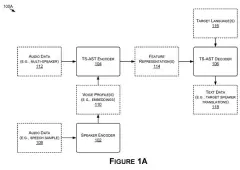
More in AI / ML
All 2,738 AI / ML patents →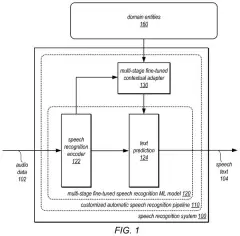
Amazon
Amazon Files Patent for Transcription That Gets Rare Names and Jargon Right
Samsung
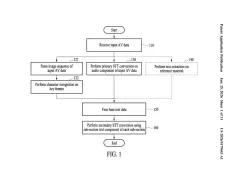
Samsung Patents a Transcription Method That Reads the Screen Before It Listens
Salesforce
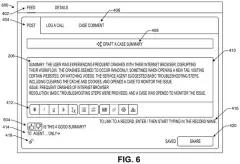
Salesforce Patents an AI Button That Recaps a Customer's Case Across Email, Chat and Phone
Meta
No comments yet