
Nvidia Patents a Parallel Processing Approach for 360-Degree Image Math
Processing a 360-degree image requires a lot of repeated math on a lot of pixels. Nvidia's new patent describes splitting that work across multiple parallel software threads to get it done faster.
What Nvidia's spherical image threading patent actually does
Ever tried to watch a 360-degree video and noticed it lagging, or seen artifacts in a virtual reality scene? A big part of what makes spherical images hard to handle is the sheer amount of calculation required to render or edit every point on a sphere-shaped picture.
Nvidia's patent covers a way to split that math across multiple processing threads running at the same time. Instead of one worker grinding through the calculations pixel by pixel, you get a team working in parallel. The specific math involved, called a fast Fourier transform, is a standard tool for converting image data into a form that's easier to manipulate and compress.
The result is that spherical images, the kind used in VR headsets, 360-degree cameras, and environment mapping, can be processed more quickly and efficiently on Nvidia hardware.
One or more processors comprising: processing circuitry to cause two or more software threads to be used to perform two or more fast Fourier transforms (FFTs) on two or more pixels of one or more spherical images.
Translation: Specialized chips run multiple computing tasks at once to process the math behind 360-degree photos.
How parallel threads split the FFT workload across pixels
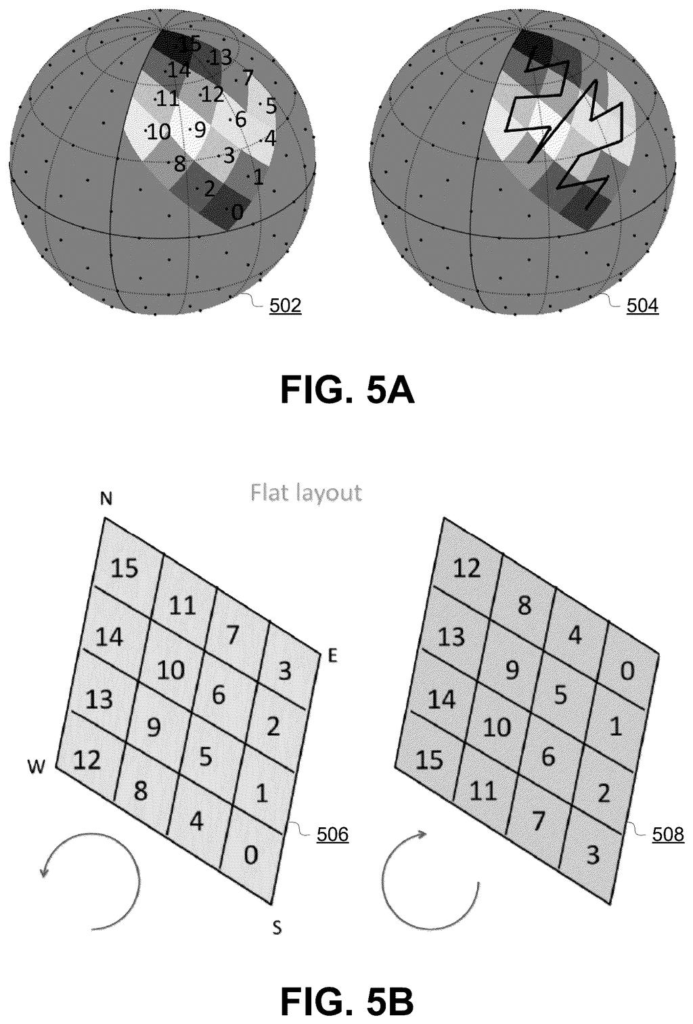
The patent covers hardware and software that assigns two or more software threads (independent streams of instructions running simultaneously on a processor) to carry out fast Fourier transforms, or FFTs, on pixels of a spherical image.
An FFT is a mathematical shortcut for analyzing or transforming data. When applied to images, it converts pixel values from their raw form into a frequency-based representation, which makes operations like filtering, compression, and editing much cheaper to compute. Spherical images are a particular challenge because they map a full 360-degree scene onto a flat grid, and the transforms needed to work with them (called spherical harmonics transforms) involve a large number of these FFT operations.
By running those operations on multiple threads in parallel, the system can distribute the workload across a processor's available cores rather than running them one after another.
- Two or more software threads are launched simultaneously.
- Each thread handles FFTs on a separate set of pixels.
- The results feed into spherical harmonics transforms used to edit or process the full spherical image.
Apparatuses, systems, and techniques to edit data elements of a spherical image. In at least one embodiment, two or more software threads are used to perform two or more fast Fourier transforms (FFTs) on two or more pixels of one or more spherical images.
Translation: The hardware setup uses parallel software threads to manipulate data points in spherical visual media.
What this means for 360-degree video and spatial computing
For anyone using a VR headset or working with 360-degree video, faster spherical image processing means smoother rendering and quicker editing. Environment lighting in games and simulations, which often relies on spherical harmonics, is one area where this kind of speedup shows up directly in visual quality.
Nvidia's interest in spatial computing and real-time rendering makes this a logical area to file in. That said, claim 1 as written is broad: it covers any processor that uses two or more threads to run FFTs on spherical image pixels, without specifying the architecture, the number of threads, or the type of spherical image. That breadth could give Nvidia wide coverage, but it also means the claim faces a real test in examination for how it differs from existing parallel processing approaches.
Nvidia's 38th filing we've tracked since July in the GPU rendering race joins one avoiding redundant image work and one filling missing frames.
Claim 1 covers a processor that uses two or more software threads to run fast Fourier transforms on two or more pixels of a spherical image. That scope is very wide. Any system that touches a 360-degree image and splits that mathematical work across parallel processes would fall inside it.
In practice, that breadth matters because spherical images are everywhere: VR headsets, satellite mapping, panoramic photography, video conferencing backgrounds. A granted claim at this width could give Nvidia a toll-booth position over a large portion of how those images get processed efficiently on any chip.
The claim lives or dies on whether pairing "spherical image" with "parallel processing" counts as a real invention under scrutiny from the patent office. If examiners find that combination already existed in signal-processing or graphics research, the claim will shrink considerably before any grant. As written, it is an ambitious opening bid.
There are more where this came from
We read every patent application Big Tech publishes and send you the ones worth knowing. Plain English, free, every week.
The drawings
30 drawing sheets from US 2026/0300426 A1 · click any drawing to enlarge


Want this weekly breakdown for a company we don't cover? Patentlyze Pro →
Be the first to weigh in