
Nvidia Patents a Morton-Code Voxel Sorting Method for Real-Time Radiance Field Rendering
Nvidia is patenting a technique that uses a clever spatial sorting trick — Morton codes — to bring radiance field rendering closer to real-time speeds. It's a data-structure play hiding inside a graphics pipeline.
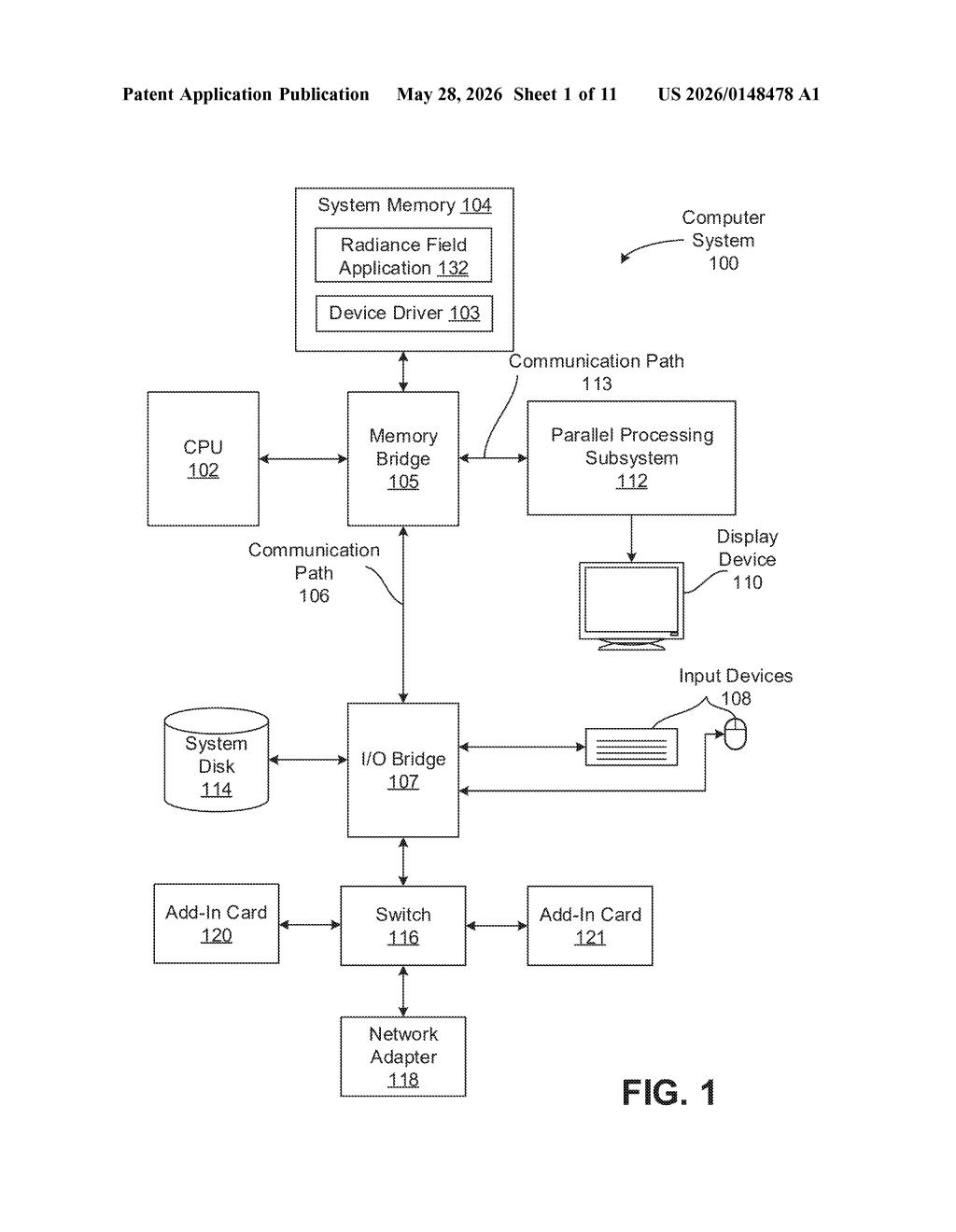
How Nvidia's voxel renderer tackles real-time 3D scenes
Imagine trying to describe a 3D scene — a room, a face, a landscape — by filling it with millions of tiny cubes, each holding color and light information. That's basically what a voxel radiance field does. The problem is that rendering all those cubes in the right order, so that light and transparency look correct, is genuinely hard to do fast.
Nvidia's approach borrows a trick called Morton code sorting. Instead of processing voxels in arbitrary order, the system assigns each voxel a number based on its position in 3D space — in a way that naturally clusters nearby voxels together. That clustering makes the rendering order more GPU-friendly, which means less wasted work and faster frames.
The goal is high-fidelity, real-time output — not the slow, offline ray-traced renders you'd wait minutes for, but something fast enough to use interactively. Think virtual production sets, game engines, or digital twins.
How Morton codes set the voxel rendering order
The patent describes a three-step pipeline. First, the system allocates a set of voxels to represent a scene — essentially subdividing 3D space into a grid of small volumetric units, each capable of storing radiance (light and color) information derived from a neural or data-driven model.
Second, each voxel gets a Morton code (also called a Z-order curve value — a space-filling curve that interleaves the binary coordinates of a point in X, Y, and Z into a single integer). Sorting voxels by this code groups spatially close voxels together in memory, which is a classic trick for improving cache coherence — meaning the GPU wastes fewer cycles fetching data that's scattered all over memory.
Third, the sorted voxels are rendered in that order to produce a final image. The rendering order matters because radiance fields use alpha compositing (blending semi-transparent volumes front-to-back or back-to-front), so getting the sequence right is essential for visual correctness.
The abstract is lean and the independent claim is broad — the core invention as filed is essentially: allocate voxels, sort by Morton code, render. The implementation details (how the radiance values are stored, what neural network backs them, how the voxel grid adapts) are likely in the dependent claims and specification figures referenced in the abstract.
What this means for real-time neural rendering pipelines
Radiance fields — popularized by NeRF (Neural Radiance Fields) — produce photorealistic scene reconstructions but have historically been painfully slow to render. Getting them to run in real time has been the industry's central challenge for the past few years. Nvidia, which sells the GPUs that do this work, has an obvious stake in making the pipeline more efficient at the architecture level.
For you as a developer or end user, a faster voxel radiance renderer could mean quicker previews in tools like Omniverse, lower-latency rendering in virtual production, or eventually more realistic environments in games and XR headsets. The Morton-code approach is not exotic — it's a well-known spatial indexing technique — but applying it systematically inside an adaptive voxel radiance pipeline, and patenting that specific combination, is where Nvidia is planting its flag.
This is a narrow, infrastructure-level graphics patent — not a moonshot. Morton code sorting is decades-old computer science, and the independent claim as filed is surprisingly bare-bones. What makes it worth noting is the context: Nvidia is actively building out its Omniverse and real-time neural rendering stack, and even incremental rendering pipeline optimizations matter enormously when you're trying to hit 60+ FPS with photorealistic voxel scenes. Don't expect a press release, but do expect this technique to quietly ship inside a future CUDA or OptiX update.
There are more where this came from
We read every patent application Big Tech publishes and send you the ones worth knowing. Plain English, free, every week.
Want this weekly breakdown for a company we don't cover? Patentlyze Pro →