
Nvidia Patents a Write-Only Memory System for Cluster Encryption Keys
Nvidia is patenting a way to protect encryption keys in large compute clusters by storing them in memory that literally cannot be read back — even by the system itself. It's a clever architectural trick that removes one of the most common attack surfaces in distributed storage.
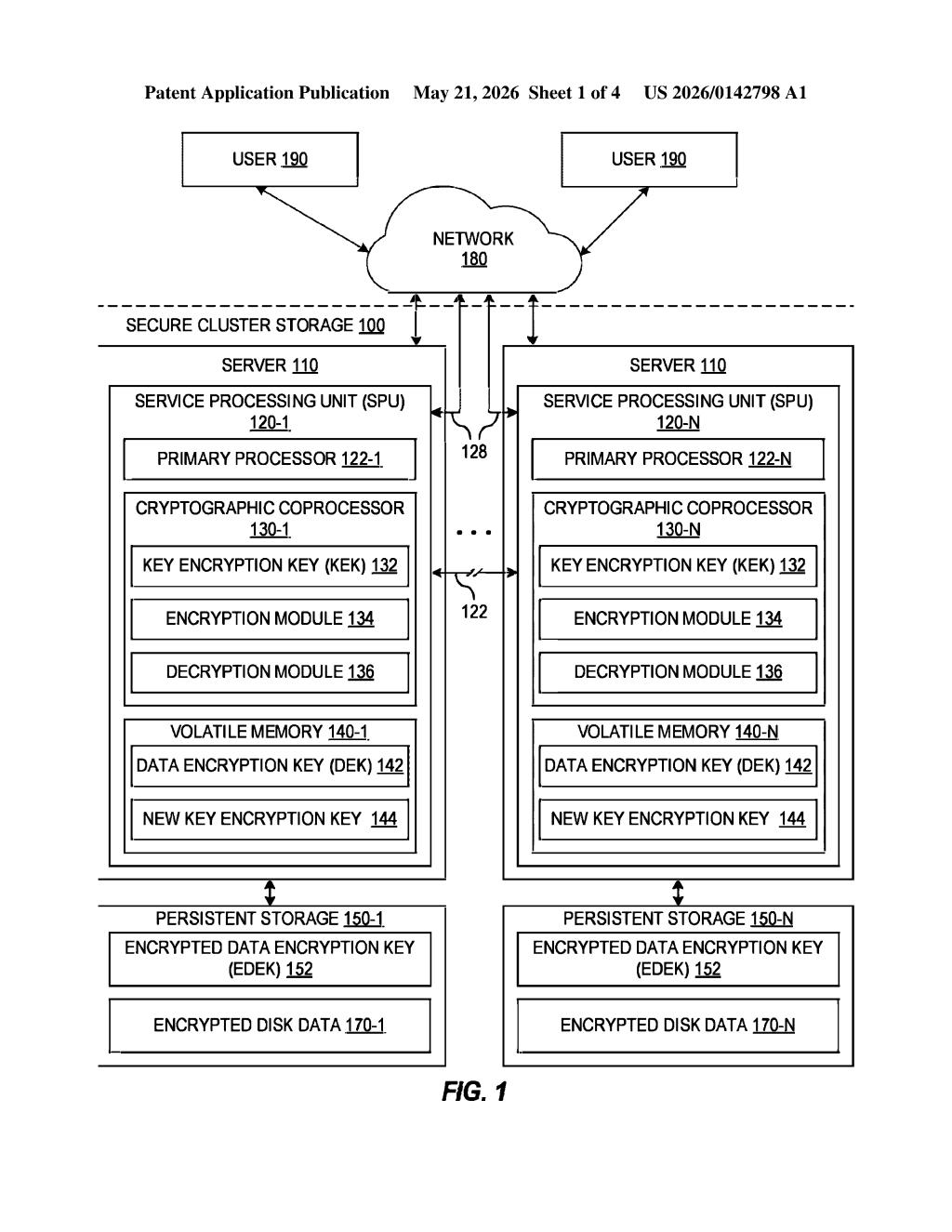
How Nvidia keeps encryption keys off readable storage
Imagine a safe-deposit box where even the bank teller can't peek inside — they can only put things in or take them out on your behalf. That's roughly the idea here. When a cluster of servers needs to encrypt and decrypt data, the biggest risk is that the secret keys used to lock and unlock that data might be exposed somewhere — in a log file, a memory dump, or on a hard drive.
Nvidia's approach stores the most critical key — the one that protects all the other keys — in a special type of memory that is write-only. You can put a value in, but you can never read it back out directly. Only a dedicated cryptographic coprocessor can use it to do encryption or decryption work.
The result is that even if an attacker fully compromises a server, they still can't extract that master key. It never appears in readable form anywhere in the system. This matters especially when clusters grow, shrink, or swap in new nodes — moments when key management is typically most fragile.
How the cryptographic coprocessor wraps and unwraps keys
The system uses a classic key-wrapping hierarchy: data is encrypted with a data encryption key (DEK), and the DEK itself is encrypted ("wrapped") with a key encryption key (KEK). Both the encrypted data and the wrapped DEK live in ordinary persistent storage. So far, fairly standard.
The novel part is where the KEK lives. Instead of storing it anywhere readable, Nvidia's design places the KEK inside write-only memory on a dedicated cryptographic coprocessor — a separate processing unit from the main CPU and storage subsystem. The coprocessor can use the KEK to decrypt the wrapped DEK, but it cannot return the raw KEK value to any caller. The key never leaves the coprocessor in plaintext form.
When a node needs to decrypt data, it:
- Retrieves the encrypted DEK from persistent storage
- Passes it to the cryptographic coprocessor
- The coprocessor uses the unreadable KEK to unwrap the DEK
- The DEK is used to decrypt the actual data
The patent also covers how this works during cluster membership changes — when nodes join or leave, keys need to be redistributed or rotated without ever writing an unprotected key to disk or exposing it over the network in a readable form.
What this means for data center and AI cluster security
For large-scale AI training clusters and data centers — exactly the hardware Nvidia dominates — key management during node joins and failures is a real operational headache. Most solutions involve some compromise: keys get written to encrypted disk, passed through a key management server, or briefly held in readable memory. Each step is an attack surface. Nvidia's write-only coprocessor approach eliminates the "key at rest" problem at the hardware level.
This is infrastructure-layer security work, not a flashy user-facing feature, but it's the kind of thing that shows up in compliance certifications and enterprise sales conversations. If Nvidia bakes this into its DGX or HGX cluster platforms, it could become a meaningful differentiator for customers in regulated industries — finance, healthcare, government — who need provable key isolation.
This is a focused, well-scoped security patent solving a real problem in clustered compute environments. It's not conceptually revolutionary — hardware security modules and write-only key stores exist — but applying the pattern specifically to cluster formation and membership changes, tied to Nvidia's GPU-centric hardware stack, is a practical and meaningful contribution. Worth paying attention to if you care about enterprise AI infrastructure security.
There are more where this came from
We read every patent application Big Tech publishes and send you the ones worth knowing. Plain English, free, every week.
Want this weekly breakdown for a company we don't cover? Patentlyze Pro →