
Philips Hue
Philips Hue · Gear · Filed Oct 30, 2025 · USPTO published Nov 19, 2026 · This week's release
Signify Patents a Grow Light That Counts Red Light to Stop Plants Bleaching White
Pale, bleached patches on indoor crops can wipe out the value of a harvest. Signify's patent application says the fix is to count the red light hitting the plants, not just how bright the lamp is.
- Publication number
- US 2026/0363178 A1(US20260363178A1)
- Applicant
- SIGNIFY HOLDING B.V.
- Filed · Published
- Oct 30, 2025 · Nov 19, 2026
- Inventors
- BRIAN POEL, DAVID HAWLEY
- Status when we published
- Waiting for an examiner
- Document
- 14 claims
- US classification
- 47/58.1LS
- Examiner
- REYES, EDGAR (Art Unit 3642)
- Parent application
- National Stage Entry of PCT/EP2024/060862 (filed Apr 22, 2024)(PCTEP2024060862)
What Signify's anti-bleaching grow light does
Ever moved a houseplant to a sunnier window, only to watch its leaves go pale and crispy? Plants can take in more light than they can use, and the extra energy damages the green pigment (chlorophyll) they depend on.
Indoor growers run into the same thing with powerful LED lights. Plants love red light, so growers load up on it, but too much leaves white, bleached patches. The filing points out that bleached cannabis buds look unappealing, taste worse and are seen as less potent, and the top buds are often the most valuable. The usual fix is to dim the lights, which cuts the harvest.
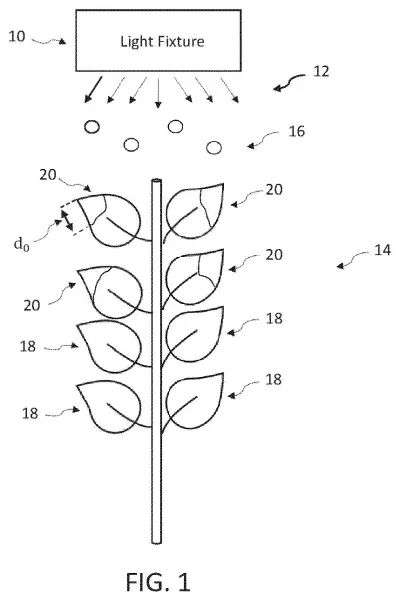
Signify's patent application takes a different route. The lighting system counts the red light actually landing on the plants and keeps that count under a limit it works out by trial and adjustment. The filing says this count predicts bleaching better than brightness or red share alone.
… calculating an absolute number of red photons in the red-light portion; iteratively determining a range of photobleaching thresholds for the cultivar based, at least in part, on the absolute number of red photons the predetermined range of photosynthetic photon flux density and the red light portion; …
Translation: The system counts the red light particles and figures out when the light becomes too intense for the plants.
How the light counts red photons and adjusts
The filing describes a grow-light system built from an LED fixture whose colors can be controlled, plus a controller (a small computer) that manages it. The light must contain a red portion between 600 and 700 nanometers (the red part of the spectrum) making up at least 40% of the total light.
The controller works in four steps:
- Expose: the crop gets a set light intensity (called photosynthetic photon flux density, or PPFD, a measure of how many light particles hit a patch of leaf each second) and a set red share.
- Count: it multiplies intensity by red share to get the absolute number of red photons (light particles) reaching the plant.
- Learn the limit: it repeatedly nudges the light up or down, depending on whether bleaching shows up, to find the crop's bleaching threshold.
- Stay under it: it holds the red photon count below that threshold.
The description gives about 550 micromoles of red photons per square meter per second as a level many cannabis varieties tolerate. Two lighting mixes can hit the same count: 687.5 at 80% red, or 1,100 at 50% red. Optional extras include cameras (color, thermal or infrared) that spot bleaching, temperature sensors, since heat lowers the limit, and separate limits for the seedling, vegetative and flowering stages.
… controls the LED-based light fixture so that the absolute number of red-light photons is below the range of photobleaching thresholds.
Translation: It automatically dims the red light to prevent the plants from turning white.
Why growers care about bleached top buds
If you eat or buy greenhouse-grown or indoor-grown crops, the practical point is yield and quality. Growers now often play it safe and dim their lights to avoid bleaching, which leaves growth on the table. A system that knows each crop's real limit could let growers run brighter light, with the red share tuned to match, and still protect the prized top buds.
For Signify, which makes professional horticultural lighting, this is a way to turn a lighting fixture into something that manages the crop's results. The filing leans heavily on cannabis, but it defines crops broadly, naming tomatoes, peppers, lettuce and many others. Nothing here says a product is coming, but the idea is simple enough to add to any controllable LED grow light.
Philips Hue's second patent in our home tech coverage since November follows a stretchy rubber streetlight as the second filing we've tracked from the company.
Source: US 2026/0363178 A1 at the USPTO (PDF). Full patent text and figures are in the official publication.
Get our take in your Top Stories
Liked this breakdown? Add Patentlyze as a preferred source on Google, and our plain-English take shows up more often in your Top Stories the next time Philips Hue patent news breaks.
Add Patentlyze on Google
One click.
There are more where this came from
We read the new patents from Big Tech, carmakers and more and send you the ones worth knowing. Plain English, free, every week.
The drawings · 4 sheets
4 drawing sheets from US 2026/0363178 A1 · click any drawing to enlarge


More from Philips Hue
All 2 Philips Hue patents →More in Gear
All 26 Gear patents →
Roborock
Roborock Files Patent for a Brush Cover That Won't Latch Shut Without the Brush
SharkNinja
SharkNinja Patents a Coffee Maker Part That Wets All Your Grounds Evenly
Lutron
Lutron Files Patent for a Window Shade That Charges Its Own Motor From Sunlight
SharkNinja
No comments yet