
Qualcomm Patents a Way for Two Devices to Share AI Processing in Real Time
What if your phone could offload half its AI thinking to a nearby device, like a car, a server, or a second chip, and get a better answer than either could produce alone? That's the core idea behind Qualcomm's latest patent filing.
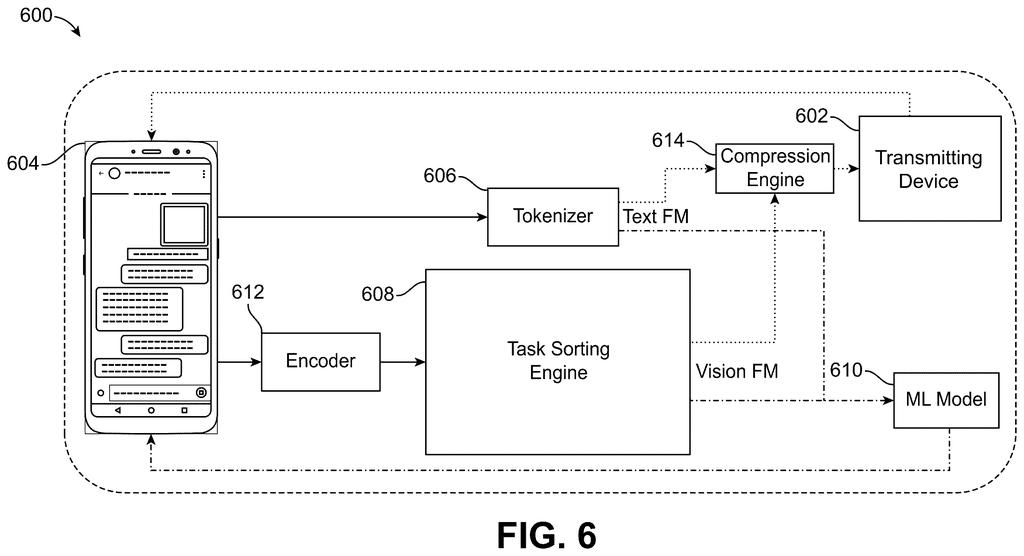
How Qualcomm's cross-device AI feature maps actually work
Imagine your phone is trying to recognize what's in a live video feed, but the task is too demanding for its chip alone. Instead of giving up or sending everything to a remote cloud server, it reaches out to a nearby device, maybe a smart speaker, a car system, or an edge server, and the two devices split the work.
That's what Qualcomm's new patent describes. Each device processes the raw data through its own AI encoder and produces what the patent calls a feature map, essentially a compressed, meaningful summary of what it saw. The two summaries are then combined, using instructions baked into the data itself, so the final AI result is richer than what either device could have produced on its own.
The practical effect is that your device doesn't have to be powerful enough to handle every task alone. It can collaborate with whatever hardware is nearby, without you doing anything at all.
… obtain a second feature map from a plurality of feature maps associated with processed data from a second device, wherein the second feature map includes metadata indicating how to combine the second feature map with at least one other feature map …
Translation: The system grabs intermediate AI data from another gadget along with instructions on how to merge it.
How the encoder splits and merges AI data across devices
The patent describes a machine learning architecture where two separate devices each run an encoder (the part of an AI model that translates raw input, like pixels or audio, into a compact internal representation). Each encoder produces a feature map, which is a grid of numerical values capturing the patterns the AI noticed.
The key innovation is in how those two feature maps get combined. The second device attaches metadata (literally, instructions about itself) to its feature map before sending it over. That metadata tells the receiving device how to merge the two outputs. There are two merging strategies:
- Concatenation: the two feature maps are stacked side by side, giving the combined model more raw material to work with.
- Cross-attention combination: a more sophisticated method (borrowed from transformer AI models, the same family behind large language models) where each feature map is used to selectively highlight the most relevant parts of the other. Think of it as the two devices asking each other, "what should I pay attention to here?"
The result is a combined feature map that a downstream AI model then uses to actually perform a task, whether that's object detection, speech recognition, or something else. The metadata-driven approach means the system can adapt on the fly to whatever devices happen to be in range, rather than requiring a fixed pre-configured network.
… the combined feature map is a concatenation or cross-attention combination of the first feature map and the second feature map …
Translation: The devices combine their AI workloads by either linking the data together or using cross-attention.
What this means for on-device AI in phones and chips
For anyone using a Qualcomm-powered phone, laptop, or car system, this architecture could mean better AI results in situations where a single device would normally struggle. Think low-light photo processing, real-time translation in a noisy environment, or object detection in an autonomous vehicle, where two sensors feeding one model outperform one sensor feeding one model. The improvement happens inside the hardware, with no extra steps from you.
Qualcomm sits at the center of mobile and edge AI, supplying chips to Android flagships, car platforms, and AR headsets, so a cross-device AI framework like this one fits squarely into where the company's chip strategy is heading. The latest Big Tech patents in the edge-AI and on-device inference space show a consistent push toward distributed processing that keeps data local while still matching cloud-quality results, and this filing is a concrete example of that architecture taking shape.
The metadata-in-the-payload approach is the part worth focusing on here. Letting the sending device specify how its output should be merged, rather than hardcoding that logic into a shared model, means the system can work with devices that have never met before. For a user, that translates to AI features that degrade more gracefully when the ideal hardware isn't available and improve automatically when better hardware shows up nearby. That's a meaningful reliability win, even if you'd never see the word "feature map" anywhere on screen.
There are more where this came from
We read every patent application Big Tech publishes and send you the ones worth knowing. Plain English, free, every week.
The drawings
12 drawing sheets from US 2026/0236744 A1 · click any drawing to enlarge


Want this weekly breakdown for a company we don't cover? Patentlyze Pro →
Be the first to weigh in