
Qualcomm Patents a Way to Label Every Part of a 3D Model Automatically
Qualcomm has filed a patent for a pipeline that can look at a 3D model, figure out which parts are which objects, and stick a label on each one automatically. It is the kind of plumbing that makes AR glasses or AI-powered cameras actually useful in the real world.
What Qualcomm's automatic 3D-object labeling actually does
Ever tried to figure out which shelf in a store photo holds the cereal, versus the soup? Now picture a computer trying to do that inside a full 3D scan of a room. Every wall, chair, and lamp looks like one big blob of geometry unless something tells the system where one object ends and another begins.
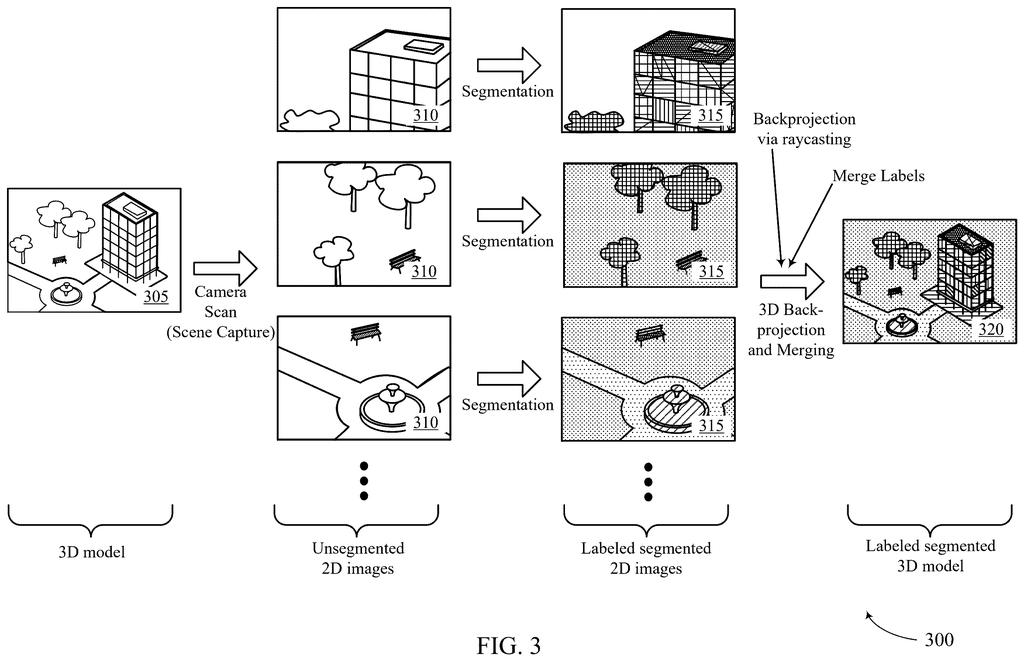
That is what this Qualcomm patent addresses. The system takes a 3D model and turns it into a set of flat photos from different angles. It then runs each photo through an image-recognition tool that draws outlines around objects and names them. After that, it maps those labels back onto the original 3D model, so every surface in the 3D scene gets a tag saying what it is.
The result is a labeled 3D model where the system knows a chair is a chair, a table is a table, and so on. That kind of organized scene understanding is essential for anything from self-driving vehicles to mixed-reality headsets that need to interact with the physical world.
obtain a plurality of two-dimensional images from a three-dimensional model; generate a plurality of image segmentation masks based at least in part on one or more segmentation operations performed on each two-dimensional image of the plurality of two-dimensional images, wherein respective objects of the plurality of image segmentation masks are assigned one or more labels; …
Translation: The system takes flat pictures of a 3D object and uses software to identify and label the different parts in those images.
How 2D snapshots teach the system what each 3D object is
The patent describes a computer vision pipeline designed to run segmentation on 3D models. Segmentation, in plain terms, means drawing a border around each distinct object in a scene and giving it a name.
Here is how the process flows step by step:
- Render multiple 2D images: The system takes a 3D model and generates several flat images from different camera angles, essentially photographing the model from many directions.
- Segment each flat image: Each 2D image goes through a segmentation algorithm that produces a mask (a color-coded map where every pixel is labeled with a category, like "floor," "wall," or "furniture").
- Backprojection: The system then reverses the camera math to figure out which pixel in each flat image corresponds to which surface in the original 3D model. This step is called backprojection and acts like tracing a ray from the flat photo back into 3D space.
- Merge labels: Because the same object appears in multiple photos from different angles, the system collects all the labels assigned to each surface across every image and merges them into a single agreed-upon label for that object.
The output is a segmented 3D model in which every geometric piece carries a meaningful category tag. This lets downstream applications, like a headset or an autonomous robot, query the scene and know exactly what they are looking at.
Backprojection operations may be performed for each image segmentation mask, where a correspondence between respective pixels of each image segmentation mask and respective objects of the 3D model is identified in accordance with the backprojection operations.
Translation: The computer maps the labeled parts from the flat images back onto the original 3D shape to identify what each piece is.
What this means for AR headsets and on-device AI
For anyone wearing a future AR headset or using a phone camera that overlays information on the real world, a device needs to know what objects surround you before it can do anything useful with them. Labeling 3D models by hand is slow and expensive; doing it automatically at the quality this pipeline targets is what moves AR from a demo into a practical tool you might actually reach for.
Qualcomm sits at the center of this because it makes the chips inside many mobile and XR devices, so a segmentation technique that runs efficiently on its hardware has a direct path into real products. The approach of leaning on existing 2D image-recognition tools and projecting their results into 3D space is practical rather than exotic, which suggests it is built to ship, not just to demonstrate a concept. For a broader view of how chip and wireless companies are pushing AI deeper into 3D sensing, the coverage of new Big Tech patents in this space shows Qualcomm is far from alone in treating scene understanding as the next battleground for on-device AI.
That makes this Qualcomm's 31st filing we've tracked in the AR glasses race since July, adding to earlier work on AI vision for smart glasses and dual-focus VR headsets.
The reader-facing payoff here is specific: if you own an AR headset or a phone with a live 3D mapping feature, this kind of pipeline is what stands between a device that sees geometry and one that actually understands your environment. A headset that knows the coffee table is a coffee table can warn you before you walk into it. One that just sees polygons cannot.
The technique itself is practical rather than flashy. Using existing 2D image-recognition models as the heavy lifter, then projecting their output back into 3D, means the system inherits years of training data and research without needing to solve 3D segmentation from scratch. That is a real engineering advantage, not just a patent claim.
Where this filing is honest about its limits: merging labels from many camera angles is harder than it sounds when objects overlap or look different from different directions. Whether Qualcomm's merge step handles those edge cases well is the question a user would eventually answer the first time their headset mistakes a lamp for a plant.
Get our take in your Top Stories
Liked this breakdown? Add Patentlyze as a preferred source on Google, and our plain-English take shows up more often in your Top Stories the next time Qualcomm patent news breaks.
There are more where this came from
We read every patent application Big Tech publishes and send you the ones worth knowing. Plain English, free, every week.
The drawings
12 drawing sheets from US 2026/0253339 A1 · click any drawing to enlarge


Want this weekly breakdown for a company we don't cover? Patentlyze Pro →
Be the first to weigh in