
Qualcomm Files Patent for a Depth-Scanning System That Focuses Where the Camera Spots Objects
A laser depth sensor that sprays evenly spaced dots across a room can miss a thin pencil entirely. Qualcomm's patent filing has the camera spot objects first, so the laser can take a closer look at them.
What Qualcomm's camera-guided laser scan does
Imagine you're photographing a desk with a cup of pencils on it. A phone that measures distance with a laser could fire its beams at evenly spaced dots and miss a thin pencil that falls between two of them. Firing more dots everywhere fixes that, but it costs time and drains your battery.
Qualcomm's filing describes a two-step scan instead. The device takes a quick, sparse pass and combines it with what the camera sees to work out where the objects are. Once it spots one, it scans again with a different number of dots.
In the filing's version, that second pass packs more dots onto the object and fewer onto empty or plain areas. The goal is a sharper picture of depth without wasting laser pulses on parts of the scene that don't need them.
The camera is configured to capture an image with an adjusted focus based on depth information, obtained by the LIDAR unit, associated with the detected object.
Translation: The camera automatically adjusts its focus using the precise depth data gathered for that specific object.
How the two scans hand off to each other
The claims describe a device with a camera, a depth sensor and a processor. The depth sensor measures how far away things are. The filing's main example is a LiDAR unit (a laser that sends out pulses and times how long the light takes to bounce back, like radar but with light).
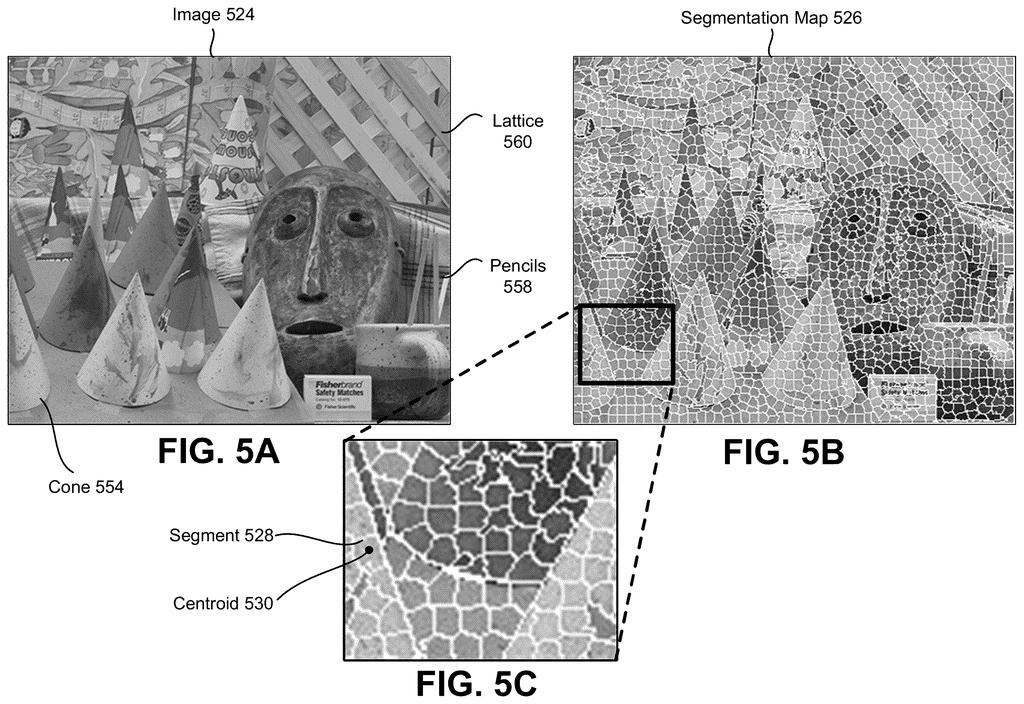
The processor first takes a quick scan at one scan point density (how many measurement dots per area). It combines that scan with the camera image to carve the scene into segments (patches whose borders follow the edges of real objects) and picks out an object. Once it finds one, it takes a second scan at a different density. Dependent claims make the second scan denser over the object and sparser elsewhere, steered by the coordinates of the segments.
The description adds detail. In one example, the picture is split into 2,000 irregular segments and the laser samples the center of each. The same 2,000 points laid out as an even grid gave fuzzier edges and missed thin things like pencils. A feedback step can also merge neighboring segments that share a color and the same depth over the last 10 frames, so the laser takes one sample instead of two.
The abstract adds that the camera can set its focus using the depth reading for a detected object. This filing continues a family of applications that goes back to 2015.
Why cheaper depth scanning matters for phones and cars
Laser depth sensing eats time and battery. The filing says dense scans lower frame rates and drain phones. Spending laser pulses only where something is going on could mean a camera that focuses faster, or a depth sensor that doesn't empty your battery.
The filing names smartphones, but it also points to driver assistance systems, drones and robots, where missing a thin object matters more than a blurry photo. The document only describes the method and doesn't tie it to a specific Qualcomm product, so where it ends up is open.
This is the 22nd camera patent from Qualcomm we've tracked since May, a company whose filings include a sound-guided focus camera and a light-sensing fingerprint reader.
Claim 2 is wide. It asks for a camera, a depth sensor and a processor that does a first scan, spots an object using both the picture and the depth readings, then takes a second scan at a different density of points. That is the whole requirement.
Look at what the claim leaves out. It never says the second scan must be denser (that comes in claim 3), never says the sensor must be a laser (claim 8), and never mentions the center-point method that most of the description covers. A device that rescans after detecting an object falls inside that wording as written, in almost any scan pattern.
If granted, a claim this open would matter to anyone building depth sensing into phones, cars or drones, because the trigger is simple and common sense. The narrower dependent claims are where Qualcomm's specific idea lives, and those are the ones to judge on merit.
Get our take in your Top Stories
Liked this breakdown? Add Patentlyze as a preferred source on Google, and our plain-English take shows up more often in your Top Stories the next time Qualcomm patent news breaks.
There are more where this came from
We read every patent application Big Tech publishes and send you the ones worth knowing. Plain English, free, every week.
The drawings
9 drawing sheets from US 2026/0341046 A1 · click any drawing to enlarge


Show the other 1 sheets

Want this weekly breakdown for a company we don't cover? Patentlyze Pro →
Be the first to weigh in