
Qualcomm Files Patent for Spotting Shelf Price Tags That Have Been Moved
Qualcomm's filing describes a store system that notices when an electronic price tag has been moved, by watching its radio signal and its flashing pattern on camera.
What Qualcomm's moved-price-tag check actually does
Every time you pick a product off a store shelf and glance at the price tag below it, you trust that the tag still sits where the store thinks it does. Stores with electronic price tags often rely on those positions for more than prices, including locating other tracked items. But tags get bumped, or moved by a curious kid or someone with bad intentions.
Qualcomm's patent application describes a server that keeps watch. At setup, it records what each tag's radio signal looks like from nearby equipment. Later, if the signal drifts well away from that baseline, the server collects more readings before sounding an alarm, since obstacles can distort signals too.
A second approach uses a security camera. Tags flash a distinct color or pattern, and the camera checks whether each one is still where it should be.
… determine whether a statistic of a set of RF measurements of the plurality of RF measurements received over a measurement window varies from an expected value of the statistic by more than a threshold; …
Translation: The system checks if the radio signal data changes enough over time to signal a shift.
How the server compares signals and camera images
The filing covers two separate checks run by a server, the central computer that manages a store's electronic labels. Both work the same way: compare what is observed now against a record made when the labels were installed, and act if the gap is too big.
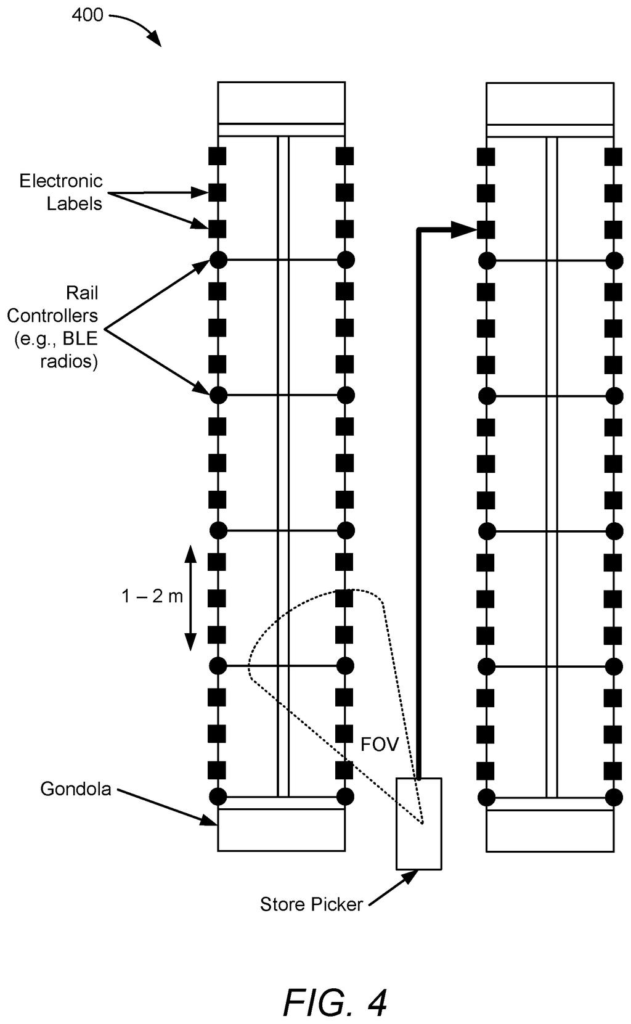
The first check uses radio signals. Each label's radio (built into the label or into the rail it clips onto) sends out regular beacon signals, which are short, repeated radio pings. An access point, other store equipment or a phone measures them, using signal strength, arrival time or arrival angle (three ways of judging distance and direction). The server keeps a running average or median (the middle value) and compares it with a lookup table built at setup. The description gives an example: an average signal 10 dB lower than the recorded value.
When the numbers drift too far, the server runs validation operations, such as:
- Lengthening the measurement window
- Asking for more frequent measurements
- Sending an alert
The second check uses cameras. Labels show a distinct color or pattern, and a camera system sends images to the server. The server draws a box around each label in the image and checks whether it has strayed from its recorded spot. The filing also describes several labels flashing different patterns at once so the camera can check them together.
… performing one or more validation operations based on a determination that the statistic of the set of RF measurements received over the measurement window varies from the expected value of the statistic by more than the threshold.
Translation: It triggers a check to see if the price tag was moved when the signal changes too much.
Why stores could care about misplaced price tags
For shoppers, the practical payoff is a shelf where the tag under the item can be trusted. For stores, it means less walking the aisles to audit thousands of tags by hand. The server can flag a tag, or an entire shelving unit that has shifted, and staff go straight to the problem.
The filing also ties tag locations to indoor positioning. According to the description, a tag in the wrong place gives bad reference points, which makes it harder to locate other tracked items in the store. The filing does not name a product, so treat this as a description of how such a system could work, not a sign of anything shipping.
Qualcomm's 496th filing we have tracked since May in our Qualcomm coverage adds to a run that includes keeping compressed data apart and skipping cell tower check-ins.
A price tag drifting from its spot sounds trivial, and for one shelf it is. In a grocery store with thousands of tags clipped to rails, nobody can check each one by hand, and the filing says tags get moved by kids or deliberate mischief. A wrong tag in front of a shopper is a small embarrassment for the store, and it also corrupts the location data the store relies on.
The approach matches the size of that problem. It builds on radios, access points and security cameras a store may already have, and it waits for repeated evidence before raising an alert, which spares staff from chasing false alarms.
The limit is that the system detects a moved tag and does nothing about who moved it or how to put it back. That is a modest ambition, but this is a small chore that deserves a sensible fix, and this one reads as sensible.
Get our take in your Top Stories
Liked this breakdown? Add Patentlyze as a preferred source on Google, and our plain-English take shows up more often in your Top Stories the next time Qualcomm patent news breaks.
There are more where this came from
We read every patent application Big Tech publishes and send you the ones worth knowing. Plain English, free, every week.
The drawings
14 drawing sheets from US 2026/0313411 A1 · click any drawing to enlarge


Want this weekly breakdown for a company we don't cover? Patentlyze Pro →
Be the first to weigh in