
Qualcomm Files Patent for Faster Reflections in Games and VR
Shiny floors and mirror-like windows are expensive for a game to draw. Qualcomm has filed a patent application for a shortcut that reuses depth data the game already makes.
What Qualcomm's depth-map shortcut actually does
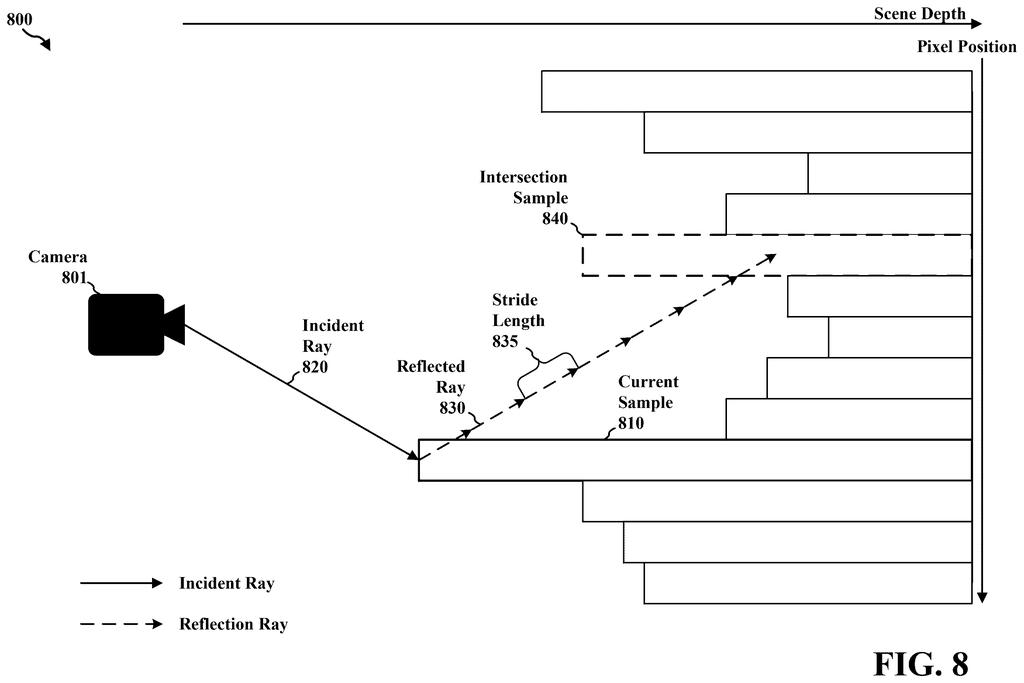
Ever wondered how a video game works out what should show up in a puddle or on a polished floor? The game sends out an imaginary line from each point and has to find the first thing that line bumps into. The slow way is to shuffle along the line one tiny step at a time. The filing says a single line can take about 1,400 steps across a 1024 by 1024 image.
Qualcomm's patent application takes a shortcut. Games already keep a depth map, a record of how far away each pixel is, which can be viewed as a grayscale picture. Qualcomm proposes sorting that record into nested boxes, big boxes holding smaller boxes, so the chip can skip huge empty stretches and zero in on the hit. Graphics chips with built-in ray-tracing hardware are made for exactly this kind of box searching.
There is a bonus for video. The next frame usually looks a lot like the last one, so the box layout is built once and only the heights get refreshed.
obtain a depth map associated with an image; generate a bounding volume hierarchy (BVH) for the depth map; and perform a ray tracing operation based on the generated BVH for the depth map.
Translation: The chip creates a spatial map of the scene to calculate realistic lighting much faster.
How Qualcomm builds boxes from a depth map
The claims cover three steps: take a depth map for an image, build a bounding volume hierarchy (BVH, a tree of boxes where each box wraps smaller boxes) over it, and run a ray tracing operation on that tree. In the description, the depth values are flipped into heights, so each pixel becomes a column of that height. Because the boxes at one level never overlap, the first box a ray hits is the closest one.
Building the tree works by coalescing (merging a group of neighboring boxes into one parent box that keeps the tallest height). The example hardware supports eight children per parent. Eight neighbors can be arranged as 4 by 2 or 2 by 4, but a long, thin parent box is slow to search. So the filing alternates:
- Odd levels of the tree group cells in a 4 by 2 rectangle.
- Even levels use the transposed 2 by 4 rectangle, so every other level ends up with a square footprint.
- Data is stored in a modified Morton order (a way of laying a 2D grid out in memory so neighbors sit together) so each parent's eight children are contiguous.
For a series of same-size images, the layout stays fixed. Only depth values that changed are rewritten and pushed up the tree. The result of a trace is the closest hit pixel, or the lowest-level box that contains it. The filing names screen-space reflections and filling holes after image warping for extended reality as example uses.
What this means for reflections in games and VR
If you play games with shiny surfaces or use a VR headset, the goal is reflections that look right without slowing the game down. Qualcomm's filing aims at that by swapping a slow pixel-by-pixel search for a box lookup that dedicated ray-tracing hardware can run. The description lists phones, game consoles and VR or AR headsets among the devices that could use it.
It also covers a second job: filling in gaps that appear when a VR image is warped. This is a patent application, and the examiner's first review rejected the claims as filed, which is routine at this stage and usually followed by amendments. Nothing here says a product is coming.
Qualcomm's 16th filing we've tracked since July in the GPU rendering race adds to a run that includes one on skipping redrawn points and one on photo-like image correction.
Claim 1 is short: a chip with memory takes a depth map for an image, builds a tree of nested boxes over it, and traces rays through that tree. That is the whole claim. It says nothing about reflections, nothing about eight boxes per group, and nothing about reusing the layout between frames.
Those specifics show up only in the dependent claims, such as the alternating 4 by 2 and 2 by 4 grouping in claim 2 and the reuse of one layout for the next image in claim 5. If the broad version survived, it would reach anyone who builds a box tree from a depth map and fires rays into it, however they arrange the boxes.
Claims that wide are usually the first thing a reviewer pushes on, so expect the final wording to land closer to the alternating-box trick. That trick is the part with real engineering detail behind it.
Get our take in your Top Stories
Liked this breakdown? Add Patentlyze as a preferred source on Google, and our plain-English take shows up more often in your Top Stories the next time Qualcomm patent news breaks.
There are more where this came from
We read every patent application Big Tech publishes and send you the ones worth knowing. Plain English, free, every week.
The drawings
16 drawing sheets from US 2026/0350910 A1 · click any drawing to enlarge


Show the other 8 sheets


Want this weekly breakdown for a company we don't cover? Patentlyze Pro →
Be the first to weigh in