
Qualcomm Patents a Layered Audio Decoding System for Cleaner Compressed Sound
Squeezing high-quality audio into a small data package always costs you something in sound quality. Qualcomm's new patent describes a specific decoding technique that tries to claw some of that quality back at the receiving end.
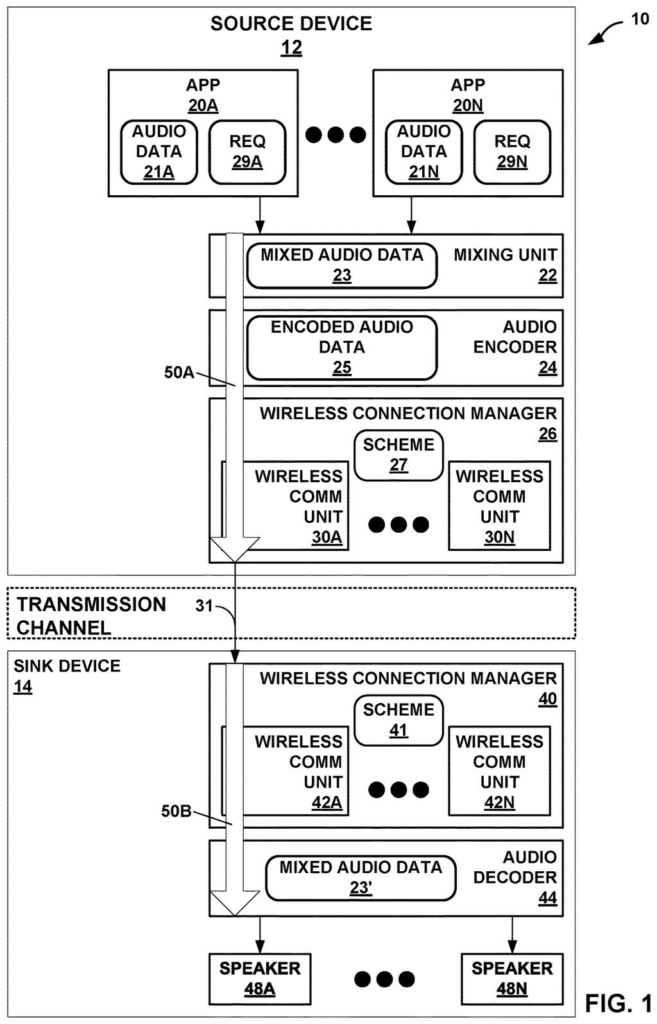
What Qualcomm's audio compression fix actually does
Ever wondered why two streaming services playing the same song can sound noticeably different, even through the same headphones? A lot of that comes down to how audio is compressed and then rebuilt on your device.
Qualcomm's patent describes a way for a device, think a phone or a wireless speaker chip, to decode compressed audio in carefully ordered layers. Instead of trying to rebuild the full sound in one step, the system peels it apart into frequency bands and reconstructs each one using a technique called multi-stage vector quantization (basically, a series of progressively finer guesses at what the original sound was).
The key detail is how the system handles a specific number format: 14 bits in a fixed-point signed representation. That's a precise, consistent way of storing intermediate audio data during decoding, which keeps rounding errors small and predictable across every stage of reconstruction.
obtain, from the encoded audio bitstream, normalized residual data as 14 bits using a fixed-point signed representation; perform inverse multi-stage vector quantization with respect to the normalized residual data to obtain one or more subbands representative of the audio data; …
Translation: The chip extracts precise digital data blocks and converts them back into distinct frequency bands.
How the 14-bit normalization step rebuilds audio layers
The patent covers the decoding side of an audio compression system that uses what's called gain-shape residual coding. In that approach, audio is broken into a "shape" (the relative pattern of frequencies) and a "gain" (how loud each part is). After encoding, what's left over, the difference between the original and the approximation, is called the residual.
To decode audio, the device's processing circuitry follows these main steps:
- Retrieve normalized residual data stored as 14-bit fixed-point numbers from the encoded bitstream. Normalization here means the data has been scaled to a known range so the decoder always knows what it's working with.
- Run inverse multi-stage vector quantization (essentially reversing a series of compression approximations, each stage correcting the errors left by the previous one) to recover the audio's frequency subbands.
- Reconstruct the full audio signal from those subbands, then render it into speaker feeds for playback.
The choice of 14-bit fixed-point representation is the specific engineering decision at the center of the claim. Fixed-point arithmetic (as opposed to floating-point) is faster and more power-efficient on embedded chips, and 14 bits gives enough precision to keep cumulative errors across multiple decoding stages from audibly degrading the output.
The processing circuitry may render, based on the audio data, one or more speaker feeds, and output, for playback, the one or more speaker feeds.
Translation: The processor turns the processed sound data into final channels ready to play through your speakers.
What this means for audio quality on Qualcomm-powered devices
Most people never think about what happens inside a chip when audio plays, but the quality of that decoding process is exactly what separates clear, full-sounding audio from something that sounds thin or slightly off. Qualcomm makes the chips inside a huge share of Android phones and wireless audio devices, so decoding improvements here could affect a lot of real hardware.
For you as a listener, the payoff would be audio that holds up better at lower bitrates, meaning the same song streamed under a weak connection, or compressed more aggressively to save battery, sounds closer to the original. the pattern in Qualcomm's audio codec filings suggests the company is building toward tighter integration between its compression and decoding stages across its chip lineup.
Qualcomm's 65th filing in our Chip patent coverage since May follows earlier work like a self-correcting image method and a power-splitting system for processors in the patents we've tracked.
For anyone listening to compressed audio on a Qualcomm-powered phone or headset, this patent addresses a failure most people would never name but would definitely feel: audio that sounds slightly off when the file is compressed aggressively, a faint wrongness in the texture of the sound that makes you reach for the volume knob without knowing why.
The fix lives in a precise numerical choice made during decoding, one small decision in how the device reconstructs sound from a compressed file. Getting that number wrong doesn't silence the audio or cause an obvious glitch; it just makes the audio worse in a way that accumulates across a listening session.
That subtlety is exactly why it matters. The best audio engineering is invisible, and this patent is Qualcomm locking down one specific place where invisibility was earned.
There are more where this came from
We read every patent application Big Tech publishes and send you the ones worth knowing. Plain English, free, every week.
The drawings
21 drawing sheets from US 2026/0301753 A1 · click any drawing to enlarge


Want this weekly breakdown for a company we don't cover? Patentlyze Pro →
Be the first to weigh in